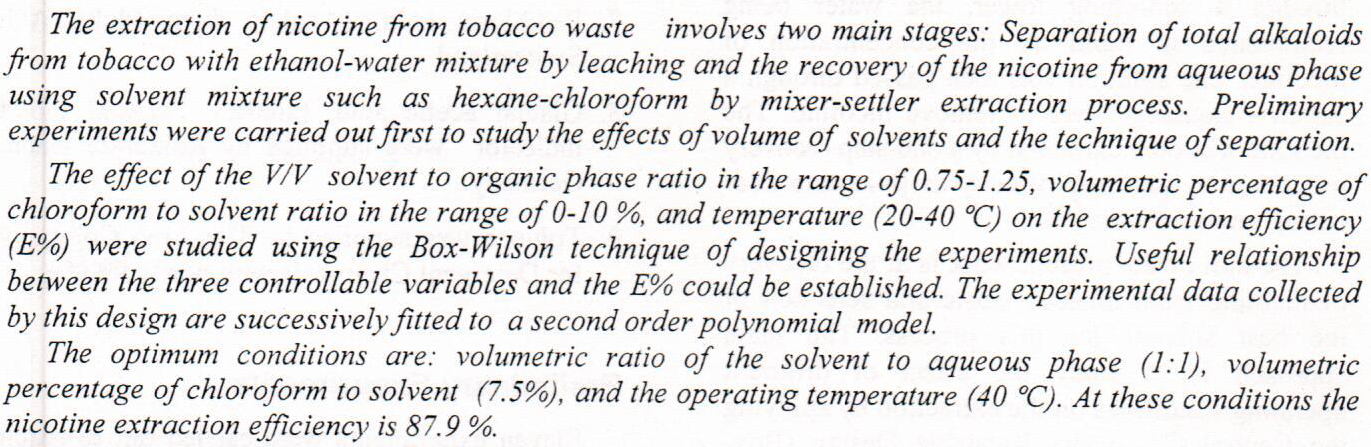
The Nicotine Extraction from Tobacco Wastes

The presence of heavy metals in the environment is major concern due to their toxicity. In the present study a strong acid cation exchange resin, Amberlite IR 120 was used for the removal of lead, zinc and copper from simulated wastewater. The optimum conditions were determined in a batch system of concentration 100 mg/L, pH range between 1 and 8, contact time between 5 and 120 minutes, and amount of adsorbent was from 0.05 to 0.45 g/100 ml. A constant stirring speed, 180 rpm, was chosen during all of the experiments. The optimum conditions were found to be pH of 4 for copper and lead and pH 6 for zinc, contact time of 60 min and 0.35 g of adsorbent. Three different temperatures (25, 40 and 60°C) were selected to investigate the effect
... Show More (7)
(7)

The development of a new, cheap, efficient, and ecofriendly adsorbents has become an important demand for the treatment of waste water, so nano silica is considered a good choice. A sample of nanosilica (NS) was prepared from sodium silicate as precursor and the nonionic surfactant Tween 20 as a template. The prepared sample was characterized using various characterization techniques such as FT-IR, AFM, SEM and EDX analysis. The spectrum of FTIR confirms the presence of silica in the sample, while SEM analysis of sample shows nanostructures with pore ranging (2-100nm).The adsorptive properties of this sample were studied by removing Congo red dye (CR) from aqueous solution. Batch experimental methods were carried o
... Show More (14)
(5)
(14)
(5)


The apricot plant was washed, dried, and powdered after harvesting to produce a fine powder that was used in water treatment. created an alcoholic extract from the apricot plant using ethanol, which was then analysed using GC-MS, Fourier transform infrared spectroscopy, and ultraviolet-visible spectroscopy to identify the active components. Zinc nanoparticles were created using an alcoholic extract. FTIR, UV-Vis, SEM, EDX, and TEM are used to characterize zinc nanoparticles. Using a continuous processing procedure, zinc nanoparticles with apricot extract and powder were employed to clean polluted water. Firstly, 2 g of zinc nanoparticles were used with 20 ml of polluted water, and the results were Tetra 44% and Levo 32%; after
... Show More
(4)
(4)
In the recent years the research on the activated carbon preparation from agro-waste and byproducts have been increased due to their potency for agro-waste elimination. This paper presents a literature review on the synthesis of activated carbon from agro-waste using microwave irradiation method for heating. The applicable approach is highlighted, as well as the effects of activation conditions including carbonization temperature, retention period, and impregnation ratio. The review reveals that the agricultural wastes heated using a chemical process and microwave energy can produce activated carbon with a surface area that is significantly higher than that using the conventional heating method.
(7)
(6)
(24)
(16)
This study was aimed to investigate the response surface methodology (RSM) to evaluate the effects of various experimental conditions on the removal of levofloxacin (LVX) from the aqueous solution by means of electrocoagulation (EC) technique with stainless steel electrodes. The EC process was achieved successfully with the efficiency of LVX removal of 90%. The results obtained from the regression analysis, showed that the data of experiential are better fitted to the polynomial model of second-order with the predicted correlation coefficient (pred. R2) of 0.723, adjusted correlation coefficient (Adj. R2) of 0.907 and correlation coefficient values (R2) of 0.952. This shows that the predicted models and experimental values are in go
... Show More
(19)
(28)
(22)
Six isolates of Bacillus thuringiensis were isolated from Iraqi soil characterized as non- insecticidal and non- hemolytic parasporal inclusion proteins. Bacterial isolates were propagated on nutrient broth. Then, the parasporal inclusion proteins were extracted and processed with proteinase K and trypsin. The major protein segments produced of 64KDa were characterized and tested for cytocidal activity against human leukemic T- cells (CLL) (Chronic lymphoid leukemia). Results indicated that the treated parasporal proteins of four isolates (Bt2, Bt3, Bt4 and Bt6) showed strong cytotoxicity with no significant differences between normal lymphocytes and leukemic lymphocytes. Two isolates BtA1 and BtA5 show discriminative cytotoxicity between n
... Show More
(4)
(1)
Copper oxide (CuO) nanoparticles were synthesized through the thermal decomposition of a copper(II) Schiff-base complex. The complex was formed by reacting cupric acetate with a Schiff base in a 2:1 metal-to-ligand ratio. The Schiff base itself was synthesized via the condensation of benzidine and 2-hydroxybenzaldehyde in the presence of glacial acetic acid. This newly synthesized symmetric Schiff base served as the ligand for the Cu(II) metal ion complex. The ligand and its complex were characterized using several spectroscopic methods, including FTIR, UV-vis, 1H-NMR, 13C-NMR, CHNS, and AAS, along with TGA, molar conductivity and magnetic susceptibility measurements. The CuO nanoparticles were produced by thermally decomposing the
... Show More
(4)
(4)
The risk of significant concern is resistance to antibiotics for public health. The alternative treatment of metallic nanoparticles (NPs), such as heavy metals, effects on antibiotic resistance bacteria with different types of antibiotics of - impossible to treat using noval eco-friendly synthesis technique nanoparticles copper oxide (CuO NPs) preparation from S. epidermidis showed remarkable antimicrobial activity against S.aureus Minimum inhibitory concentra range (16,32,64,256,512) µg/ml via well diffusion method in vitro, discover those concentrations effected in those bacteria and the best concentration is 64 µg/ml, characterization CuO NPs to prove this included atomic force microscope, UV, X-ray Diffraction and TEM, and ant
... Show More
(14)
(9)