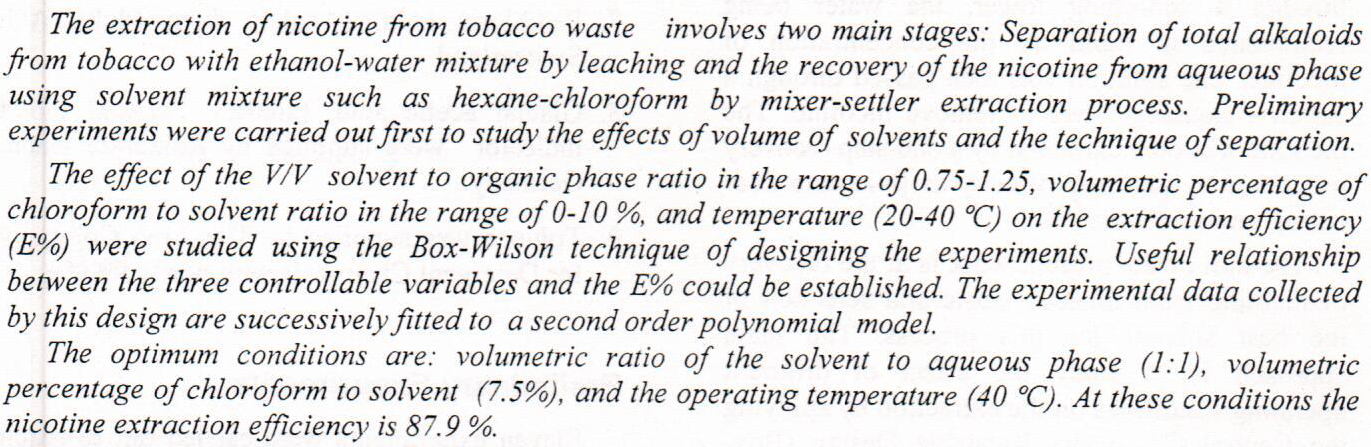
The Nicotine Extraction from Tobacco Wastes

 (11)
(11)
 (8)
(8)


Clerodendron inerme is used for the treatment for many diseases such as dysentery, heart diseases, AIDS, cancers, and others. Aim of this research was to determine the antibacterial and antioxidant activities the leaf alkaloids of Clerodendron inerme. To evaluate the antibacterial effects, Well diffusion assay, minimum inhibitory concentration and the minimum bactericidal concentration were used to test antibacterial activity against Staphylococcus aureus, Escherichia coli, Klebsiella pneumonia and Pseudomonas aeruginosa.For antioxidant activity, DPPH radical scavenging activity assay was used a standard method. GC-MS analysis was used to identify alkaloids. Alkaloid component from the leaves of C. inerme exhibited significant inhibition zo
... Show More
(1)
The objective of present study was to investigate the effect of using duplex volaticle oil of Rosmarinusoficinolis and Nigella sativain microbial quality, sensing and extending storage time of minced cold poultry meat. Duplex volaticle oil was added at 25, 50 and 75 mg/kg to minced poultry meat , these treatments were stored individually for (0 ,4 and 7) days at( 4-7) C0 . After making several microbial and sensing test. The following results were obtained:- The process of adding duplex volaticle oil of Rosmarinus officinolis and Nigella sativa to minced poultry meat led to significant reduced (P<0.01) in total arobic count, psychrophilic count and coliform bacteria during refrigerated storage periods. The results showed asignificant sens
... Show More
In light of the developments and intense competition that the world has witnessed, the need to search for a sustainable and continuous competitive advantage for economic units has emerged, as the economic units must not lose sight of their interest in the activities they perform to achieve that advantage, and it can be said that the goal of the research is to identify the theoretical dimensions of the green value chain represented by: (Green research and development, green design, green manufacturing, green marketing, green services) and the dimensions of the sustainable competitive advantage represented by (quality, creativity, innovation, cost, response to the customer), as well as identifyi
... Show MoreThe insurance activity in the various countries of the world are important indicators of the strength of the country's economy, he came to study the stages compensation insurance settlement against fire and the importance of investing time risk in achieving the payment of compensation speed, and the implications for the continuation of the insured to carry out insurance with the insurance company, whether working within the public sector or the private sector. Hence the research problem in how quickly insurance companies to pay compensation as soon as possible and the return of the insured to carry out its work and make up for what he died from loss. Intentional sample was selected from branches and divisions and Their assistants manager
... Show More
This work deals with the description of histopathological effects of the nematode Hartertia
gallinarurn Theiler. 1919 on the digestive system of the seesee partridge collected from Qa’ra
area in the western desert district of Iraq. along with some notes on intensity fluctuation of the
parasite according to the seasons. It is found that the major effects of the nematode are
necrosis and fibrosis of gizzard: granulomatous reaction. necrosis and mononuclear
infiltration of proventriculus: damage of mucosal lining of intestine and lymphocytic
infiltration of liver.
(2)
 (4)
(4)
Silver nanoparticles synthesized by different species