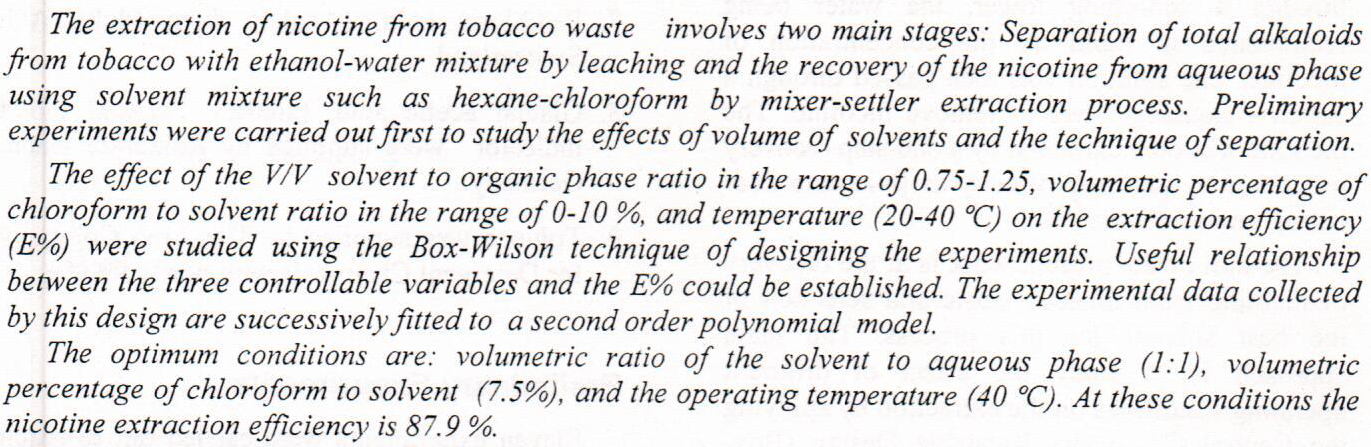
The Nicotine Extraction from Tobacco Wastes

Water hyacinth (Eichhornia crassipes) is a free-floating plant, growing plentifully in the tropical water bodies. It is being speculated that the large biomass can be used in wastewater treatment, heavy steel and dye remediation, as a substrate for bioethanol and biogas production, electrical energy generation, industrial uses, human food and antioxidants, medicines, feed, agriculture, and sustainable improvement. In this work, the adsorption of Congo Red (CR) from aqueous solution onto EC biomass was investigated through a series of batch experiments. The effects of operating parameters such as pH (3-9), dosage (0.1-0.9 g. /100 ml), agitated velocity (100-300), size particle (88-353μm), temperature (10-50˚C), initial dye
... Show More (14)
(14)

 (23)
(5)
(23)
(5)

This study aimed to assess the efficiency of Nerium oleander in removing three different metals (Cd, Cu, and Ni) from simulated wastewater using horizontal subsurface flow constructed wetland (HSSF-CW) system. The HSSF-CW pilot scale was operated at two hydraulic retention times (HRTs) of 4 and 7 days, filled with a substrate layer of sand and gravel. The results indicated that the HSSF-CW had high removal efficiency of Cd and Cu. A higher HRT (7 days) resulted in greater removal efficiency reaching up to (99.3% Cd, 99.5% Cu, 86.3% Ni) compared to 4 days. The substrate played a significant role in removal of metals due to adsorption and precipitation. The N. oleander plant also showed a good tolerance to the uptake of Cd, Cu, and Ni ions fr
... Show More
(23)
The present study reports Morchella conica Pers.1818, which belongs to the family, Morchellaceae as a new record of Iraqi macromycota based on the morphological and molecular methods. During their short and often sporadic fruiting season, this fungal species was found in mixed forest unburned areas in Branan ranges (Suliamaniya Province, Northeast Iraq). Currently, M. conica is the second Morchella species reported from Iraq. The current study aimed to introduce this new record, which is poorly studied in the Middle East. M. conica is morphologically described and phylogenetically confirmed. The relationship between this species and other species within the genus was studied using the nrDNA ITS sequences from different species and divers
... Show More
(4)
Numerical simulations have been investigated to study the external free convective heat transfer from a vertically rectangular interrupted fin arrays. The continuity, Naver-Stockes and energy equations have been solved for steady-state, incompressible, two dimensional, laminar with Boussiuesq approximation by Fluent 15 software. The performance of interrupted fins was evaluated to gain the optimum ratio of interrupted length to fin length (
The present study was carried out to determine the bacterial isolates and study their antimicrobial susceptibility in case of burned wound infections. 70 burn wound swabs were taken from patients, who presented invasive burn wound infection from both sex and average age of 3-58 years, admitted to teaching medical Al- Kendi hospital from October 2007 to June 2008. Pseudomonas aeruginosa was found to be the most common isolate (48.9%) followed by Staphylococcus aureus (24.4%), Citrobacter braakii (13.3%), Enterobacter spp. (11.1%), Coagulase-negative Staphylococci (11.1%), Proteus vulgaris (6.66%), Corynebacterium spp. (6.66%), Micrococcus (6.66%), Proteus mirabilis (4.44%), Enterococcus faecalis (4.44%), E.coli (4.44%), Klebsiella spp. (2.22
... Show More
(12)
In the present work advanced oxidation process, photo-Fenton (UV/H2O2/Fe+2) system, for the treatment of wastewater contaminated with oil was investigated. The reaction was influenced by the input concentration of hydrogen peroxide H2O2, the initial amount of the iron catalyst Fe+2, pH, temperature and the concentration of oil in the wastewater. The removal efficiency for the system UV/ H2O2/Fe+2 at the optimal conditions and dosage (H2O2 = 400mg/L, Fe+2 = 40mg/L, pH=3, temperature =30o C) for 1000mg/L load was found to be 72%.
(13)
Microalgae have been increasingly used for wastewater treatment due to their capacity to assimilate nutrients. Samples of wastewater were taken from the Erbil wastewater channel near Dhahibha village in northern Iraq. The microalga Coelastrella sp. was used in three doses (0.2, 1, and 2g. l-1) in this experiment for 21 days, samples were periodically (every 3 days) analyzed for physicochemical parameters such as pH, EC, Phosphate, Nitrate, and BOD5, in addition to, Chlorophyll a concentration. Results showed that the highest dose 2g.l-1 was the most effective dose for removing nutrients, confirmed by significant differences (p≤0.05) between all doses. The highest removal percentage was
... Show More
(4)
This study was aimed to evaluate atotal phenolic content, antibacterial activity, and antioxidant activity of M. communis callus extracts were evaluated. Callus induction in general Murashige and Skoog (MS) media is completed by the Benzil adenine's unique knowledge of callus formation. A well diffusion experiment was used to examine antibacterial interest in Staphylococcus aureus, Escherichia coli, Klebsiella pneumonia, and Pseudomonas aeruginosa. The DPPH radical scavenging activity test was used to measure antioxidant activity. FTIR and HPLC have been used to pinpoint the presence of polyphenol compounds in calluses. The total phenol content of plant leaves extract (0.1, 0.5, and 1) mg/ml was 42.12, 94.08, and 189 mg of Gallic ac
... Show More
(6)
(1)
This study aimed to assess the efficiency of Nerium oleander in removing three different metals (Cd, Cu, and Ni) from simulated wastewater using horizontal subsurface flow constructed wetland (HSSF-CW) system. The HSSF-CW pilot scale was operated at two hydraulic retention times (HRTs) of 4 and 7 days, filled with a substrate layer of sand and gravel. The results indicated that the HSSF-CW had high removal efficiency of Cd and Cu. A higher HRT (7 days) resulted in greater removal efficiency reaching up to (99.3% Cd, 99.5% Cu, 86.3% Ni) compared to 4 days. The substrate played a significant role in removal of metals due to adsorption and precipitation. The N. oleander plant also showed a good tolerance to the uptake of Cd, Cu, and Ni ions fr
... Show More
(25)
(23)
