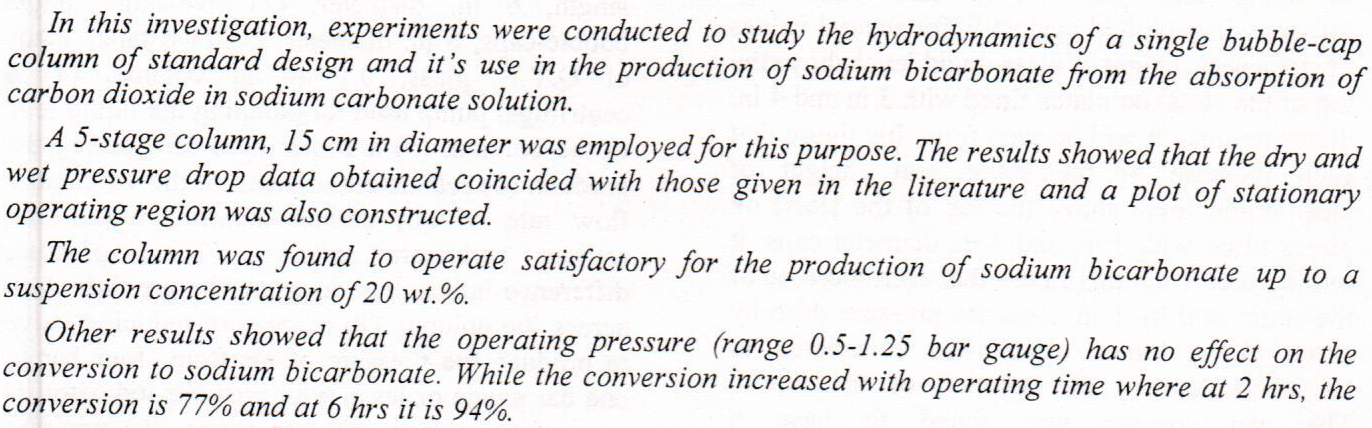
A Study of Absorption Column with Single Bubble Cap Tray in the Production of Sodium Bicarbonate

The current research is a spectroscopic study of Coumarin 334 dissolved in methanol. The range of concentrations of the prepared stock solution was (3.39x10⁻⁹ to 2.03x10⁻⁸) M. Some optical characteristics of this dye were investigated such as absorbance and transmission spectra, absorption coefficient, refractive and extinction coefficients, oscillation and dispersion energies, and energy band gap. The absorbance spectra were recorded at 452 nm using Broad Band Cavity Enhanced Absorption Spectroscopy (BBCEAS) which depends on increasing the path length of the traveling light from the source to the detector. The minimum absorbance amount was 0.07 with a low concentration of 3.39x10⁻⁹ M. As a result, the ot
... Show More (6)
(6)
 (5)
(5)



Finding the shortest route in wireless mesh networks is an important aspect. Many techniques are used to solve this problem like dynamic programming, evolutionary algorithms, weighted-sum techniques, and others. In this paper, we use dynamic programming techniques to find the shortest path in wireless mesh networks due to their generality, reduction of complexity and facilitation of numerical computation, simplicity in incorporating constraints, and their onformity to the stochastic nature of some problems. The routing problem is a multi-objective optimization problem with some constraints such as path capacity and end-to-end delay. Single-constraint routing problems and solutions using Dijkstra, Bellman-Ford, and Floyd-Warshall algorith
... Show More
(1)
Acute appendicitis is one of the commonest causes of acute abdomen. There is a wide discussion and controversy on the surgical and nonsurgical treatment of acute uncomplicated appendicitis. The aim of this study was to evaluate the efficacy and outcomes of the conservative management of selected cases of acute appendicitis with an antibiotic first plan.
This was a single hospital-based prospective study with a durat
(4)
(4)
(3)
(2)
This study was done to evaluate a new technique to determine the presence of methamphetamine in the hair using nano bentonite-based adsorbent as the filler of extraction column. The state of the art of this study was based on the presence of silica in the nano bentonite that was assumed can interact with methamphetamine. The hair used was treated using methanol to extract the presence of methamphetamine, then it was continued by sonicating the hair sample. Qualitative analysis using Marquish reagent was performed to confirm the presence of methamphetamine in the isolate.The hair sample that has been taken in a different period confirmed that this current developing method can be used to analyzed methamphetamine. This m
... Show More
(2)
(2)
Background: Dolutegravir sodium (DTG), used to treat HIV, faces challenges in delivering effective therapeutic concentrations to the brain due to the blood-brain barrier (BBB). Nanostructured lipid carriers (NLCs) combined with in situ gels present a promising strategy for enhancing brain drug delivery via the intranasal route. Objective: To compare brain pharmacokinetics of DTGs delivered via NLC-loaded in situ gel intranasal administration with the conventional intravenous (IV) drug solution. Methods: 80 Wistar rats, which were divided into three groups: two groups consisting of 39 animals each and a control group with 2 animals. Rats were administered with a dose of 1.0 mg/kg of DTGs IV, and DTGs NLC-loaded in situ gel were admin
... Show More
(5)
(3)
Background: Opportunistic viral infections make an important threat to renal transplantation recipients (RTRs), and with the use of more intense newly-developed immunosuppressive drugs; the risk of renal allograft loss due to reactivation of these viruses has increased considerably. At the top priority of these viruses lie BK polyomavirus (BKV) and human cytomegalovirus (CMV). Reactivation of these viruses in these chronically immunosuppressed RTRs can lead to renal impairment and subsequently allograft loss, unless early detected and properly treated. Objectives: The study aimed to detect and quantify plasma viral load of BKV and CMV in RTRs using quantitative real time PCR (qRT-PCR), in order to study the prevalence of these two viruses i
... Show MoreThe PbSe alloy was prepared in evacuated quarts tubs by the method of melt quenching from element, the PbSe thin films prepared by thermal evaporation method and deposited at different substrate temperature (Ts) =R.T ,373 and 473K . The thin films that deposited at room temperature (R.T=303)K was annealed at temperature, Ta= R.T, 373 and 473K . By depended on D.C conductivity measurements calculated the density of state (DOS), The density of extended state N(Eext) increases with increasing the Ts and Ta, while the density of localized state N(Eloc) is decreased . We investigated the absorption coefficient (?) that measurement from reflection and transmission spectrum result, and the effect of Ts and Ta on it , also we calculated the tai
... Show More
Electrochemical Machining is a term given to one of nontraditional machining that uses a chemical reaction associated with electric current to remove the material. The process is depending on the principle of anodic dissolution theory for evaluating material removal during electrochemical process. In this study, the electrochemical machining was used to remove 1 mm from the length of the a workpiece (stainless steel 316 H) by immersing it in to electrolyte (10, 20 and 30 g) of NaCl and Na2SO4 to every (1 litter of filtered water). The tool used was made from copper. Gap size between the workpiece and electrode is (0.5) mm. This study focuses on the effect of the changing the type and concentration of electroly
... Show More
(1)