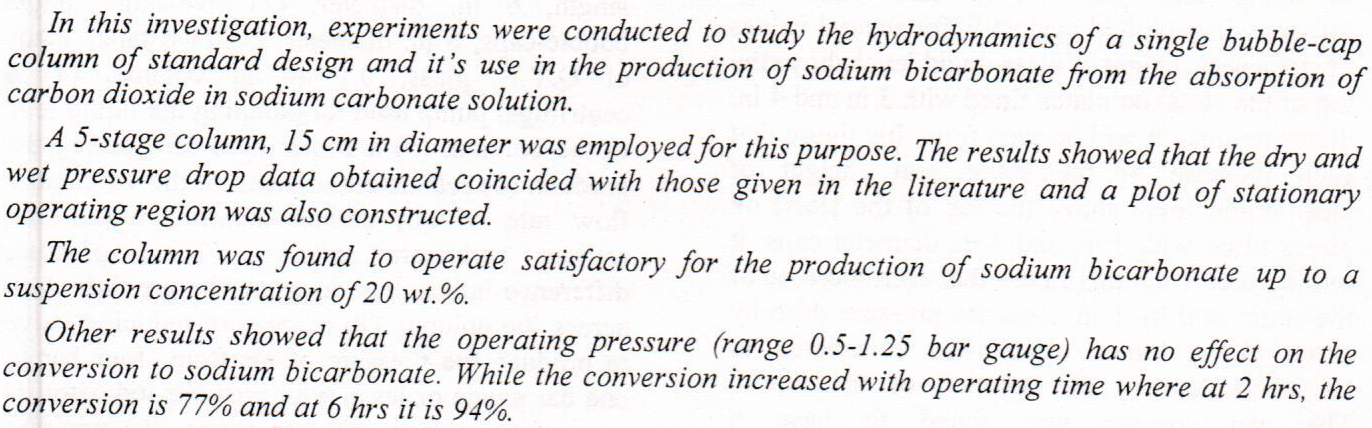
A Study of Absorption Column with Single Bubble Cap Tray in the Production of Sodium Bicarbonate

 (3)
(3)
 (1)
(1)


Date stones were used as precursor for the preparation of activated carbons by chemical
activation with ferric chloride and zinc chloride. The effects of operating conditions represented
by the activation time, activation temperature, and impregnation ratio on the yield and adsorption
capacity towards methylene blue (MB) of prepared activated carbon by ferric chloride activation
(FAC) and zinc chloride activation (ZAC) were studied. For FAC, an optimum conditions of 1.25
h activation time, 700 °C activation temperature, and 1.5 impregnation ratio gave 185.15 mg/g
MB uptake and 47.08 % yield, while for ZAC, 240.77 mg/g MB uptake and 40.46 % yield were
obtained at the optimum conditions of 1.25 h activation time, 500
(6)
(2)
(2)
In this work, a composite material was prepared from Low-density polyethylene (LDPE) with different weight percent of grain and calcinations kaolin at temperature of (850oC) using single screw extruder and a mixing machine operated at a temperature between (190-200oC). Some of mechanical and physical properties such as tensile strength, tensile strength at break, Young modulus, and elongation at break, shore hardness and water absorption were determined at different weight fraction of filler (0, 2, 7, 10 and 15%). It was found that the addition of filler increases the modulus of elasticity, elongation at break, shore hardness and impact strength; on other hand, it decreases the tensile strength and tensile strength
... Show MoreThe synthesized ligand [4-chloro-5-(N-(5,5-dimethyl-3-oxocyclohex-1-en-1-yl)sulfamoyl)-2-((furan-2-ylmethyl)amino)benzoic acid] (H2L1) was identified utilizing Fourier transform infrared spectroscopy (FT-IR), 1 H, 13 C – NMR, (C.H.N), Mass spectra, UVVis methods based on spectroscopy. To detect mixed ligand complexes, analytical and spectroscopic approaches such as micro-analysis, conductance, UV-Visible, magnetic susceptibility, and FT-IR spectra were utilized. Its mixed ligand complexes [M(L1)(Q)Cl2] [ where M= Co(II), Ni(II) , and Cd(II)] and complexes [Pd(L1)(Q)] and [Pt(L1)(Q)Cl2]; [H2L1] =β-enaminone ligand =L1 and Q= 8-Hydroxyquinoline = L2]. The results showed that the complexes were synthesised utilizing the molar ratio M: L1
... Show More
(5)
(4)
Grapes and grape seeds are important samples employed for environmental medical studies . The air of this work was to identify and concentration calculation of the elements in grapes fruit and thier seeds by using X-Ray fluoresces technique (XRF) . Samples were collected from Abo Ghraib of Baghdad city ,the grape seeds were obtained from those samples . Both samples were taken under experimental procedure to obtain the sample which were ready for analysis . The samples were then submitted to experimental conditions using a radiation source and then samples were applied for counting analysis shows the elements Na , Mg , Al , Si , P , S , Cl , K , Ca , and Sr as major components of the samples. Fe , Sr , I , Ba and V were
... Show More
(1)
This study was conducted to determine the fungal cause and bio control of damping off and root rot of wheat plants by using pseudomonas fluorescens under greenhouse and field conditions. Results showed isolation of eight species from the soil and roots to deferent region of Baghdad government. Rhizoctonia solani (Rs) and Fusarium solani (Fs) were the predominant damping off fungus with frequency 60 and 52% respectively. Led the using of bacteria formulations such as crud suspension , pure bacteria filtration and pure living cells in culture medium inhibit all type fungi with rates ranging from 84-96% , 80- 93% and 75-88% respectively. Rs and Fs were more pathogenesis under greenhouse conditions, with incidence of 80 and 68% and disease s
... Show More
(1)
Objective: The antimicrobial efficacy of three disinfection solutions: 5.25% sodium hypochlorite (NaOCl), 2% chlorhexidine (CHX) and Listerine mouthwash were investigated as routine chair-side gutta-percha (GP) disinfection reagents. Design: four groups of gutta percha points were contaminated with E. faecalis bacteria then disinfected by immersion in different solutions (5.25% sodium hypochlorite, 2% chlorhexidine gluconate, Listerine mouth wash and distilled water as control) after 1 and 7 days culturing periods. The antibacterial efficacy of these disinfection solutions was evaluated by using colonies per units (CPU) Methods: Forty GP cones (F3 Dentsply) were sterilized with ethylene oxide gas before immersed contamination within broth m
... Show More
(2)
(1)