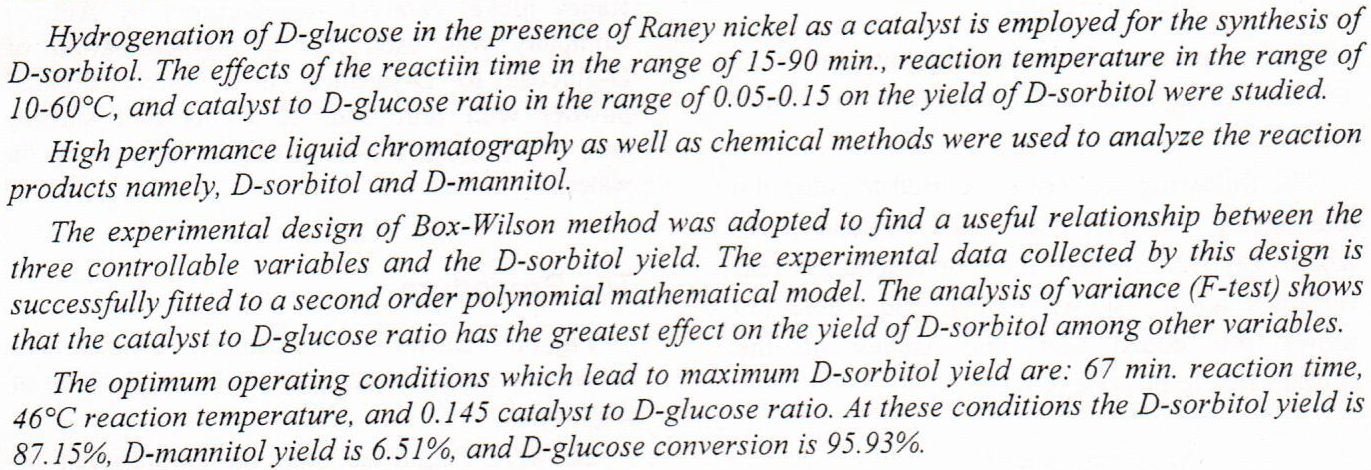
D-Sorbitol Production by Catalytic Hydrogenation of D-Glucose

n-Hexane conversion enhancement was studied by adding TCE (Trichloro-ethylene) on feed stream using 0.3%Pt/HY zeolite catalyst. All experiments were achieved at atmospheric pressure and on a continuous laboratory unit with a fixed bed reactor at a temperature range 240-270◦C, LHSV 1-3h-1, H2/nC6 mole ratio 1-4.
By adding 435 ppm of TCE, 49.5 mole% conversion was achieved at LHSV 1h-1, temperature of 270ºC and H2/nC6 mole ratio of 4, while the conversion was 18.3 mol% on the same catalyst without adding TCE at the same conditions. The activation energy decreased from 98.18 for pure Pt/HY zeolite to 82.83 kJ/mole by adding TCE. Beside enhancement the activity, selectivity and product distribution enhanced by providing DMB (Dimethyl b
Polyhydroxyalkanoates (PHAs) have gained much attention as biodegradable polymers, many efforts are being made to minimize the cost of PHAs by finding cheap carbon source depending on the type of microorganism and fermentation conditions. The aims of this study were to evaluate the effects of different glucose concentrations and other important conditions on the PHA production by Bacillus cereus isolated from soil. Polyhydroxyalkanoates PHAs accumulated by soil microorganisms were examined by screening the isolated bacteria using Sudan B Black and Nile Blue staining process. A Gram positive strain was identified using the 16s rRNA gene, deposited in the NCBI GenBank sequence database. Different growth conditions (favorite glucose concentrat
... Show More (29)
(29)
 (32)
(32)


 (22)
(21)
(22)
(21)
There are serious environmental problems in all countries of the world, due to the waste material such as crushed clay bricks (CCB) and in huge quantities resulting from the demolition of buildings. In order to reduce the effects of this problem as well as to preserve natural resources, it is possible to work on recycling (CCB) and to use it in the manufacture of environmentally friendly loaded building units by replacing percentages in coarse aggregate by volume. It can be used as a powder and replacing of percentages in cement by weight and study the effect on the physical and mechanical properties of the concrete and the masonry unit. Evaluation of its performance through workability, dry density, compressive strength, thermal conduct
... Show More
(5)
(2)
Kinetics study on the phenol oxidation by catalytic wet air oxidation (CWAO) using CuO.NiO/Al2O3 as heterogeneous catalyst is presented. 4 g/l phenol solution of pH 7.3 was oxidized in a trickle bed reactor with gas flow rate of 80% stochiometric excess (S.E).. In order to verify the proposed kinetics, a series of CWAO experimental tests were done at two temperatures (140 and 160° C), oxygen partial pressures (9 and 12 bar), and weight hourly space velocity (WHSV) (1, 1.5, 2, 2.5, and 3 h-1). According to Power Law, the reaction orders are found to be approximately 1 and 0.5 with respect to phenol concentration and oxygen solubility, respectively. These values favorably compare with those cited in the literature for intrinsic kinetics,
... Show MoreThis work demonstrated a simple and environmentally friendly method for synthesizing silica-supported copper nanocubes (CuNCs/SiO2). The copper nanocubes, with a size of 15 ± 5 nm, were synthesized using green reagents and conditions. Ascorbic acid, water, and di-n-butyl sulfide were employed as reducing agent, solvent, and stabilizing ligand, respectively. The designed nanoscale catalyst was utilized for the esterification of acetic acid to methyl acetate at room temperature. The catalyst exhibited high efficiency, converting 80% of the reactant to the desired product (methyl acetate) after 24 hours of reaction at room temperature. The size and shape of copper nanocubes were characterized by transmission electron microsco
... Show More
(1)
(1)