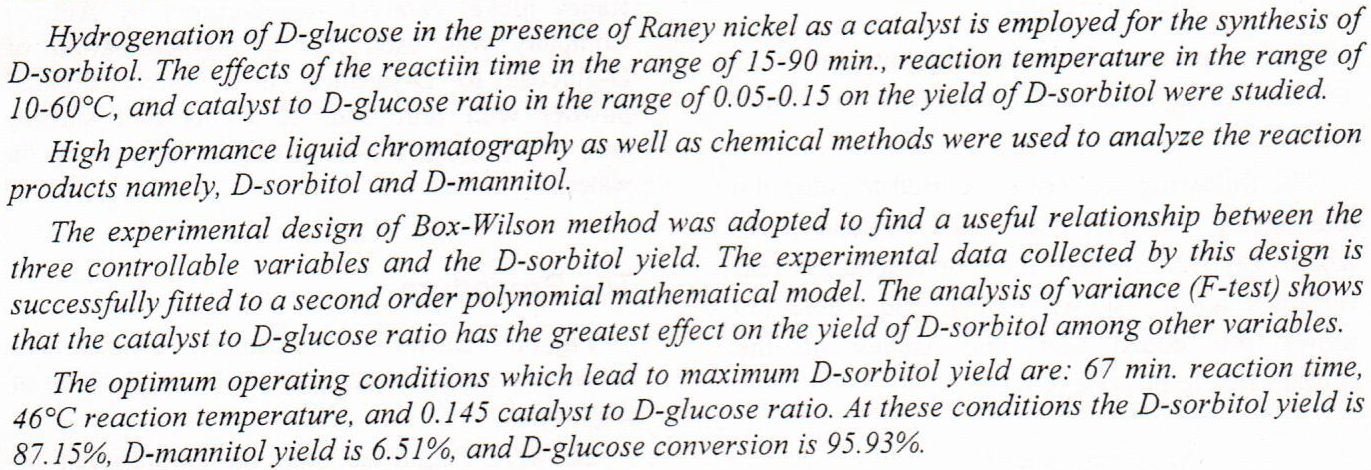
D-Sorbitol Production by Catalytic Hydrogenation of D-Glucose

Football is one of the most important team sports, practiced by men and women, young and old, across various age groups. The physical development in this sport can be attributed to athletic training and modern technology, which have contributed significantly to advancing the sports field in general. Outstanding performance in football requires precise and quick physical abilities, closely tied to the competitive nature of the game. Speed is fundamental in football, making the use of technologies such as GPS tracking devices and heart rate monitors essential in both training and matches. This study aims to develop the speed of Al-Talaba SC players in Baghdad using a scientifically-based approach to improve their performance. The impo
... Show More
This research includes the preparation of a new azo 2-((2-(1H-indol-2- yl)ethyl)diazinyl)-5-aminophenol, in which the diazonium salt of 2(1H– Indole–3yl)- ethylamine reacts with a compound 3-aminophenol, and complexes have been prepared with the ions of Ni (II), Pd(II), Pt(IV), and Au(III). The characteristics of compounds include F.A.A, (C. H .N and O), 1H & 13C-NMR, IR, LC-Mass , UV-Vis spectral, DSC/TGA curve, the measurements of magnetic, and molar conductance. Each complex has an amount of [1:1] [M:L] and does not contain electrolytes. Based on the obtained results, molecular structural and geometry have been octahedral geometry suggest of Pt(IV) complex and tetrahedral of Ni (II)complex, the square planar of both Pd(II) and Au(III
... Show MoreQuality control of well logs has always been an important objective in reservoir studies because of the key role played by well logs as input data. This study aims to make a quality control on well logs data for two wells of Yamama formation in southern Iraqi field to ensuring and enhancing the measurement accuracy. In the beginning, the calibration data of before and after surveys are applied as initial evaluation for the quality of density log in well R-1. Then, depth matching is used to fit the depth of all logs in each well. After that, the comparison between the main and repeat sections is helped to check the repeatability. Finally, all uncorrected logs are environmentally corrected to remove the effects of the borehole conditi
... Show More
Mixed ligands reaction of [2-[(3-hydroxyphenyl)diazinyl]-1,2-benzothiazol-3(2H)-one-1,1-dioxide] (H2L, primary ligand) and bipyridyl (secondary ligand) with salts of Cr(III), Mn(II), Fe(III), Co(II) and Ni(II) was performed. A series of air-stable complexes with distinctive octahedral moieties was created by equal molar ratio (1:1:1). The formation of these compounds was verified using detecting analysis techniques incorporating mass spectra, which validated the achieved geometries. Fourier transform infrared (FTIR) analysis demonstrated how the ligands (H2L and bipyridyl) are chelated as tridentate (ONO) and bidentate (NN) groups, respectively and the coordination with the metal ions. Thermal decomposition studies using pyrolysis (
... Show More (3)
(3)


Sports skills in some individual games require physical and motor qualities to facilitate the process of skill performance and also require the instructor or trainer to use more than one strategy, method and way to bring the performance to the level of mastery and avoid injury. The aim of the research is to know the effect of using special exercises using tools and their effect on teaching the skill of a front shoulder circle. The research hypothesis is that using special exercises with tools has a positive effect on teaching the skill of a front shoulder circle on the rings apparatus. Research method: - The researchers used the experimental method by designing two equal groups, the control and the experimental, to suit the research
... Show More
The reaction of [Benzoyl hydrazine] with [Diphenyl mono oxime] and Glacial acetic acid was carried out in methanol gave a new tridentate ligand [Benzoic acid (2- hydroxyimino- 1, 2-diphyneylethylidene) - hydrazide]. This ligand was reacted with some metal ions (Fe(II), Co(II), Ni(II), and Cu(II)) in methanol with (1:1) metal : ligand ratio to give a series of new complexes of the general formula [M(L)Cl2.H2O], where M= Fe(11), Co(11), Ni(11) and Cu(11) . All compounds were characterized by spectroscopic methods (I.R, UV-Vis), elemental microanalysis (C.H.N), atomic absorption, magnetic susceptibility, and conductivity measurements. From the obtained data the proposed molecular structures were suggested for the complexes of Fe (II), Co (II)
... Show MoreThe clinical spectrum of cutaneous leishmaniasis (CL), an intracellular parasitic pathogen, ranges from a single sore healing to chronic crusty lesions with a manifestation of treatment resistance. The complicated interaction between Leishmania bodies and the early immune response, including innate and adaptive mechanisms, determines the evolution of nodules. This study examined the levels of the chemoattractant interleukin 8 (IL-8), pro-inflammatory nitric oxide (NO), and immunoregulatory macrophage inhibitory factor (MIF) in the serum of subjects recently diagnosed with cutaneous leishmaniasis, in parallel with patients being monitored during consecutive sodium stibogluconate (Pentostam) treatment. A total of 161 serum samples of newly di
... Show More
(9)
 (3)
(3)
Background : Although development and progress in various diagnostic methods, but still identification of remnants of skeletal and decomposing parts of human is one of the most difficult skills in forensic medicine . Gender and age estimation is also considering an important problem in the identification of unknown skull. The aims of study: To estimate volume and dimension of maxillary sinus in individuals with dentate and edentulous maxillae using CT scan, and to correlate the maxillary sinus volume in relation to gender and age. Materials and Methods : This study included 120 patients ranged from (40-69 years), divided into two groups, dentate group with fully dentate maxilla and edentulous group with complete edentulous maxilla, and e
... Show MoreThe city of Karbala is one of the most important holy places for visitors and pilgrims from the Islamic faith, especially through the Arabian visit, when crowds of millions gather to commemorate the martyrdom of Imam Hussein. Offering services and medical treatments during this time is very important, especially when the crowds head to their destination (the holy shrine of Imam Hussein (a.s)). In recent years, the Arba'in visit has witnessed an obvious growth in the number of participants. The biggest challenge is the health risks, and the preventive measures for both organizers and visitors. Researchers identified various challenges and factors to facilitating the Arba'in visit. The purpose of this research is to deal with the religious an
... Show MoreThe reaction of [Benzoyl hydrazine] with [Diphenyl mono oxime] and Glacial acetic acid was carried out in methanol gave a new tridentate ligand [Benzoic acid (2-hydroxyimino- 1, 2-diphyneylethylidene) - hydrazide]. This ligand was reacted with some metal ions (Fe(II), Co(II), Ni(II), and Cu(II)) in methanol with (1:1) metal : ligand ratio to give a series of new complexes of the general formula [M(L)Cl2.H2O], where M= Fe(11), Co(11), Ni(11) and Cu(11). All compounds were characterized by spectroscopic methods (I.R, UV-Vis), elemental microanalysis (C.H.N), atomic absorption, magnetic susceptibility, and conductivity measurements. From the obtained data the proposed molecular structures were suggested for the complexes of Fe
... Show More
(1)