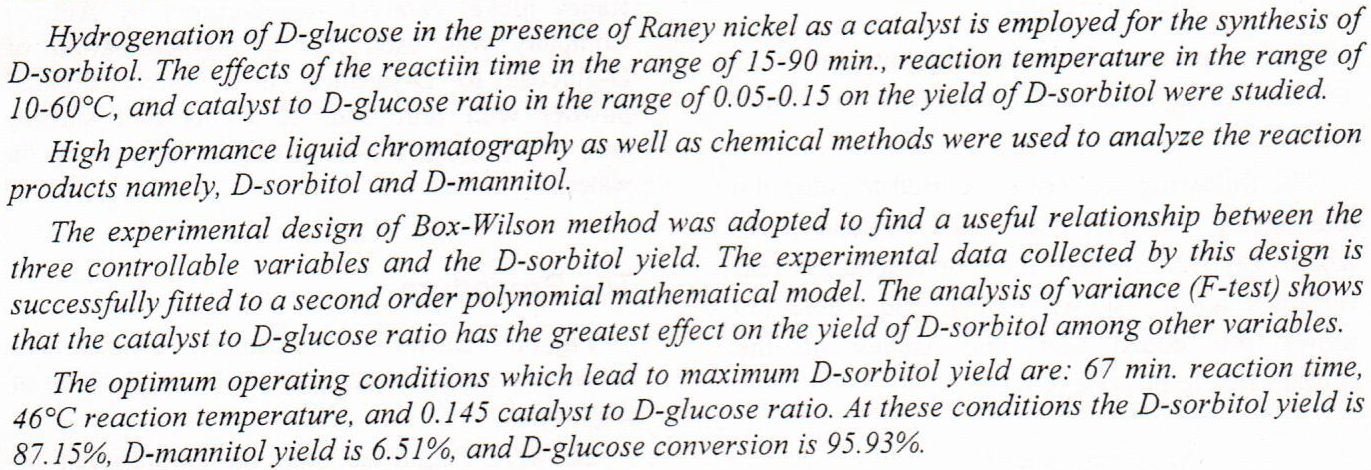
D-Sorbitol Production by Catalytic Hydrogenation of D-Glucose

Background: The elimination of the microorganisms from the root canal systems, an important step for the successful root canal treatment. This study was conducted to evaluate the antibacterial effectiveness of the photoactivated disinfection by using the toluidine blue O and a low- energy light emitting diode (LED) lamp . Materials and method: Sixty single rooted extracted teeth were decoronated, instrumented, irrigated, sealed at the apex and contaminated with endodontic anaerobic bacteria for 7 days to form biofilms in prepared root canals. Group I. Twelve teeth were medicated by photosensitizer (toluidine blue O) solution activated by diode lamp (FotoSan; CMS Dental, Copenhagen, Denmark).Group II. Twelve teeth were medicated by the tricr
... Show MoreLiquid – liquid interface reaction is the method for
preparation nanoparticles (NP'S) which depend on the super
saturation of ions that provide by using the system that consist from
toluene and water, the first one is above the second to obtain
nanoparticles (NP's) CdS at the interface separated between these
two immiscible liquid. The structure properties were characterized by
XRD-diffraction and transmission electron microscopy.
The crystalline size estimate from X-ray diffraction pattern
using Scherer equation to be about 7nm,and by TEM analysis give us
that ananosize is about 5 nm which give a strong comparable with
Bohr radius. Photoluminescence analysis give two emission peak,
the first one around
 (1)
(1)

Abstract:In this research we prepared nanofibers by electrospinning from poly (Vinyl Alcohol) / TiO2. The spectrum of the solution (Emission) was studied at 772 nm. Several process parameter were Investigated as concentration of PVA, the effect of distance from nozzle tip to the grounded collector (gap distance), and final the effect of high voltage. We find the optimum condition to prepare a narrow nanofibers is at concentration of PVA 16gm, the fiber has 20nm diameter.
In this study the thermal conductivity of the epoxy composites were characterized as function of volume fraction, particle size of fillers and the time of immersion(30,60,90)days in water .Composites plates were prepared by incorporating (bi-directional) (0º-90º) glass fiber and silicon carbide (SiC) particles of (0.1,0.5,1)mm as particle size at (10%,20%,30%,40%) percent volume in epoxy matrix.
The composites shows slightly increase of the thermal conductivity with increasing volume fraction, particle size and increase with increasing the days of immersion in water. The maximum thermal conductivity (0.51W/m.K) was obtained before the immersion in water at 90 days for epoxy reinforcement by bi-directional glass fiber and SiC particl
The progress of science in all its branches and levels made great civilized changes of
our societies in the present day, it's a result of the huge amount of knowledge, the increase of
number of students, and the increase of community awareness proportion of the importance of
education in schools and universities, it became necessary for us as educators to look at
science from another point of view based on the idea of scientific development of curricula
and teaching methods and means of education, and for the studying class environment as a
whole, by computer and internet use in education to the emergence of the term education
technology, which relies on the use of modern technology to provide educational content to<
In this research we prepared nanofibers by electrospinning
from poly (Vinyl Alcohol) / TiO2. The spectrum of the solution
(Emission) was studied at 772 nm. Several process parameter were
Investigated as concentration of PVA, the effect of distance from
nozzle tip to the grounded collector (gap distance), and final the
effect of high voltage. We find the optimum condition to prepare a
narrow nanofibers is at concentration of PVA 16gm, the fiber has
20nm diameter
This study focuses on the writing skill which is a social act .Students need to express
themselves in writing, but students of History and Geography departments are poor in
writing. This study aims at identifying and classifying the errors committed by the
students, and then giving remedies.
Writing can be considered as a channel or as a goal of language learning.
Students learn to write in a foreign language. Writing as a goal basically focuses on
the development of writing skills to fulfill such purposes as note-taking, summarizing,
narrating, reporting and replying required for various real-life situation
(Mechalakelli,2007)
Students at Departments of Geography and History study English as a part of
their
Desulfurization of a simulated diesel fuel by different adsorbents was studied in a fixed-bed adsorption process operated at ambient temperature and pressure. Three different adsorption beds were used, commercial activated carbon, Cu-Y zeolite, and layered bed of 15wt% activated carbon followed by Cu-Y zeolite.Initially Y-zeolite was prepared from Iraqi rice husk and then impregnated with copper. In general, the adsorbents tested for total sulfur adsorption capacity at break through followed the order Ac/Cu-Y zeolite>Cu-Y zeolite>Ac. The best adsorbent, Ac/Cu-Y zeolite is capable of producing more than 30 cm3 of simulated diesel fuel per gram of adsorbent with a weighted average content of 5 ppm-S, while Cu-Y zeolite producing of
... Show More
(7)
The geometric morphometric technique was used to study the variables in the shape and size wings of different populations of mosquitoes Culex quinquefasciatus from different Iraqi provinces Babylon, Baghdad and Wasit. The results showed that the average of centroid size were 366, 387.5 and 407.4 Micron in Babylon, Baghdad and Kut, respectively. The statistical analysis showed that there were no significant differences in the average of centroid size of all specimens and they belong to the same species.
 (2)
(2)

The present work involves studying the effect of electrolyte composition [@1= 0.5 wt.% NH4F / 5% H2O / 5% Glycerol (GLY)/ 90% Ethylene Glycol (EG)] and [ @2= 0.5 wt. % NH4F / 5% H2O / 95% Ethylene Glycol (EG)] on the structural and photoelectrochemical properties of titania nanotubes arrays (TNTAs). TNTAs substrates were successfully carried out via anodization technique and were carried out in 40 V for one hour in different electrolytes (@1, and @2). The properties of physicochemical of TNTAs were distinguished via an X-ray Diffractometer (XRD), Field Emission Scanning Electron Microscope (FESEM), an Energy Dispersive X-ray (EDX), and UV–visible diffuse reflectance. T
... Show More
(19)
(12)
