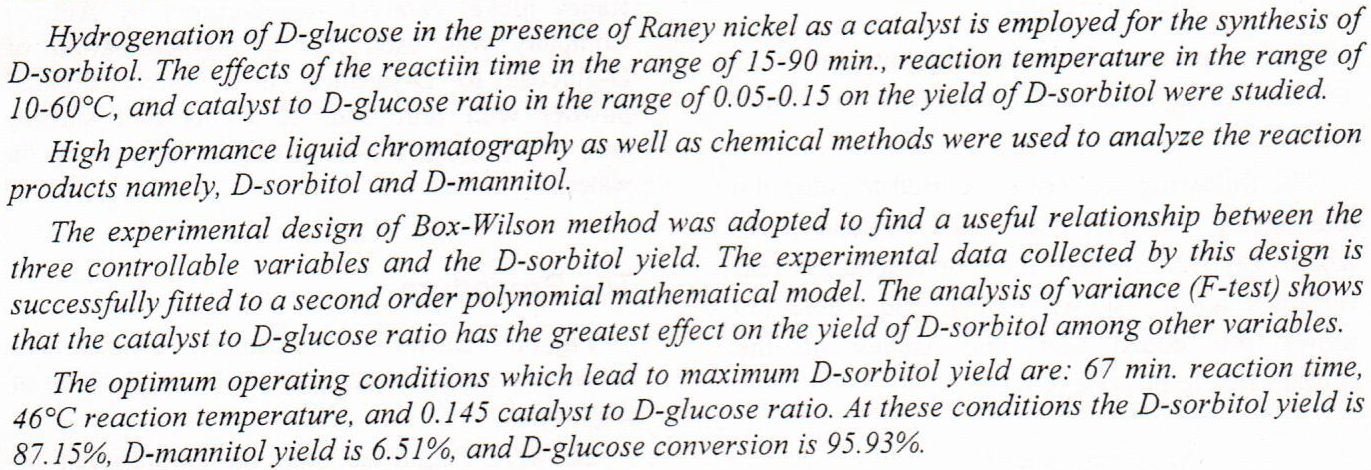
D-Sorbitol Production by Catalytic Hydrogenation of D-Glucose

A comparative study was done on the adsorption of methyl orange dye (MO) using non-activated and activated corn leaves with hydrochloric acid as an adsorbent material. Scanning electron microscopy (SEM) and Fourier Transform Infrared spectroscopy (FTIR) were utilized to specify the properties of adsorbent material. The effect of several variables (pH, initial dye concentration, temperature, amount of adsorbent and contact time) on the removal efficiency was studied and the results indicated that the adsorption efficiency increases with the increase in the concentration of dye, adsorbent dosage and contact time, while inversely proportional to the increase in pH and temperature for both the treated and untreated corn leav
... Show More (27)
(27)

 (12)
(6)
(12)
(6)

The integration of Artificial Intelligence with Big Data Analytics is one of the most groundbreaking developments that could change the face of educational sustainability in higher education.. Using AI and Big Data technologies not only makes the educational process more efficient but also changes the way people learn and thus opens the door for educators and institutions to make decisions based on the data. The document imparts the manner that the use of AI and the digital revolution can remove student requirements, execute the efficiency of the curriculum, and acquire the balance of educational resources through a majority of instances and the latest developments in that field. Furthermore, the paper, along with the issues of morality wit
... Show More
(1)
Water pollution as a result of contamination with dye-contaminating effluents is a severe issue for water reservoirs, which instigated the study of biodegradation of Reactive Red 195 and Reactive Blue dyes by E. coli and Bacillus sp. The effects of occupation time, solution pH, initial dyes concentrations, biomass loading, and temperature were investigated via batch-system experiments by using the Design of Experiment (DOE) for 2 levels and 5 factors response surface methodology (RSM). The operational conditions used for these factors were optimized using quadratic techniques by reducing the number of experiments. The results revealed that the two types of bacteria had a powerful effect on biodegradable dyes. The regression analysis reveale
... Show More
(52)
The properties of structural and optical of pure and doped nano titanium dioxide (TiO2) films, prepared using chemical spray pyrolysis (CPS) technique, with different nanosize nickel oxide (NiO) concentrations in the range (3-9)wt% have been studied. X-Ray diffraction (XRD) technique where using to analysis the structure properties of the prepared thin films. The results revealed that the structure properties of TiO2 have polycrystalline structure with anatase phase. The parameters, energy gap, extinction coefficient, refractive index, real and imaginary parts were studied using absorbance and transmittance measurements from a computerized ultraviolet visible spectrophotometer (Shimadzu UV-1601 PC) in the wavelength
... Show More
(4)
In this work, an explicit formula for a class of Bi-Bazilevic univalent functions involving differential operator is given, as well as the determination of upper bounds for the general Taylor-Maclaurin coefficient of a functions belong to this class, are established Faber polynomials are used as a coordinated system to study the geometry of the manifold of coefficients for these functions. Also determining bounds for the first two coefficients of such functions.
In certain cases, our initial estimates improve some of the coefficient bounds and link them to earlier thoughtful results that are published earlier.
(4)
(2)

Magnetic nanoparticles (MNPs) of iron oxide (Fe3O4) represent the most promising materials in many applications. MNPs have been synthesized by co-precipitation of ferric and ferrous ions in alkaline solution. Two methods of synthesis were conducted with different parameters, such as temperature (25 and 80 ̊C), adding a base to the reactants and the opposite process, and using nitrogen as an inert gas. The product of the first method (MNPs-1) and the second method (MNPs-2) were characterized by x-ray diffractometer (XRD), Zeta Potential, atomic force microscope (AFM) and scanning electron microscope (SEM). AFM results showed convergent particle size of (MNPs-1) and (MNPs-2) with (86.01) and (74.14)
... Show More
(48)
During COVID-19, wearing a mask was globally mandated in various workplaces, departments, and offices. New deep learning convolutional neural network (CNN) based classifications were proposed to increase the validation accuracy of face mask detection. This work introduces a face mask model that is able to recognize whether a person is wearing mask or not. The proposed model has two stages to detect and recognize the face mask; at the first stage, the Haar cascade detector is used to detect the face, while at the second stage, the proposed CNN model is used as a classification model that is built from scratch. The experiment was applied on masked faces (MAFA) dataset with images of 160x160 pixels size and RGB color. The model achieve
... Show More
(7)
(4)
(46)
(43)
Fourier Transform-Infrared (FT-IR) spectroscopy was used to analyze gasoline engine oil (SAE 5W20) samples that were exposed to seven different oxidation times (0 h, 24 h, 48 h, 72 h, 96 h, 120 h, and 144 h) to determine the best wavenumbers and wavenumber ranges for the discrimination of the oxidation times. The thermal oxidation process generated oil samples with varying total base number (TBN) levels. Each wavenumber (400–3900 cm−1) and wavenumber ranges identified from the literature and this study were statistically analyzed to determine which wavenumbers and wavenumber ranges could discriminate among all oxidation times. Linear regression was used with the best wavenumbers and wavenumber ranges to predict oxidation time.
... Show More
(22)
(21)