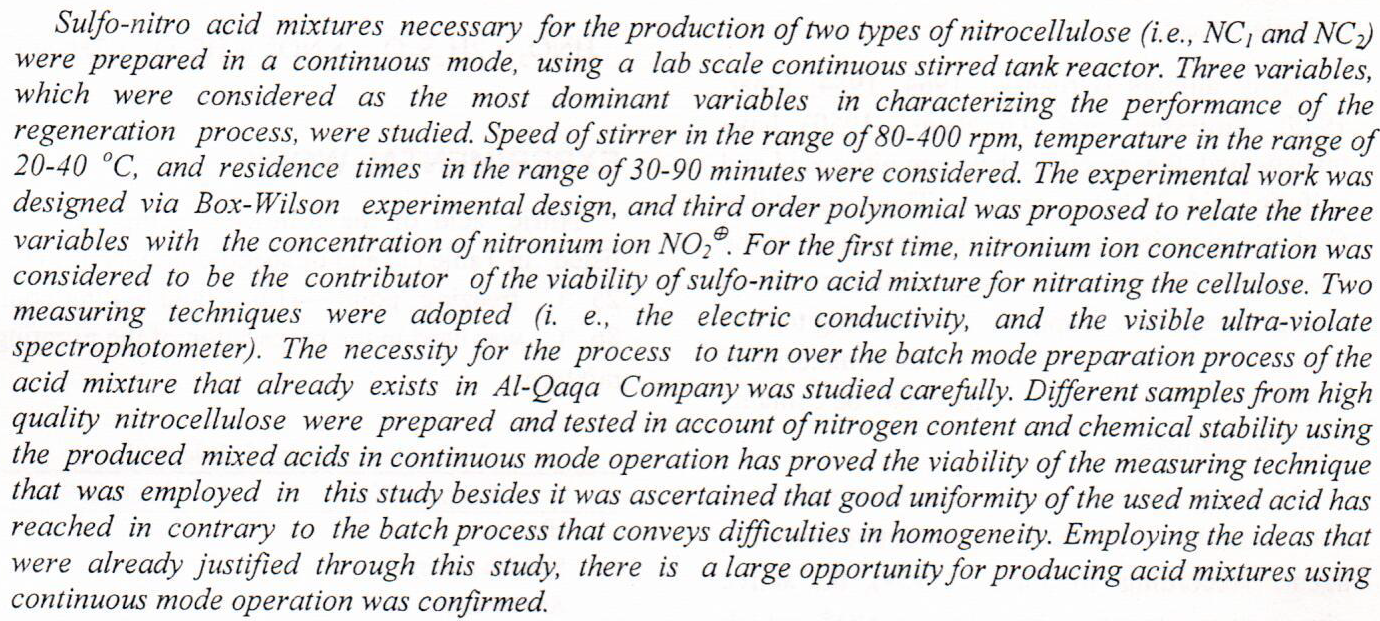
Regeneration of SLFO_Nitro Acid Mixture in Continuous Mode Operation

A novel metal-organic framework (MOF) sorbent based on tannic acid/copper (TA/Cu) was synthesized and characterized for the application of the anticancer drug imatinib (IMA) from biological samples. The TA/Cu MOF was prepared via a facile coordination reaction and thoroughly characterized by SEM, XRD, and FTIR techniques. Critical parameters influencing the extraction efficiency of imatinib mesylate (IMAM), including pH, ionic strength, desorption solvent, and adsorption-desorption time were optimized. With acetonitrile as the desorption solvent, the method demonstrated a broad linear range of 0.55-300 μg L-1 under ideal conditions. Limits of detection and quantification were found to be 0.16 μg L-1 and 0.55 μg L-1, respectively.
... Show More (5)
(5)


This research includes the synthesis of some new N-Aroyl-N \ -Aryl thiourea derivatives namely: N-benzoyl-N \ -(p-aminophenyl) thiourea (STU1), N-benzoyl-N \ -(thiazole) thiourea (STU2), N-acetyl-N ` -(dibenzyl) thiourea (STU3). The series substituted thiourea derivatives were prepared from reaction of acids with thionyl chloride then treating the resulted with potassium thiocyanate to affored the corresponding N-Aroyl isothiocyanates which direct reaction with primary and secondary aryl amines, The purity of the synthesized compounds were checked by measuring the melting point and Thin Layer Chromatography (TLC) and their structure, were identified by spectral methods [FTIR,1H-NMR and 13C-NMR].These compounds were investigated as a
... Show MoreA novel metal-organic framework (MOF) sorbent based on tannic acid/copper (TA/Cu) was synthesized and characterized for the application of the anticancer drug imatinib (IMA) from biological samples. The TA/Cu MOF was prepared via a facile coordination reaction and thoroughly characterized by SEM, XRD, and FTIR techniques. Critical parameters influencing the extraction efficiency of imatinib mesylate (IMAM), including pH, ionic strength, desorption solvent, and adsorption-desorption time were optimized. With acetonitrile as the desorption solvent, the method demonstrated a broad linear range of 0.55-300 μg L-1 under ideal conditions. Limits of detection and quantification were found to be 0.16 μg L-1 and 0.55 μg L-1, respectively.
... Show More
(5)
 (28)
(28)
 (26)
(26)
A novel metal-organic framework (MOF) sorbent based on tannic acid/copper (TA/Cu) was synthesized and characterized for the application of the anticancer drug imatinib (IMA) from biological samples. The TA/Cu MOF was prepared via a facile coordination reaction and thoroughly characterized by SEM, XRD, and FTIR techniques. Critical parameters influencing the extraction efficiency of imatinib mesylate (IMAM), including pH, ionic strength, desorption solvent, and adsorption-desorption time were optimized. With acetonitrile as the desorption solvent, the method demonstrated a broad linear range of 0.55-300 μg L-1 under ideal conditions. Limits of detection and quantification were found to be 0.16 μg L-1 and 0.55 μg L-1, respectively.
... Show More
(5)
(14)
(1)
MCM-48 zeolites have unique properties from the surfaces and structure point of view as it’s shown in the results ,and unique and very sensitive to be prepared, have been experimentally prepared and utilized as a second-generation/ acid - catalyst for esterification reactions of oleic acid as a model oil for a free fatty acid source with Ethanol. The characterization of the catalyst used in the reaction has been identified by various methods indicating the prepared MCM-48 is highly matching the profile of common commercial MCM-48 zeolite. The XRF results show domination of SiO2 on the chemical structure with 99.1% and agreeable with the expected from MCM-48 for it's of silica-based, and the SEM results show the cubic c
... Show More
(5)
PVC membrane sensor for the selective determination of Mefenamic acid (MFA) was constructed. The sensor is based on ion association of MFA with Dodecaphospho molybdic acid (PMA) and Dodeca–Tungstophosphoric acid(PTA) as ion pairs. Nitro benzene (NB) and di-butyl phthalate (DBPH) were used as plasticizing agents in PVC matrix membranes. The specification of sensor based on PMA showed a linear response of a concentration range 1.0 × 10⁻² –1.0 × 10⁻⁵ M, Nernstian slopes of 17.1-18.86 mV/ decade, detection limit of 7 × 10⁻⁵ -9.5 × 10 -7M, pH range 3 – 8 , with correlation coefficients lying between 0.9992 and 0.9976, respectively. By using the ionphore based on PTA gives a concentration range of 1.0 × 10⁻⁴ –1.0 × 10⁻⁵ M,
... Show More
This study aimed to obtain a local isolation of Aspergillus niger and then studied its ability to produce citric acid from raw materials available locally using solid state fermentation. Six local isolates were collected from different sources including some samples of the damaged fruits such as grapefruit, oranges and sindi. Wheat bran was used as a raw material or as culture medium for the production of citric acid from the collected isolates. The conditions for citric acid production were determined by humidity percentage of 1: 1 (water: culture medium), temperature of 28 C, pH 4 and inoculum dose with 5× 10⁶ spore/ml and for 3 days of incubation. The orange was the best model for citric acid production with a concentration of 12.8 mg/m
... Show More
(4)
(2)