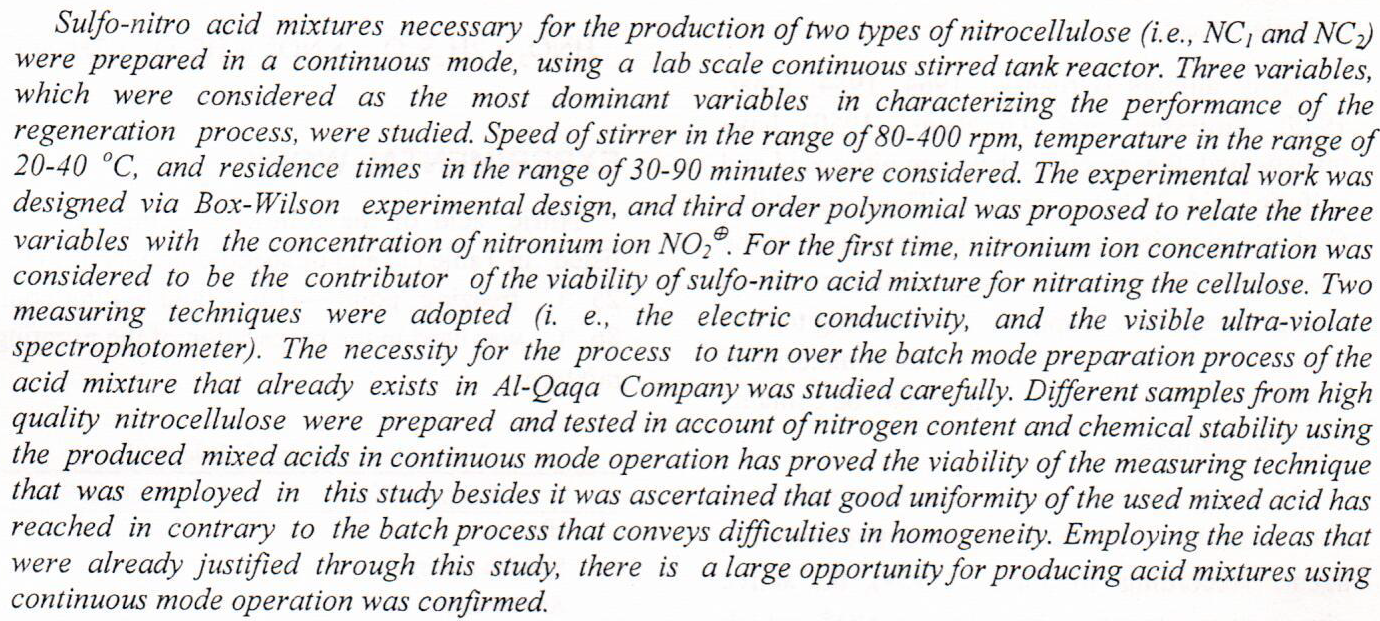
Regeneration of SLFO_Nitro Acid Mixture in Continuous Mode Operation

 (15)
(15)
 (13)
(13)


The dried fruit peel of pomegranate in Punicaceae family was fractionated chromatographically on Sephadex-LH-20 column .Gallic acid (trihydroxybenzoic acid) and its related galloyl esters such as gallotannin(i.e. β-penta-O-galloyl–D-glucose) were obtained homogenously. Different concentrations of gallic acid and gallotannin were used to determine their inhibitory effect on human serum cholinesterase. The enzyme activity was measured according to the method reported by the WHO .The inhibitory effect of these compounds on the activity of human serum cholinesterase have been studied in vitro .The inhibitory effect was remarkably clear with increasing concentration of gallic acid .Whereas galloyl ester showed n
... Show More
The importance of algae as a natural source of various bioactive compounds continues to grow due to their diverse biological activities. One of such compounds is n-hexadecanoic acid, more commonly known as palmitic acid; it is more lipidous than many algal species. It is one of the most common saturated fatty acids in nature. One can find it in algal, animal, and plant oils and is extracted from numerous natural sources. Its chemical and biological attributes enable its widespread use in the pharmaceutical, food, and cosmetic industries. Numerous studies have found that palmitic acid is effective for fungal activities and does have pharmaceutical and environmental promising antioxidant capabilities.
(8)
A novel encapsulated deep eutectic solvent (DES) was introduced for biodiesel production via a two-step process. The DES was encapsulated in medical capsules and were used to reduce the free fatty acid (FFA) content of acidic crude palm oil (ACPO) to the minimum acceptable level (< 1%). The DES was synthesized from methyltriphenylphosphonium bromide (MTPB) and p-toluenesulfonic acid (PTSA). The effects pertaining to different operating conditions such as capsule dosage, reaction time, molar ratio, and reaction temperature were optimized. The FFA content of ACPO was reduced from existing 9.61% to less than 1% under optimum operating conditions. This indicated that encapsulated MTPB-DES performed high catalytic activity in FFA esterificatio
... Show More
(21)
(13)
 (4)
(2)
(4)
(2)
A specific, sensitive and new simple method was used for the determination of methyldopa in pure and pharmaceutical formulations by using continuous flow injection analysis. This method is based on formation of ion pair compound between methyldopa and potassium hexacyanoferrate in acidic medium to obtain a yellow precipitate complex using long distance chasing photometer (NAG-ADF-300-2). The linear range for calibration graph was 0.05-35 mmol/L for cell A and 0.05-25 mmol/L for cell B, and LOD 1.4292 µg /200 µL for both cells with correlation coefficient (r) 0.9981 for cell A and 0.9994 for cell B, RSD% was lower than 0.5 % for n=8 for. The results were compared with classical method UV-Spectrophotometric at λ max=280 nm and turbi
... Show More
(7)
(2)
Background: Lead-acid battery workers are at higher risk for systemic diseases as well as oral diseases like dental caries. The aim of this study was to assess selected salivary antioxidants and their relation with dental caries among lead acid battery factory workers in comparison with non-exposed group. Materials and methods: The sample consisted of 35 subjects aged 35-45 year-old who worked in Babylon lead acid battery factory in Baghdad city and matching group that not exposed to lead were selected as a control. Dental caries severity was recorded by using DMFS index, stimulated salivary samples were collected and analyzed for the measurement of salivary antioxidants (uric acid, total protein, catalase and glutathione peroxidase enzymes
... Show MoreSince its first description as a cytotoxic agent, Olea europaea leaves extract gained significant popularity against human breast cancer, ethyl acetate extract of Olea europaea leaves obtained by acid hydrolysis method was evaluated in vitro as cytotoxic agent against new human breast cancer (AMJ13) cell line, using the MTT assay. One main pentacyclic triterpenoid; oleanolic acid, was isolated from leaves of Olea europaea by well-known two different methods, but not used for this compound before, the acidic hydrolysis method and basic acidic method. The presence of oleanolic acid was proved in both methods with qualitative and quantitative d
... Show More
(7)
(1)