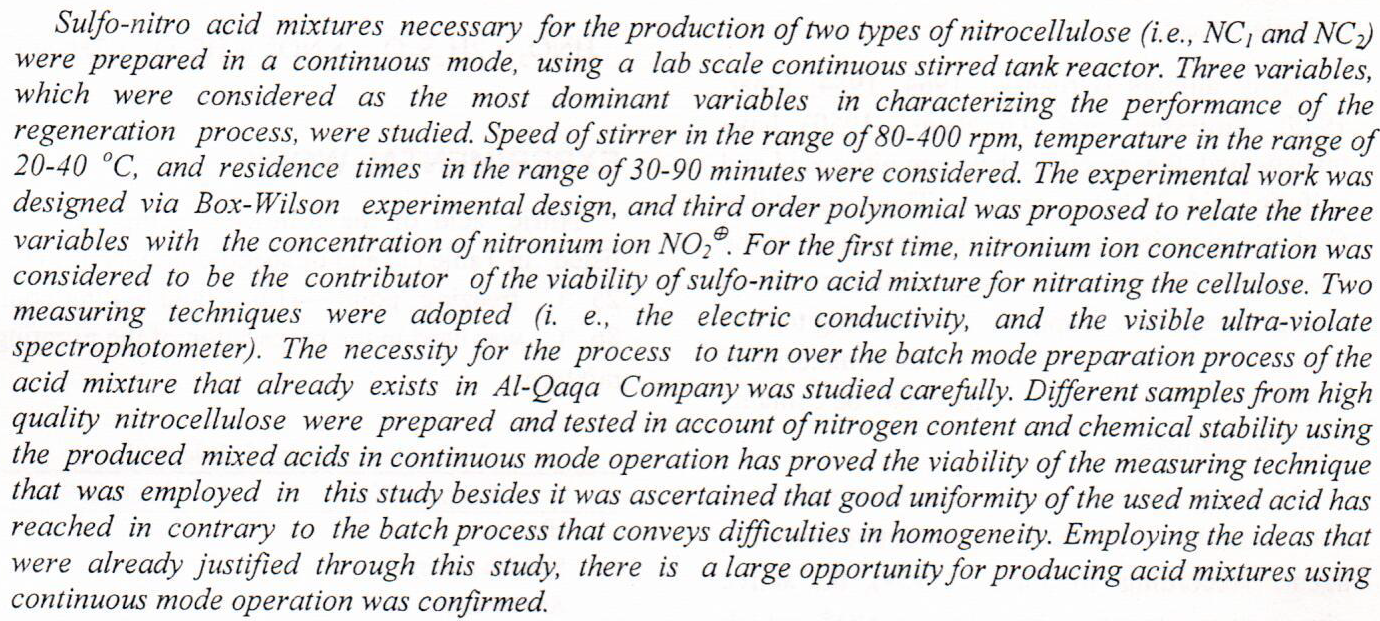
Regeneration of SLFO_Nitro Acid Mixture in Continuous Mode Operation

Abstract-Servo motors are important parts of industry automation due to their several advantages such as cost and energy efficiency, simple design, and flexibility. However, the position control of the servo motor is a difficult task because of different factors of external disturbances, nonlinearities, and uncertainties. To tackle these challenges, an adaptive integral sliding mode control (AISMC) is proposed, in which a novel bidirectional adaptive law is constructed to reduce the control chattering. The proposed control has three steps to be designed. Firstly, a full-order integral sliding manifold is designed to improve the servo motor position tracking performance, in which the reaching phase is eliminated to achieve the invariance of
... Show More (4)
(4)
 (2)
(2)



A simple, low cost and rapid flow injection turbidimetric method was developed and validated for mebeverine hydrochloride (MBH) determination in pharmaceutical preparations. The developed method is based on forming of a white, turbid ion-pair product as a result of a reaction between the MBH and sodium persulfate in a closed flow injection system where the sodium persulfate is used as precipitation reagent. The turbidity of the formed complex was measured at the detection angle of 180° (attenuated detection) using NAG dual&Solo (0-180°) detector which contained dual detections zones (i.e., measuring cells 1 & 2). The increase in the turbidity of the complex was directly proportional to the increase of the MBH concentration
... Show More
(19)
(13)
(7)
(3)
A simple, low cost and rapid flow injection turbidimetric method was developed and validated for mebeverine hydrochloride (MBH) determination in pharmaceutical preparations. The developed method is based on forming of a white, turbid ion-pair product as a result of a reaction between the MBH and sodium persulfate in a closed flow injection system where the sodium persulfate is used as precipitation reagent. The turbidity of the formed complex was measured at the detection angle of 180° (attenuated detection) using NAG dual&Solo (0-180°) detector which contained dual detections zones (i.e., measuring cells 1 & 2). The increase in the turbidity of the complex was directly proportional to the increase of the MBH concentration
... Show More
(19)
(13)
(9)
(2)
(2)
Ball and Plate (B&P) system is a benchmark system in the control engineering field that has been used to verify many control methods. In this paper the design of a sliding mode . controller has been investigated and verified in real-time via implementation on a real ball and plate system hardware. The mathematical model has been derived and the necessary parameters have been measured. The sliding mode controller has been designed based on the obtained mathematical model. The resulting controller has been implemented using the Arduino Mega 2560 and a ball and plate system built completely from scratch. The Arduino has been programmed by the Arduino support target for Simulink. Three test signals has been used for verification purposes
... Show MoreThis paper proposes a new structure for a Fractional Order Sliding Mode Controller (FOSMC) to control a Twin Rotor Aerodynamic System (TRAS). The new structure is composed by defining two 3-dimensional sliding mode surfaces for the TRAS model and introducing fractional order derivative integral in the state variables as well as in the control action. The parameters of the controller are determined so as to minimize the Integral of Time multiplied by Absolute Error (ITAE) performance index. Through comparison, this controller outperforms its integer counterpart in many specifications, such as reducing the delay time, rise time, percentage overshoot, settling time, time to reach the sliding surface, and amplitude of chattering in control inpu
... Show MoreWireless sensor networks (WSNs) represent one of the key technologies in internet of things (IoTs) networks. Since WSNs have finite energy sources, there is ongoing research work to develop new strategies for minimizing power consumption or enhancing traditional techniques. In this paper, a novel Gaussian mixture models (GMMs) algorithm is proposed for mobile wireless sensor networks (MWSNs) for energy saving. Performance evaluation of the clustering process with the GMM algorithm shows a remarkable energy saving in the network of up to 92%. In addition, a comparison with another clustering strategy that uses the K-means algorithm has been made, and the developed method has outperformed K-means with superior performance, saving ener
... Show More
(5)
(4)
A mixture model is used to model data that come from more than one component. In recent years, it became an effective tool in drawing inferences about the complex data that we might come across in real life. Moreover, it can represent a tremendous confirmatory tool in classification observations based on similarities amongst them. In this paper, several mixture regression-based methods were conducted under the assumption that the data come from a finite number of components. A comparison of these methods has been made according to their results in estimating component parameters. Also, observation membership has been inferred and assessed for these methods. The results showed that the flexible mixture model outperformed the
... Show More