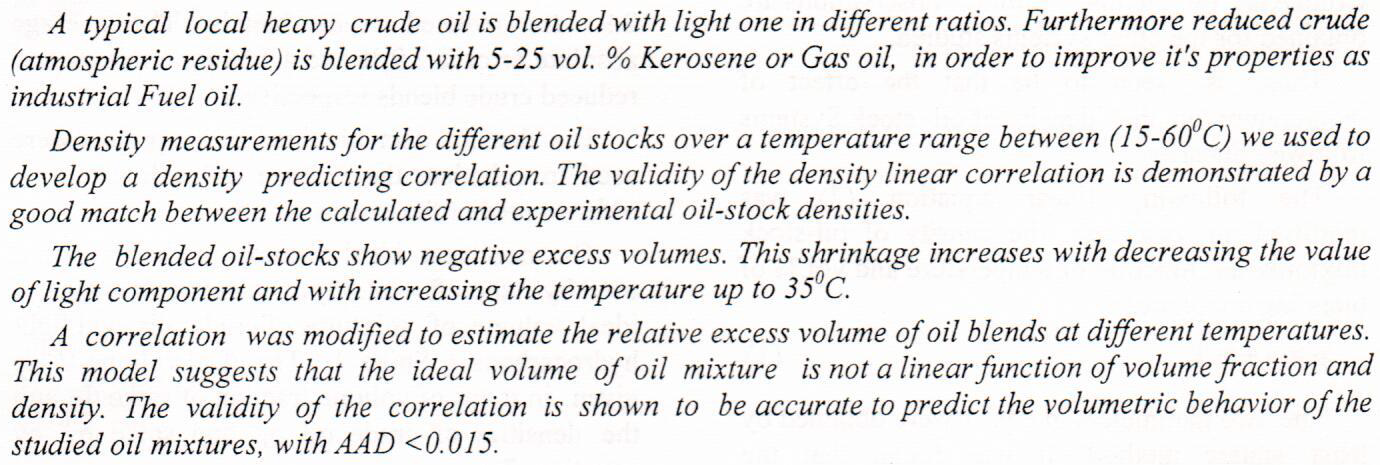
Predicting the Change in Volume of Mixed Oil Stocks

The corrosion behavior of low carbon steel in washing water of crude oil solution has been studied potentiostatically at five temperatures in the range (30–70)°C .The corrosion potential shifted to more negative values with increasing temperature and the corrosion current density increased with increasing temperature. Folic acid had on inhibiting effect on the corrosion of low carbon steel in washing water at a concentration (5× 10⁻⁴-- 5× 10⁻³ ) mol/dm3 over the temperature range (30–70)°C. Values of the protection efficiency were calculated from the corrosion current density .From the general results for this study, it can be seen that thermodynamic and kinetic function were also calculated (?G, ?S, ?H and Ea )
... Show More (3)
(3)

The research aims to present a proposed strategy for the North Oil Company, and the proposed strategy took into account the surrounding environmental conditions and adopted in its formulation on the basis and scientific steps that are comprehensive and realistic, as it covered the main activities of the company (production and exploration activities, refining and refining activities, export and transport of oil, research and development activity, financial activity, information technology, human resources) and the (David) model has been adopted in the environmental analysis of the factors that have been diagnosed according to a
... Show More
يهدف البحث الى تقديم استراتيجية مقترحة لشركة نفط الشمال ، وأخذت الاستراتيجية المقترحة بنظر الاعتبار الظروف البيئية المحيطة واعتمدت في صياغتها على اسس وخطوات علمية تتسم بالشمولية والواقعية ، اذ انها غطت الانشطة الرئيسية في الشركة (نشاط الانتاج والاستكشاف , نشاط التكرير والتصفية , التصدير ونقل النفط , نشاط البحث والتطوير , النشاط المالي , تقنية المعلومات , الموارد البشرية ) وقد اعتمد نموذج (David) في التحليل البيئي
... Show More
The influence of SDBS, SLS, SLES, and SS as drag reducing agents on flow of Iraqi crude oil in pipelines was investigated in the present work. The effect of additive type, additive concentration, pipe diameter, solution flow rate, and the presence of elbows on the percentage of drag reduction (%Dr) and the amount of flow increases (%FI) was addressed. The maximum drag reduction was 55% obtained at 250 ppm SDBS surfactant flowing in straight pipes of 0.0508 m I.D. The dimensional analysis was used for grouping the significant quantities into dimensionless groups to reduce the number of variables. The results showed good agreement between the observed drag reduction percent values and the predicted ones with high value of the co
... Show More (24)
(18)
(24)
(18)

Abstract
The research aims at the relationship between Servant leadership dimensions test as an independent variable and an organizational trust as a variable dependent. Thus it was necessary to answer the following question: Is there a correlation relationship and impact between Servant leadership dimensions and organizational trust? To investigate the contents of the answer, the researcher selected a group of employees in Oil Products Distribution Company / Baghdad. The researcher adopted the analytical descriptive approach in completing his research which dealt with a random sample of (190) individuals representing the research society out of the total number of (376) person from the middle and high Leaders. Depending
... Show More
(1)
Microbial activity of Ellagic acid when mixed with some types of candy toward Streptococcus mutans microorganism was studied. The main purpose of carrying out this study is to produce a new type of candy that contains Ellagic acid in addition to xylitol instead of sucrose to prevent dental caries. The results show that the inhibitory action of Ellagic acid was more effective when mixed with this type of candy for the purpose of reducing Streptococcus mutans microorganisms, while sensory evaluation was applied in this study to 20 volunteers to that candy sample evaluated which contain (5 mg/ml) Ellagic acid with 100g xylitol to determine consumers acceptability of this sample of candy. The results were expressed as mean value, slandered d
... Show MoreThat the main feature of the economics many countries in general is a tendency towards defining the role of the public sector in economic activity and the tendency towards encourage the private sector to investment in public projects especially in countries those tendency towards market economy actually.
That increased economic development proven failure in achieving more economic growth both individually in many countries especially developing countries socialist, by researchers this led one way or another to direction of corrective reforms in their economic was one of them in Transformation of public companies into Shareholding companies contributes to the public sector in resources and expertise
... Show More
.Curcumin (Cur) and L phenylalanine (Phy) compounds were used to prepare two mixed ligand complexes with Cr (III) and Fe (III) ions. The synthesized complexes are characterized by using conductivity measurement and different spectral methods like FT-IR and UV- Vis .Molar conductance and analytical studies confirmed that the complexes exhibit octahedral geometry., suggest that the complexes are formed in 1: 1 :2 [ L : Metal : 2phe ] ratio and they proposed to have the general formulae [M(Cur)(phe)2] Cl (M= Cr (III) and Fe (III) The compound dyeing method was studied and applied to acrylic fabric.The antibacterial activity of curcumin, phenylalanine and their mixed ligand complexes were examined on pathogenic bacterial strains and showed good
... Show More