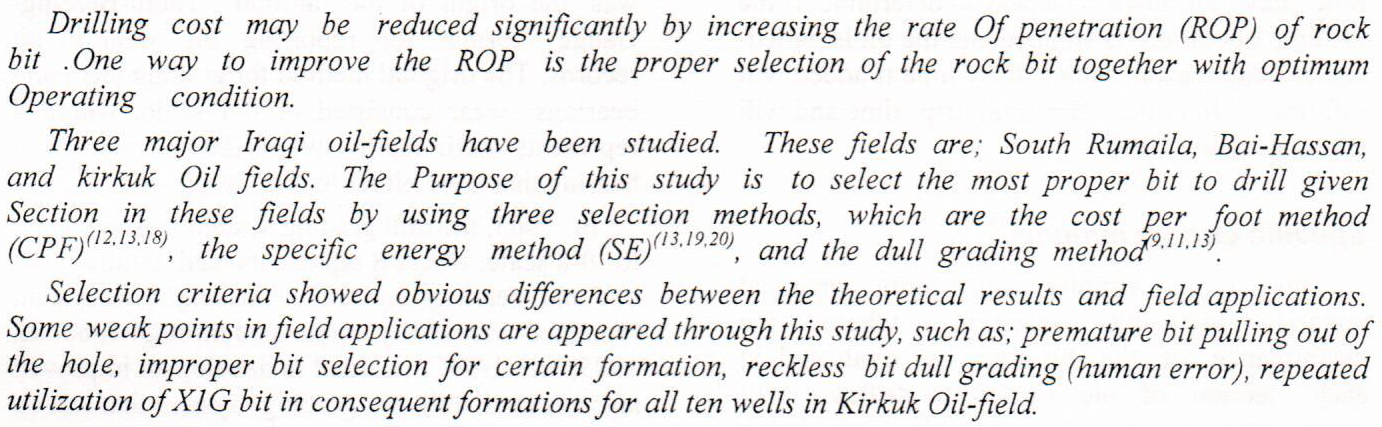
Analyzing and Optimizing Bits Performance in Three Iraqi Oil-Fields

The issues of journalists and media employees in general and photojournalists in particular have become important issues, especially as those issues are closely linked to the success or failure of the media process.
This research deals with (the issues of Iraqi photojournalists working in local and foreign institutions in Iraq - a case study in 2012), because of the ambiguity in identifying those issues, which focused on the issues of this research.
This was done through the research community of members of the Association of Iraqi photojournalists in Baghdad exclusively of (64) photographers and television photographers to identify the problems encountered in their work
... Show More


This study aimed to extraction of essential oil from peppermint leaves by using hydro distillation methods. In the peppermint oil extraction with hydro distillation method is studied the effect of the extraction temperature to the yield of peppermint oil. Besides it also studied the kinetics during the extraction process. Then, 2nd -order mechanism was adopted in the model of hydro distillation for estimation many parameters such as the initial extraction rate, capacity of extraction and the constant rat of extraction with various temperature. The same model was also used to estimate the activation energy. The results showed a spontaneous process, since the Gibbs free energy had a value negative sign.
 (7)
(7)
Aesthetic performance in the mobile sculptures
Ali Abd Almohsen Ali
Abstract
Chapters of this research are discussed one of the turning points in the In the history of sculpture, which sparked a debate in artistic circles, namely the introduction of the actual movement in sculpture . The researcher highlighted on one of the corners of the controversy on this subject for discussion and looking in and Found results contribute to answer some questions . the Beginning been allocated to the statement of this Research Methodology , research problem, and its importance, and its goal, and borders , the main problem is Lack of clarity of the concept of real motion (physical) in the sculpture , And how the audience understand the aspects
This study aimed to provide a conceptual model for the use and benefits of the e-Government as related to administrative fraud and financial corruption. The study also looked into their concepts, forms, dimensions and types and the role of e-Government on fraud reduction, corruption in administration and finance and its impact on the government performance. From the result, it is revealed that there is need for electronic government for implementation in order to curb the rate of fraud and administrative and financial corruption and improve the quality of service provision for better performance
 (15)
(15)
The problem of the research is focused on importance limited of Iraq industrial companies in application of scientific measurements of supply chains performance, The research sought to achieve a group of goals, the most important are , identifying the strengths and weaknesses in the reality of supply chain in General Company for Cotton Industries, The data and information required are gathered from the dependence company, records through the field observations and personal interviews, the research used some quantitative indicators to measure of supply chain performance, The research reached to many conclusions , the most outstanding among them is the existence of a strong inverse correlatio
... Show More
The oil and gas industry relies heavily on IT innovations to manage business processes, but the exponential generation of data has led to concerns about processing big data, generating valuable insights, and making timely decisions. Many companies have adopted Big Data Analytics (BDA) solutions to address these challenges. However, determining the adoption of BDA solutions requires a thorough understanding of the contextual factors influencing these decisions. This research explores these factors using a new Technology-Organisation-Environment (TOE) framework, presenting technological, organisational, and environmental factors. The study used a Delphi research method and seven heterogeneous panelists from an Oman oil and gas company
... Show More
(1)
(5)
(4)
Knowing the distribution of the mechanical rock properties and the far field stresses for the field of interest is an important task for many applications concerning reservoir geomechanics, including wellbore instability analysis, hydraulic fracturing, sand production, reservoir compaction, and subsidence. A major challenge with determining the rock's mechanical properties is that they cannot be directly measured at the borehole. Furthermore, the recovered carbonate core samples for performing measurements are limited and they provide discrete data for specific depths.
The purpose of this study is to build 2D and 3D geomechanical models of the Khasib reservoir in the East Baghdad oil field/ Central area. TECHLOG.2015.3 softwa
... Show More
(2)