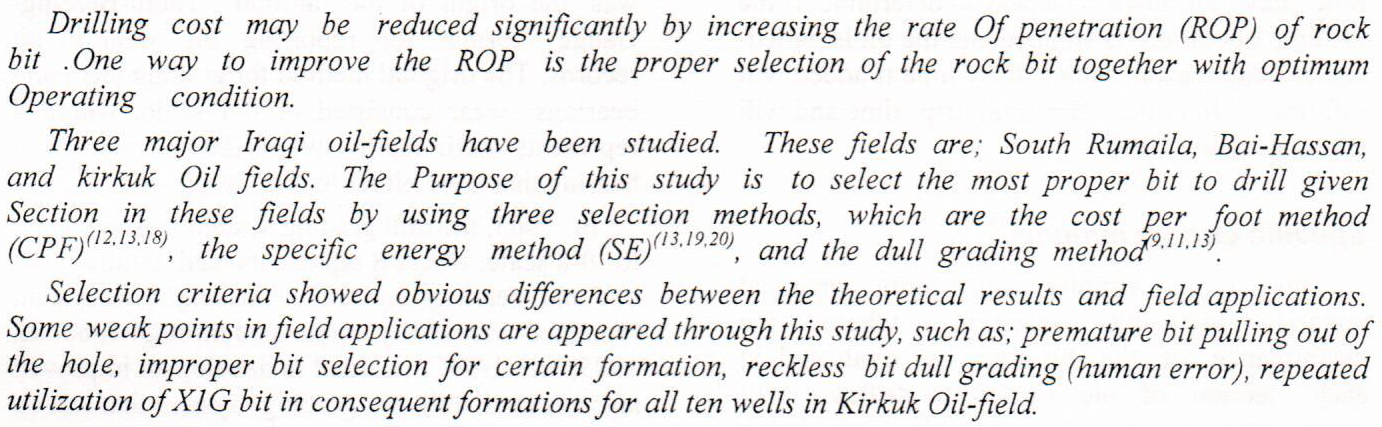
Analyzing and Optimizing Bits Performance in Three Iraqi Oil-Fields

This work deals with thermal cracking of three samples of extract lubricating oil produced as a by-product from furfural extraction process of lubricating oil base stock in AL-Dura refinery. The thermal cracking processes were carried out at a temperature range of 325-400 ºC and atmospheric pressure by batch laboratory reactor. The distillation of cracking liquid products was achieved by general ASTM distillation (ASTM D -86) for separation of gasoline fraction up to 220 ºC from light cycle oil fraction above 220 ºC. The comparison between the conversions at different operating conditions of thermal cracking processes indicates that a high conversion was obtained at 375°C, according to gasoline production. According to gasoline produ
... Show More
The Fauqi field is located about 50Km North-East Amara town in Missan providence in Iraq. Fauqi field has 1,640 MMbbl STOIIP, which lies partly in Iran. Oil is produced from both Mishrif and Asmari zones. Geologically, the Fauqi anticline straddles the Iraqi/Iranian border and is most probably segmented by several faults. There are several reasons leading to drilling horizontal wells rather than vertical wells. The most important parameter is increasing oil recovery, particularly from thin or tight reservoir permeability. The Fauqi oil field is regarded as a giant field with approximately more than 1 billion barrels of proven reserves, but it has recently experienced low production rate problems in many of its existing wells. This study
... Show More
It is very difficult to obtain the value of a rock strength along the wellbore. The value of Rock strength utilizing to perform different analysis, for example, preventing failure of the wellbore, deciding a completion design and, control the production of sand. In this study, utilizing sonic log data from (Bu-50) and (BU-47) wells at Buzurgan oil field. Five formations have been studied (Mishrif, Sadia, Middle lower Kirkuk, Upper Kirkuk, and Jaddala) Firstly, calculated unconfined compressive strength (UCS) for each formation, using a sonic log method. Then, the derived confined compressive rock strengthens from (UCS) by entering the effect of bore and hydrostatic pressure for each formation. Evaluations th
... Show More (3)
(3)
The catalytic cracking of three feeds of extract lubricating oil, that produced as a by-product from the process of furfural extraction of lubricating oil base stock in AL-Dura refinery at different operating condition, were carried out at a fixed bed laboratory reactor. The initial boiling point for these feeds was 140 ºC for sample (1), 86 ºC for sample (2) and 80 ºC for sample (3). The catalytic cracking processes were carried out at temperature range 325-400 ºC and initially at atmospheric pressure after 30 minutes over 9.88 % HY-zeolite catalyst load. The comparison between the conversion at different operating conditions of catalytic cracking processes indicates that a high yield was obtained at 375°C, according to gasoline pr
... Show MoreIn this research paper, two techniques were used to treat the drill cuttings resulting from the oil-based drilling fluid. The drill cuttings were taken from the southern Rumaila fields which prepared for testing and fixed with 100 gm per sample and contaminated with two types of crude oil, one from Rumaila oilfields with Sp.gr of 0.882 and the other from the eastern Baghdad oilfield with Sp.gr of 0.924 besides contamination levels of 10% and 15% w/w in mass. Samples were treated first with microwave with a power applied of 540 & 180 watts as well as a time of 50 minutes. It was found that the results reached below 1% w/w in mass, except for two samples they reached below 1.5% w/w in mass. Then, the sample of 1.41% w/w in mass,
... Show More
The aim of this study was to investigate the effect of operating variables on, the percentage of removed sludge (PSR) obtained during re-refining of 15W-40 Al-Durra spent lubricant by solvent extraction-flocculation treatment method. Binary solvents were used such as, Heavy Naphtha (H.N.): MEK (N:MEK), H.N. : n-Butanol (N:n-But), and H.N. : Iso-Butanol (N:Iso:But). The studied variables were mixing speed (300-900, rpm), mixing time (15-60, min), and operating temperature (2540, oC). This study showed that the studied operating variables have effects where, increasing the mixing time up to 45 min for H.N.: MEK, H.N.: n-Butanol and 30 min for H.N.: Iso-Butanol increased the PSR, after that percentage was decreased; increasing t
... Show More (33)
(36)
(33)
(36)


In this study, sulfur was removed from imitation oil using oxidative desulfurization process. Silicoaluminophosphate (SAPO-11) was prepared using the hydrothermal method with a concentration of carbon nanotubes (CNT) of 0% and 7.5% at 190 °C crystallization temperature. The final molar composition of the as-prepared SAPO-11 was Al2O3: 0.93P2O5: 0.414SiO2. 4% MO/SAPO-11 was prepared using impregnation methods. The produced SAPO-11 was described using X-ray diffraction (XRD) and Brunauer-Emmet-Teller (N2 adsorption–desorption isotherms). It was found that the addition of CNT increased the crystallinity of SAPO-11. The results showed that the surface area of SAPO-11 cont
... Show More
(5)