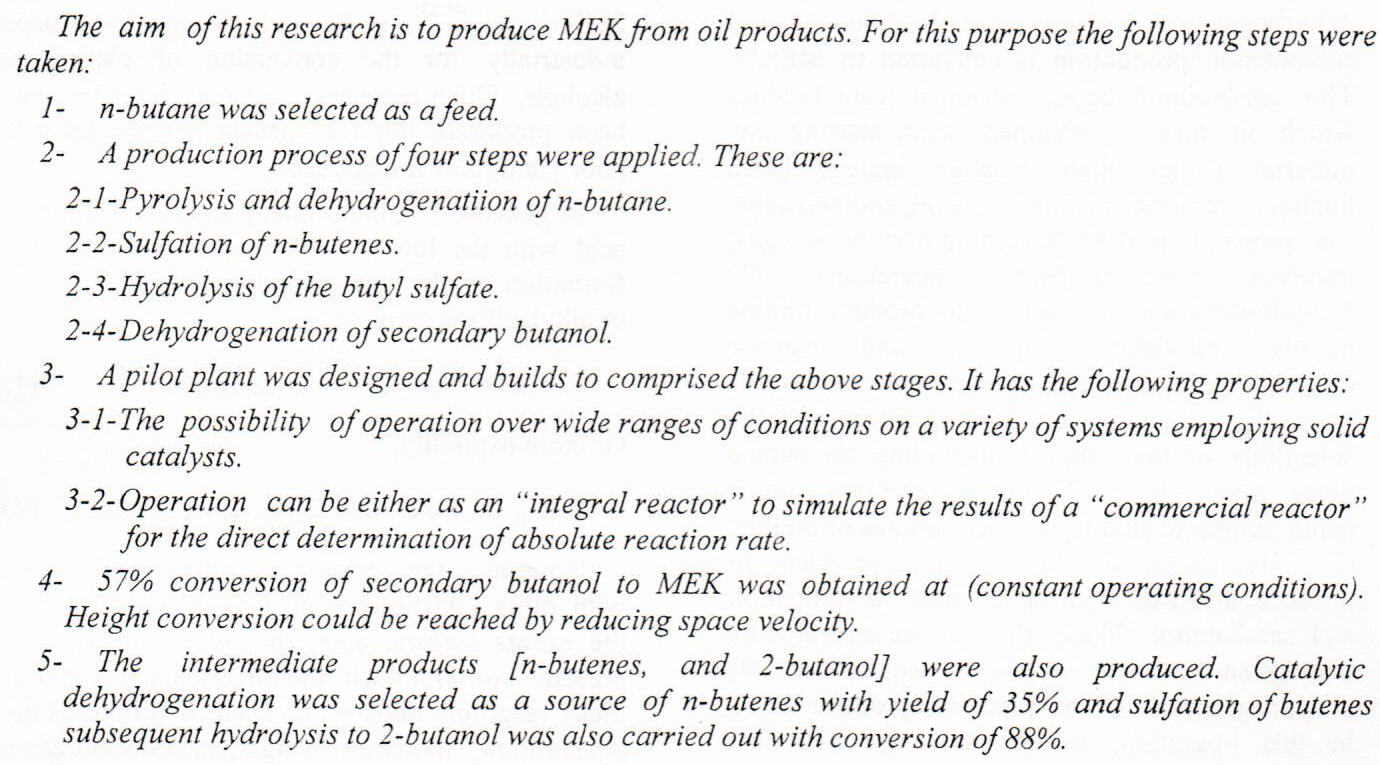
Production of Methyl Ethyl Ketone from N-Butane

Bauxite residue (red mud) is a waste material from alumina refineries in the Bayer process, containing significant quantities of valuable metals, notably scandium (Sc). The objective of this study is to recover Sc (III) from Hungarian bauxite residue by using hydrometallurgical processes, including solvent extraction and leaching. Red mud directly leached with hydrochloric acid to generate the leachate solution. The significant iron content (~38 %) in red mud makes it hard to recover scandium selectively due to comparable physicochemical characteristics. According to the findings, Fe (III) could be effectively extracted from hydrochloric acid leachate as HFeC14 using diethyl ether before Sc extraction. Protocol B demonstrated superior recov
... Show More (2)
(2)
 (2)
(2)


Bauxite residue (red mud) is a waste material from alumina refineries in the Bayer process, containing significant quantities of valuable metals, notably scandium (Sc). The objective of this study is to recover Sc (III) from Hungarian bauxite residue by using hydrometallurgical processes, including solvent extraction and leaching. Red mud directly leached with hydrochloric acid to generate the leachate solution. The significant iron content (~38 %) in red mud makes it hard to recover scandium selectively due to comparable physicochemical characteristics. According to the findings, Fe (III) could be effectively extracted from hydrochloric acid leachate as HFeC14 using diethyl ether before Sc extraction. Protocol B demonstrated superior recov
... Show More
(2)
(2)
Economic organizations operate in a dynamic environment, which necessitates the use of quantitative techniques to make their decisions. Here, the role of forecasting production plans emerges. So, this study aims to the analysis of the results of applying forecasting methods to production plans for the past years, in the Diyala State Company for Electrical Industries.
The Diyala State Company for Electrical Industries was chosen as a field of research for its role in providing distinguished products as well as the development and growth of its products and quality, and because it produces many products, and the study period was limited to ten years, from 2010 to 2019. This study used the descriptive approa
... Show More
Abstract
Most of the industrial organization in the world became suffering from the problem of the pollution of the poisonous chemicals things, this urged to depend on the principle of the responsible production, because it has the positive role by dealing with these chemical things and to safe the health of the society, due to the main goal of this study is to restrict the role responsible production in accomplishing the system of the environmental management through an actual study in the northern gas company in Kirkuk province, the topic has acquired a big importance bacause there were a limited number of studies and res
... Show More
(2)
(4)
(4)
|
Social networking sites have become very popular since the beginning of the current decade and have become linked to our daily life. We follow the news, Analyses and opinions on the one issue in a way that attracts millions of users and the number grows every secon On Twitter, one of the most important social networking sites, all social groups rushed from the president to the last citizen to open accounts when they found themselves forced to do so . During the recent Gulf crisis, Twitter was buzzing with Twitter, which achieved the largest circulation globally. Instead of serving the issue and directing it to serve the Arab interest, most of the publications were on th |
(1)
A survey of chrysidid wasps and an identification key to the genera from different localities in Iraq are provided. The genus Pseudomalus Ashmead, 1902 with Pseudomalus auratus (Linnaeus) and Omalus timidus (Nurse), are new records from Iraq. As well, a preliminary checklist of Iraq’s Chrysididae is suggested. Twenty species within nine genera in two subfamilies have been included in the current list. Historical information is provided together with remarks on the current taxonomic status and the particular validity for some species.
Our work included a synthesis of three new imine derivatives—1,3-thiazinan-4-one, 1,3-oxazinan-6-one and 1,3-oxazepin-4,7-dione—which contained an adamantyl fragment. These were produced via the condensation of the Schiff`s base (E)-N-(adamantan-1-yl)-1-(3-aryl)methanimine with 3-mercaptopropanoic acid; 3-chloropropanoic acid; and maleic, citraconic anhydride, respectively. These new imines were prepared via the condensation of adamantan-1-ylamine and 3-nitro-, 3-bromobenzaldehyde in n-BuOH. We obtained a good yield of products. FTIR, 1H NMR spectroscopy and C.H.N.S analysis were used to diagnostic the products. The molecular structure of (E)-N-(adamantan-1-yl
... Show More
(5)
(1)
 (1)
(1)
The study aimed to test the hypothesis of Caldor to estimate the relationship between industrial production and GDP growth in Iraq using with Integration Framework and to determine the causal relationship in the short and long term using the error correction vector model for the period 1990-2016. the results showed a long-term equilibrium relationship between GDP and industrial output, while Ganger causality tests showed a causal relationship in the long run of GDP to output Subliminal thus illustrated the extent of the recession suffered by the industrial sector, which is supposed to be the driving force of the economy and the development and expansion of the productive base of the industry, so this study recommends attent
... Show More