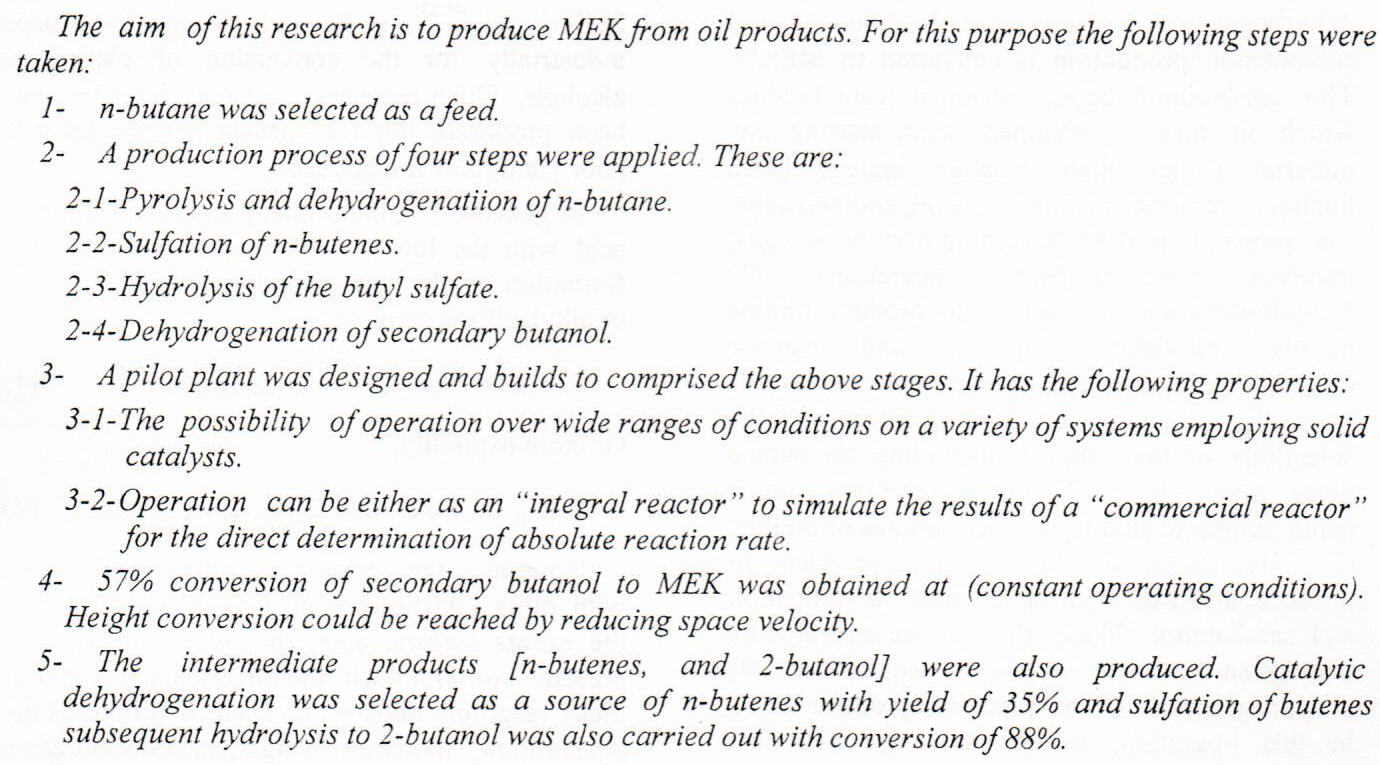
Production of Methyl Ethyl Ketone from N-Butane

Novel derivatives of 1-(´1, ´3, ´4, ´6-tetra benzoyl-β-D-fructofuranosyl)-1H- benzotriazole and 1-(´1, ´3, ´4, ´6-tetra benzoyl-β-D-fructofuranosyl)-1H- benzotriazole carrying Schiff bases moiety were synthesised and fully characterised. The protection of D- fructose using benzoyl chloride was synthesized, followed by nucleophilic addition/elimination between benzotria- zole and chloroacetyl chloride to give 1-(1- chloroacetyl)- 1H-benzotriazole. The next step was condensation reaction of protected fructose and 1-(1-chloroacetyl)-1H- benzotriazole producing a new nucleoside analogue. The novel nucleoside analogues underwent a second conden- sation reaction with different aromatic and aliphatic amines to provide new Schiff b
... Show MoreTo investigate the efficacy of polyether‐ether‐ketone (PEEK) wire as a fixed orthodontic retainer, by comparing its performance to other retainer wires and optimizing its adhesion to composite bonding materials.
Retainer wires of 15 mm segments were used, PEEK wires were prepared in cylindrical form with 0.8 mm diameter, and had two surface treatments namely air‐abrasion and conditioning with adhesive system. Three different metallic retainer wires were used for comparison and three tests were performed; two tests measured debonding force and associated wire deflec
 (23)
(23)
 (19)
(19)



A total of 37 Staphylococcus epidermidis isolates, isolated from corneal scraping of patients with bacterial keratitis and 20 isolates from healthy eyes (as control) (all isolates, isolated from, Ibn Al- Haietham eye hospital / Baghdad), were tested for slime production, 52.63% of all isolates were positive-slime production (23 isolates from patients and 7 isolates from controls). It was found that positive-slime producing S. epidermidis were exhibited a high resistance to antibiotics as compared to negative-slime producing isolates.
In this work the production of activated carbon (AC) from Imperata is done by microwave assisted Potassium hydroxide (KOH) activation and using this activated carbon for the purpose of the uptake of amoxicillin (AMX) by adsorption process from aqueous solution. The effects for irradiation power (450-800W), irradiation time (6-12min) as well as impregnation ratio (0.5-1 g/g) on the AMX uptake and yield AMX uptake at an initial concentration of AMX (150 mg/g). The optimum conditions were 700 W irradiation power, 10 min time of irradiation, as well as 0.8 g/g impregnation ratio with 14.821% yield and 12.456 mg/g AMX uptake. Total volume of hole and the area of the surface (BET) are 0.3027 m³/g, and 552.7638 m²/g respectively. The properti
... Show MoreIn this work ,medical zinc oxide was produced from zinc scraps instead of traditional method which used for medical applications such as skin diseases, Iraq is importing around 50 ton/year for samarra plant the producted powder has apartical size less than 5 micron and the purity was more than 99.98%,also apilot plant of yield capacitiy 15 kg/8hours wsa designed and manufactured .
(49)
(45)
This work was conducted to study the recovery of catalyst and desirable components from tar formed in phenol production unit and more particularly relates to such a method whereby better recovery of copper salts, phenol, benzoic acid and benzoate salts from tar by aqueous acid solution was accomplished.
The effect of solvent type, solvent concentration (5, 10, 15, 20, 25 and 30 wt%), agitation speed (100, 200, 300 and 400 rpm), agitation time (5, 10, 15, 20 and 25 min), temperature (90, 100, 110, 120, 130 and 140 oC) , phase ratio (1/1, 2/1, 3/1, 4/1 and 5/1) and number of extraction (1, 2, 3, 4, and 5) were examined in order to increase the catalyst and desirable components extraction.
Four types of solvent were used; hydrochloric
Siderophores are low molecular weight organic compounds produced by microorganisms growing under low iron concentration.In this study we describe the detection, production and extraction of siderophores secreted by Acinetobacter baumannii (Multiple-drug resistant ) pathogens. One hundered twenty Gram –negative non lactose fermenter bacilli isolates have been collected from three hospitals at Baghdad city over three months. Primary identification of these isolates is performed by standard diagnostic methods (biochemical tests and API 20 NE); 19 clinical isolates of A. baumannii are cultured on CHROMagar (highly selective medium for detection of MDR Acinetobacter) as well as diagnoses is documented by using Vitek 2 system. Isolates are exa
... Show More
(3)
(1)