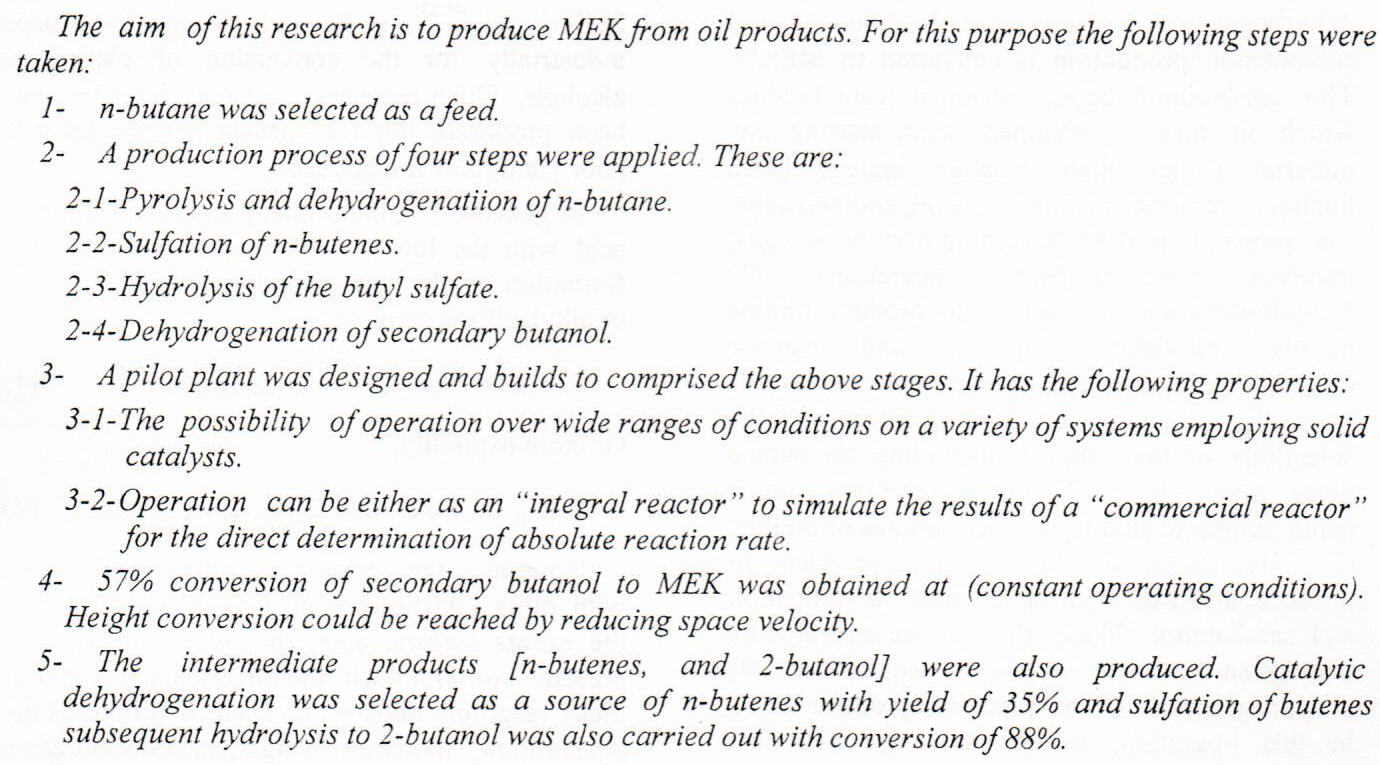
Production of Methyl Ethyl Ketone from N-Butane

Poly (3-hydroxybutyrate) (PHB) is a typical microbial bio-polyester reserve material; known as “green plastics”, which produced under controlled conditions as intracellular products of the secondary metabolism of diverse gram-negative/positive bacteria and various extremophiles archaea. Although PHB has properties allowing being very attractive, it is too expensive to compete with conventional and non-biodegradable plastics. Feasibility of this research to evaluate the suitability of using a watermelon-derived media as an alternative substrate for PHB synthesis under stress conditions was examined. Results, include the most nutrients extraction, indicated that the watermelon seeds contain a high content of nutrients makes them a promisi
... Show MoreThe effect of different antibiotics on growth pigment and plasmid curing of Serratia marcescens were studied, S. marcescens was cultured in media containing(16_500)µg/ml of antibiotics, curing mutants unable to produce prodigiosin and lost one plasmid band were obtained of of ampicillin, amoxillin, antibiotics concentrations (64 500) µg/ml metheprim, ultracloxam, azithromycin, cephalexin and erythromycin treated with (350 500) µg/ml of The mutant cells rose- light color and and refampicin revealed S.marcescens inhibited ciprodar and tetracyclin, lincomycin did not lost the plasmid band chlaforan
Infrared photoconductive detectors working in the far-infrared region and room temperature were fabricated. The detectors were fabricated using three types of carbon nanotubes (CNTs); MWCNTs, COOH-MWCNTs, and short-MWCNTs. The carbon nontubes suspension is deposited by dip coating and drop–casting techniques to prepare thin films of CNTs. These films were deposited on porous silicon (PSi) substrates of n-type Si. The I-V characteristics and the figures of merit of the fabricated detectors were measured at a forward bias voltage of 3 and 5 volts as well as at dark and under illumination by IR radiation from a CO2 laser of 10.6 μm wavelengths and power of 2.2 W. The responsivity and figures of merit of the photoconductive detector
... Show More (1)
(1)


Due to their recalcitrant characteristics, Azo dyes such as methyl orange (MO) are extremely poisonous substances, making their removal from textile industry wastewater a major problem. By employing various EC-Adsorption combined system configurations and reusing alum sludge as an adsorbent, the current study seeks to investigate the efficiency of these various systems in removing MO dye. To estimate their benefits and limitations, experiments were carried out utilizing nickel foam (NiF) and aluminum plate (Al plate) as anodes, and stainless-steel mesh (SS mesh) as cathode in the presence of alum sludge as an adsorbent in all systems. The EC-Adsorption combined system with NiF as anode and two SS meshes as cathodes with 10 g/L
... Show More
A new Schiff bases ligand 4- ((2-hyolroxy phenylimino) methyl) -2, 6-dimethoxyphenol derived from condensation of 2- amino phenol with 4-hydroxy -3, 5-dimethoxy benzaldehyde have been synthesized and characterized by spectroscopy, spectra, Mass spectrum and elemental microanalysis (C.H.N). Metal Complexes with ions have been also synthesized and characterized spectroscopic methods spectroscopy, flame atomic absorption, molar conductivity measurements and magnetic susceptibility. These studies indicate that the moler ratio for the complexes. The complexes showed characteristics octahedral geometry with the (O,N) ligand coordinated in bidentate mode while with showed square planer. The enzyme activity of the ligand and i
... Show More
Herein, date palm (Phoenix dactylifera) bunch (DPB) waste was transformed into activated carbon (DPAC) adsorbent by using microwaveinduced ZnCl2 activation for 15 min at a power of 600 W. Several analytical methods were used to explain the physicochemical parameters of DPBAC including XRD, pHpzc, BET, SEM–EDX, and FTIR. Afterwards, the adsorptive performance of DPBAC was thoroughly investigated for the removal of two structurally different organic dyes namely methyl violet (MV) and fuchsin basic (FB). The key adsorption parameters, including the dose of DPBAC (A: 0.02–0.06 g), the solution pH (B: 4–10), and the contact time (C: 2–20 min) were statistically optimized using the Box-Behnken design with response surface methodology (RSM
... Show More (3)
(2)
(3)
(2)
 (5)
(3)
(5)
(3)
This work introduces the synthesis and the characterization of N-doped TiO2 and Co3O4 thin films prepared via DC reactive magnetron sputtering technique. N-doped TiO2 thin films was deposited on indium-tin oxide (ITO) conducting substrate at different nitrogen ratios, then the Co3O4 thin film was deposited onto the N-doped TiO2 layer to synthesize a double-layer TiO2-N/Co3O4 Photoelectrochromic device. Several techniques were used to characterize the produces which are x-ray diffraction (XRD), field emission-scanning electron microscopy (FE-SEM), Fourier-transform infrared (FTIR) spectroscopy and UV–Vis spectroscopy. The Photoelectrochromic device was characterized by UV–Vis spectroscopy and the results show that the double-layer N-dope
... Show More
(3)
(3)
Azo derivative ligand[H3L] have been synthesized by the reaction of diazonium salt of p-amino benzoic acid with orcinol in(1:1)mole ratio. The bidente ligand was reacted with the metal ions MnII,FeIIandCrIIIin(2:1)mole ratio via reflux in ethanol using Et3N as a base to give complexes of the general formula: [ M(H2L)2(H2O)x]Cly The synthesized compounds were characterized by spectroscopic methods[ I.R , UV-Vis, A.A and H1 NMR]along with melting point, chloride content and conductivity measurements. The complexes were screend for their in vitro antibacterial activity against one strain of staphylococcus as Gram(+) positive and one strain of pseudomonas as Gram(-) Negative, using the agar diffusion technique.
The δ-mixing of γ-transitions in 70As populated in the 32 70 70 33 Ge p n As (, ) γ reaction is calculated in the present work by using the a2-ratio methods. In one work we applied this method for two cases, the first one is for pure transition and the sacend one is for non pure transition, We take into account the experimental a2-coefficient for previous works and δ -values for one transition only.The results obtained are, in general, in a good agreement within associated errors, with those reported previously , the discrepancies that occur are due to inaccuracies existing in the experimental data of the previous works.