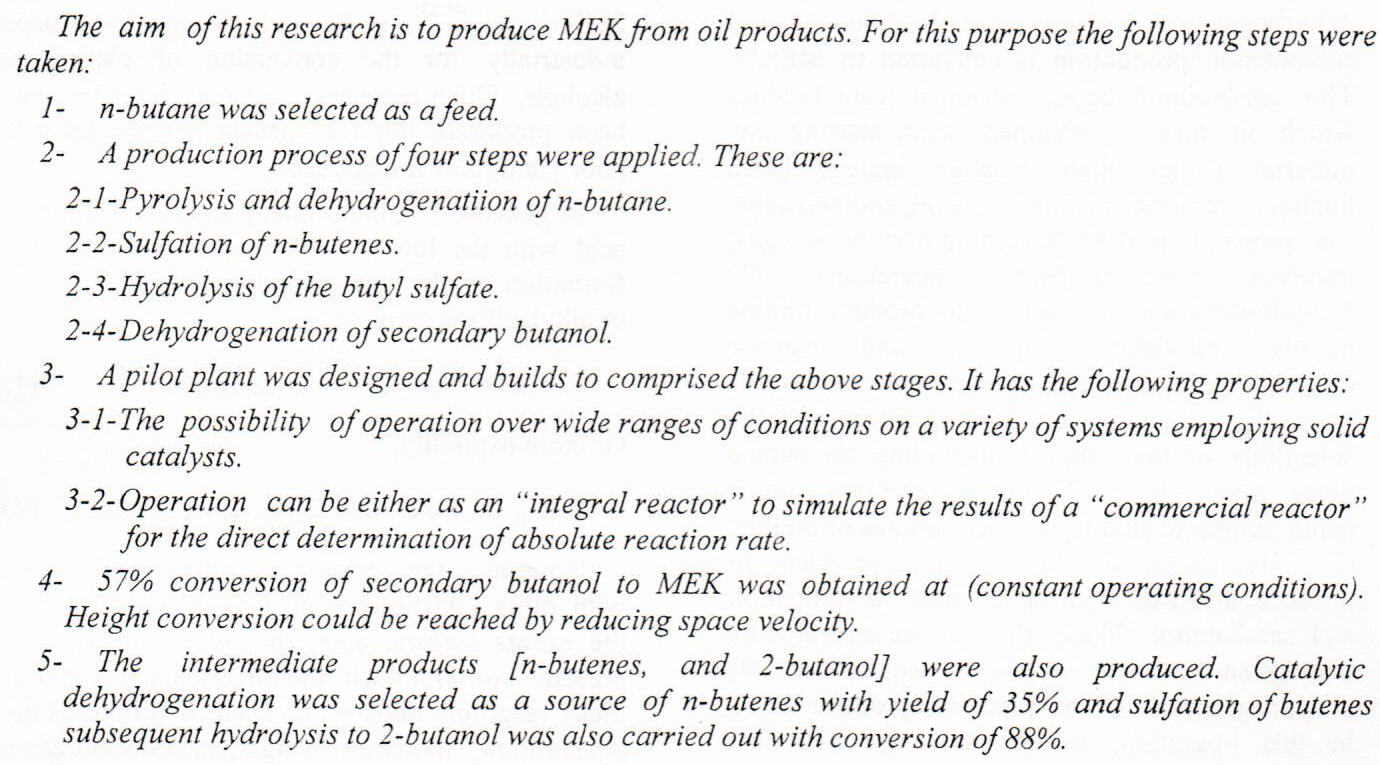
Production of Methyl Ethyl Ketone from N-Butane

In the present work, heterojunction diode detectors will be prepared using germanium wafers as a substrate material and 200 nm tin sulfide thickness will be evaporated by using thermal evaporation method as thin film on the substrate. Nd:YAG laser (λ=532 nm) with different energy densities (5.66 J/cm2 and 11.32 J/cm2) is used to diffuse the SnS inside the surface of the germanium samples with 10 laser shots in different environments (vacuum and distilled water). I-V characteristics in the dark illumination, C-V characteristics, transmission measurements, spectral responsivity and quantum efficiency were investigated at 300K. The C-V measurements have shown that the heterojunction were of abrupt type and the maximum value of build-in pot
... Show More (3)
(3)
 (3)
(3)



A series of new 4-(((4-(5-(Aryl)-1,3,4-oxadiazol-2-yl)benzyl)oxy)methyl)-2,6-dimethoxy phenol (6a-i) were synthesized from cyclization of 4-(((4-hydroxy-3,5-dimethoxy benzyl)oxy)methyl)benzohydrazide with substituted carboxylic acid in the presences of phosphorusoxy chloride.The resulting compounds were characterized by IR, 1H-NMR, 13C-NMR, and HRMS data. 2,2-Diphenyl-1-picrylhydrazide (DPPH) and ferric reducing antioxidant power (FRAP) assays were used to screen their antioxidant properties. Compounds 6i and 6h exhibited significant antioxidant ability in both assay. Furthermore, type of substituent and their position of the aryl attached 1,3,4-oxadiazole ring at position five are play an important roles in enhancing or declining the antio
... Show More
(6)
(1)
A new method for construction ion-selective electrode (ISE) by heating reaction of methyl orange with ammonium reineckate using PVC as plasticizer for determination methyl orange and determination Amitriptyline Hydrochloried drug by formation ion-pair on electrode surface . The characteristics of the electrode and it response as following : internal solution 10-4M , pH (2.5-5) ,temperature (20-30) and response time 2 sec. Calibration response for methyl orange over the concentrationrange 10-3 -10-9 M with R=0.9989 , RSD%=0.1052, D.O.L=0.315X10⁻⁹ MEre%=(-0.877- -2.76) , Rec%.=(97.230 -101.711) .
Azo dyes like methyl orange (MO) are very toxic components due to their recalcitrant properties which makes their removal from wastewater of textile industries a significant issue. The present study aimed to study their removal by utilizing aluminum and Ni foam (NiF) as anodes besides Fe foam electrodes as cathodes in an electrocoagulation (EC) system. Primary experiments were conducted using two Al anodes, two NiF anodes, or Al-NiF anodes to predict their advantages and drawbacks. It was concluded that the Al-NiF anodes were very effective in removing MO dye without long time of treatment or Ni leaching at in the case of adopting the Al-Al or NiF-NiF anodes, respectively. The structure and surface morphology of the NiF electrode were inves
... Show More
(2)
(7)
(8)
This study focused on the improvement of the quality of gasoline and enhancing its octane number by the reduction of n-paraffins using zeolite 5A. This study was made using batch and continuous mode. The parameters which affected the n-paraffin removal efficiency for each mode were studied. Temperature (30 and 40 ˚C) and mixing time up to 120 min for different amounts of zeolite ranging (10-60 g) were investigated in a batch mode. A maximum removal efficiency of 64% was obtained using 60 g of zeolite at 30 ˚C after a mixing time 120 min. The effect of feed flow rate (0.3-0.8 l/hr) and bed height (10-20 cm) were also studied in a continuous mode. The equilibrium isotherm study was made using different amounts of zeolite (2-20 g) and the
... Show More
(7)
This research includes synthesis of new heterocyclic derivatives of N-benzyl-5-bromoisatin. New 1, 2, 4-triazole, oxazoline and thiazoline derivatives of [N-benzyl-5-bromo-3-(Ethyliminoacetate)-indole-2-one] (2) have been synthesized. The preparation process started by the reaction of 5-bromoisatin with sodium hydride in dimethylformamide (DMF) at 0°C, gave suspension of sodium salt of 5-bromoisatin and subsequent reaction with benzylchloride to give N-benzyl-5-bromoisatin (1). Compound (1) reacted with ethylglycinate (Schiff base) obtained the intermediate compound (2) which reacted with different reagents in two ways. The first way, compound (2) reacted with (hydrazine hydrate, semicarbazide, phenylsemicarbazide and thiosemicarbazide)
... Show MoreTitanium dioxide nanorods have been prepared by sol-gel template
method. The structural and surface morphology of the TiO2 nanorods was
investigated by X-ray diffraction (XRD) and atomic force microscopy
(AFM), it was found that the nanorods produced were anatase TiO2 phase.
The photocatalytic activity of the TiO2 nanorods was evaluated by the
photo degradation of methyl orange (MO). The relatively higher
degradation efficiency for MO (D%=78.2) was obtained after 6h of exposed
to UV irradiation.
(1)