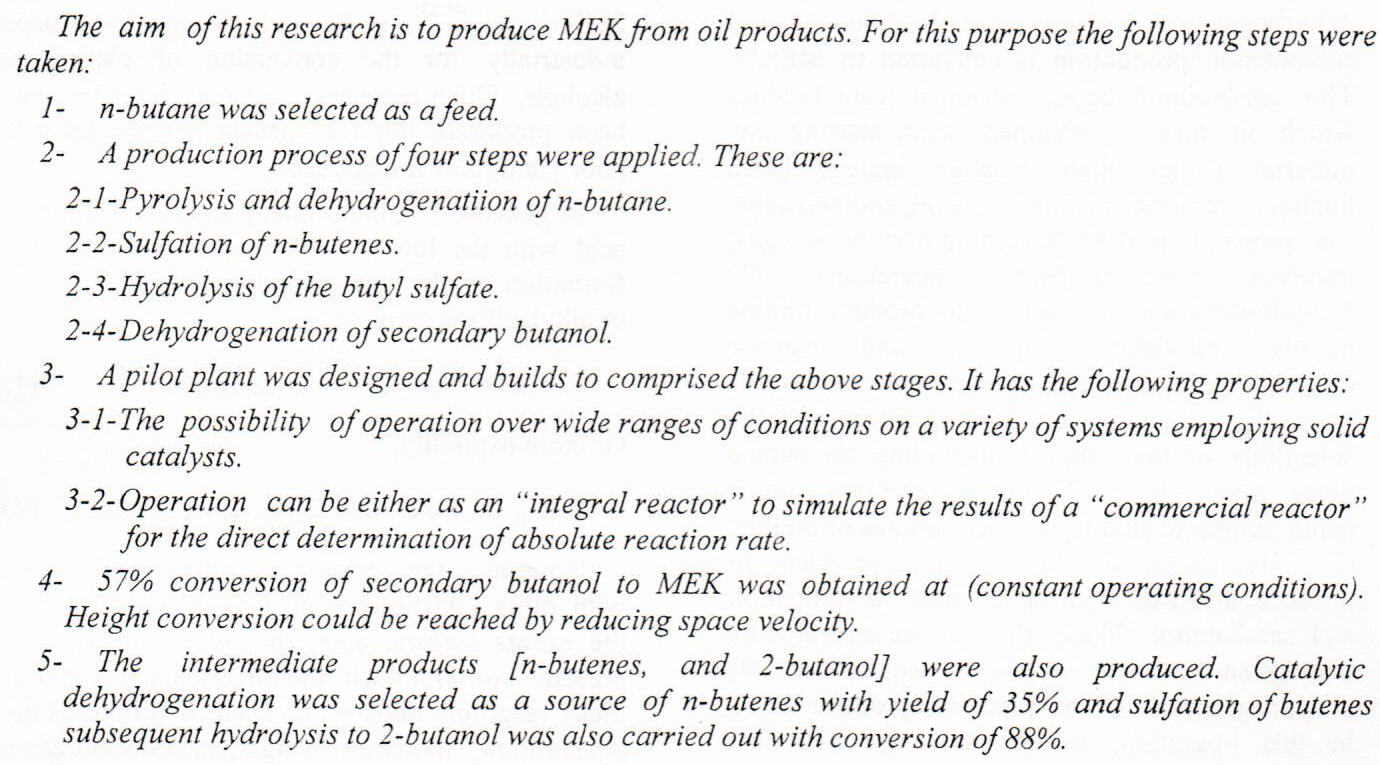
Production of Methyl Ethyl Ketone from N-Butane

Sludge from stone-cutting (SSC) factories and stone mines cannot be used as decorative stones, stone powder, etc. These substances are left in the environment and cause environmental problems. This study aim is to produce artificial stone composite (ASC) using sludge from stone cutting factories, cement, unsaturated resin, water, silicon carbide nanoparticles (SiC-NPs), and nano-graphene oxide (NGO) as fillers. Nano graphene oxide has a hydrophobic plate structure that water is not absorbed due to the lack of surface tension on these plates. NGO has a significant effect on the properties of artificial stone due to its high specific surface area and low density in the composite. Its uniform distribution in ASC is very low due to its hydropho
... Show More (5)
(5)
 (4)
(4)



Objective (s): To assess the QoL of children age from (8- lessthan13) years with acute lymphocytic leukemia undergoing chemotherapy and to find out the relationship between the QoL of children with acute lymphocytic leukemia and their illness history.
Methodology: A descriptive study included (40) children with acute lymphocytic leukemia who were ranged between (8 - less than 13 years) at the Hematology Center in Medical City for the period from 4th March 2021 to 1st September 2021. The sample was non-probability (purposive) sample of children (male and female). A questionnaire designed with 2 main parts was used. The first part focused on sociodemographic characterist
... Show MorePolyethersulfone (PES) ultrafiltration membrane blending NaX zeolite crystals as a hydrophilic additive was examined for zinc (II) and lead ions Pb (II) removal from aqueous solutions. The effect of NaX zeolite content on the permeation flux and removal efficiency was studied. The results showed that adding zeolite to the polymer matrix enhanced the permeation flux. The permeation flux of all the zeolite/PES matrix membranes was higher than the pristine membrane. No significant improvement was observed in the removal of Zn (II) ions using all prepared membranes as the removal percentage did not raise above 29.2%. However, the removal percentage of Pb (II) ions was enhanced to 97% using a membrane containing 0.9%wt. zeolite. Also, it was
... Show More
(7)
Background: The skin functions as a barrier to the external environment, damage to this barrier following a burn disrupts the innate immune system and increases susceptibility to bacterial infection. Objective: This study was carried out to determine the bacterial isolates and study their antimicrobial susceptibility in burned wound infections at one burn's hospital in Baghdad.Type of study:Cross-sectional study.Methods: The bacteria were identified at species level by using Analytic Profile Index (API) system and The antimicrobial susceptibility test was performed according to Kirby-Bauer (disk diffusion) technique.Results: Over a period of one year (from October 2014 to October 2015). Out of 848 patients with different degrees of burns
... Show More
(8)
(6)
New series of imidazole[1,2-a]pyridine-sulfonamides was designed and synthesized from 2-aminopyridine, which was reacted with p-bromo phenacyl bromide in the present of MgO to produce the corresponding imidazole[1,2-a]pyridine, which was then reacted with chlorosulfonic acid to produce 2-(4-bromophenyl)imidazole[1,2-a]pyridine-3-sulfonyl chloride [2]. Following that, treatment of (2) with different amines using the grand method to generate imidazole [1,2-a] pyridine sulfonamides. All the synthesized compounds have been characterized by FTIR, 1HNMR and 13CNMR and C.H.N analysis. The DFT, POM analysis and molecular docking were carried out on for all final compounds to investigate drug like attributes, and the results revealed showed that the
... Show More
(10)
(20)
(16)
(20)
(16)
(9)
(9)
The aim of the work is synthesis and characterization of bidentate ligand [dipotassium sodium7-((E)-2-(2-((Z)-1-carboxylatoethylideneamino)thiazol-4-yl)-2 (carboxylatemethoxyimino) acet amido)-8-oxo-3-vinyl-5- thia-1-azabicyclo[4.2.0] oct-2- ene-2- carboxylate] [Nak2L], from the reaction of cefixime with sodium pyruvet to produce the ligand [Nak2L], the reaction was carried out in methanol as a solvent under reflux. The prepared ligand [Nak2L] which was characterized by FT-IR, UV-Vis spectroscopy, 1H, 13C-NMR spectra, Mass spectra, (C.H.N) and melting point. The mixed ligand complexes were prepared from ligand [Nak2L] was used as a primary ligand while 8-hydroxy quinoline [Q] was used as a secondary ligand with metal ion M(?).Where M(?) =
... Show More
(2)