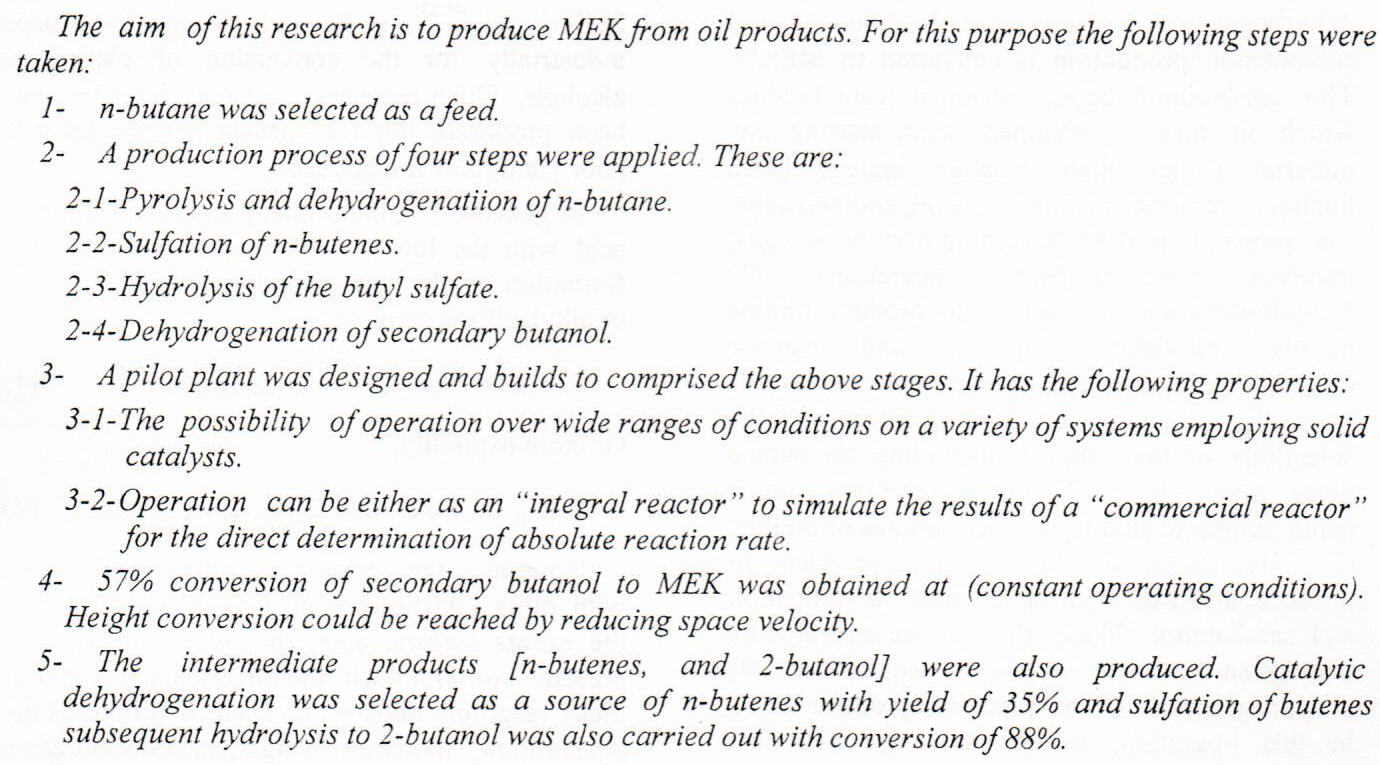
Production of Methyl Ethyl Ketone from N-Butane

 (5)
(5)
 (3)
(3)



In this work, lanthanium (III) complexes were synthesized using by Schiff base ligand (L) derived from benzaldehyde and o-aminoaniline with five amino acids (AA) from glycine (Gly), L-alanine (Ala), L-valine (Val), L-asparagine (Asp) and DL- phenylalanine (Phe). The Schiff base ligand has been characterized by elemental analysis, (MASS, FTIR, 1HNMR, 13CNMR, UV-VIS) electronic spectra. The structures of the new complexes have been described of analysis of elements, molar conductivity, (UV-Vis electronic, FTIR, mass) spectra also magnetic moment. The molar conductivity values of the complexes indicat this every of complexes are electrolytes and other analytical studies reveal octahedral geometry for La (III) ion. The Schiff base ligand, five
... Show MoreChukar partridge Alectoris chukar (Gray, 1830) is the only species of the 46 species of the genus Alectoris to be found in Iraq. At least there are fourteen subspecies of chukar were described from east Europe, the Middle East and west Asia, two of them were known to be found in Iraq, A.c. Kurdestanica (Meinertzhagen, 1923) from Alpine bio-geographical zone of altitude more than 2000m high, and A.c. werae Zarundny and Loudon, 1904, from the foothills of altitude not more than 400m. In between these two regions, there is another bio-geographical region known as the Irano-toranian zone 400-2000m high. Using morphological, ecological, behavioural, reproduction and hybridization criteria this study discove
... Show MoreThis study aimed to reveal the degree possession of secondary teachers for effective teaching skills from the perspective of the teachers themselves in the Mafraq governorate .To achieve the objective of the study(45) teachers were chosen randomly, also a questionnaire composed of 17 was prepared spread over three skill areas (planning, implementation, evaluation).
After application of the tool on the sample results of the study showed that the degree of ownership ranged between medium and high.
The results showed no differences in the degree of ownership due to the variables of sex in favor of females and variable qualification for the benefit of people with qualified Master higher, while differences are attributed to the experien
Background: Insufficient sleep due to excessive media use is linked to decrease physical activity, poor nutrition, obesity, and decreased overall health-related quality of life.
Objectives: To assess the effect of using the internet and social media on the sleep of 4th-stage secondary school students.
Subjects and Methods: Cross-sectional study with the analytic element; for 500 secondary school students, obtained by choosing two schools randomly from each of the six educational directorates, by using a structured questionnaire.
Result: Secondary scho
... Show More
(4)
(2)
|
Background: Repeated blood transfusion is the main therapeutic option for transfusion-dependent anaemias with consequent iron overload and organ damage .Therefore iron chelating agents are important protective measures for these patients. The aim of this study was to investigate the efficiency and safety of Desferroxamine in paediatrics population subjected to iron overload as a consequence of repeated transfusion in a group of Sudanese children Subjects & Methods: This was a descriptive cross-sectional hospital based study. Conducted in two main paediatric reference hospitals in, Su |
(1)
The research work was conducted to investigate the effect of oral administration of aqueous extract of turmeric at doses of (5, 10) mg/kg body weight for two weeks daily by determining the genotoxic effect (mitotic index), evaluation of immunological effect (IgG, IgM, IgA, C3, C4) and measuring fertility hormones (follicles stimulation hormone/FSH, lutenising hormone/LH) levels with histological examinations of female albino swiss mice ovaries in comparison with control (normal saline). A clear effect in increasing mitotic activity was reveled for both doses in comparison with control. Results also showed a significant increase in the value of all immunological parameters at both doses, in comparison with control. Also, obvious raise was se
... Show MoreThe present study introduced a new description of the last larval instar of the oak tree borer, Latipalpis johanidesi Niehuis, 2002 (Coleoptera, Buprestidae). The larval specimens were collected from the oak trees within the mountainous areas, Erbil governorate, Iraqi Kurdistan Region, during the beginning of April till the end of May 2019.
Schematic sketches were provided to illustrate unclear morphological features, and the results presented importance morphological evidence for confirming the identification of this species in the larval stage precisely.
(2)
(2)
Escherichia coli has been recognized worldwide as the most common causative agent for severe infections of the urinary tract. Colibactin is a genotoxin produced through a gene cluster called polyketide synthase (pks) island by members of Enterobacteriaceae. Limited information is available about the frequency of colibactin in E. coli isolates in Iraq. Hence, this study aimed to examine the frequency of some colibactin genes (CIbA and CIbQ) in clinical isolates of E. coli obtained from urinary tract infections (UTIs) in Iraq. Between October 2023 and January 2024, 120 urine samples were collected from females diagnosed with UTIs in Iraqi hospitals. 70 E. coli isolates were isolated after identification by biochemical methods and confirmed by
... Show MoreThis study investigates the stomach morphology and histochemistry of Clarias gariepinus. Grossly, the stomach is a J-shaped organ with three distinct regions: cardiac, fundic, and pyloric. Histologically, its wall comprises four layers: mucosa, submucosa, muscularis externa, and serosa. The mucosa exhibits broad longitudinal folds lined by high columnar cells with basal oval nuclei. These cells contain apical mucosubstances that react positively with Periodic Acid Schiff (PAS) stain and negatively with Alcian Blue (AB). Gastric pits result from mucosal invaginations. Glands are present in the fundic and cardiac regions but absent in the pyloric. Oxynticopeptic cells exclusively line the fundic glands. Enteroendocrine cells are distr
... Show More