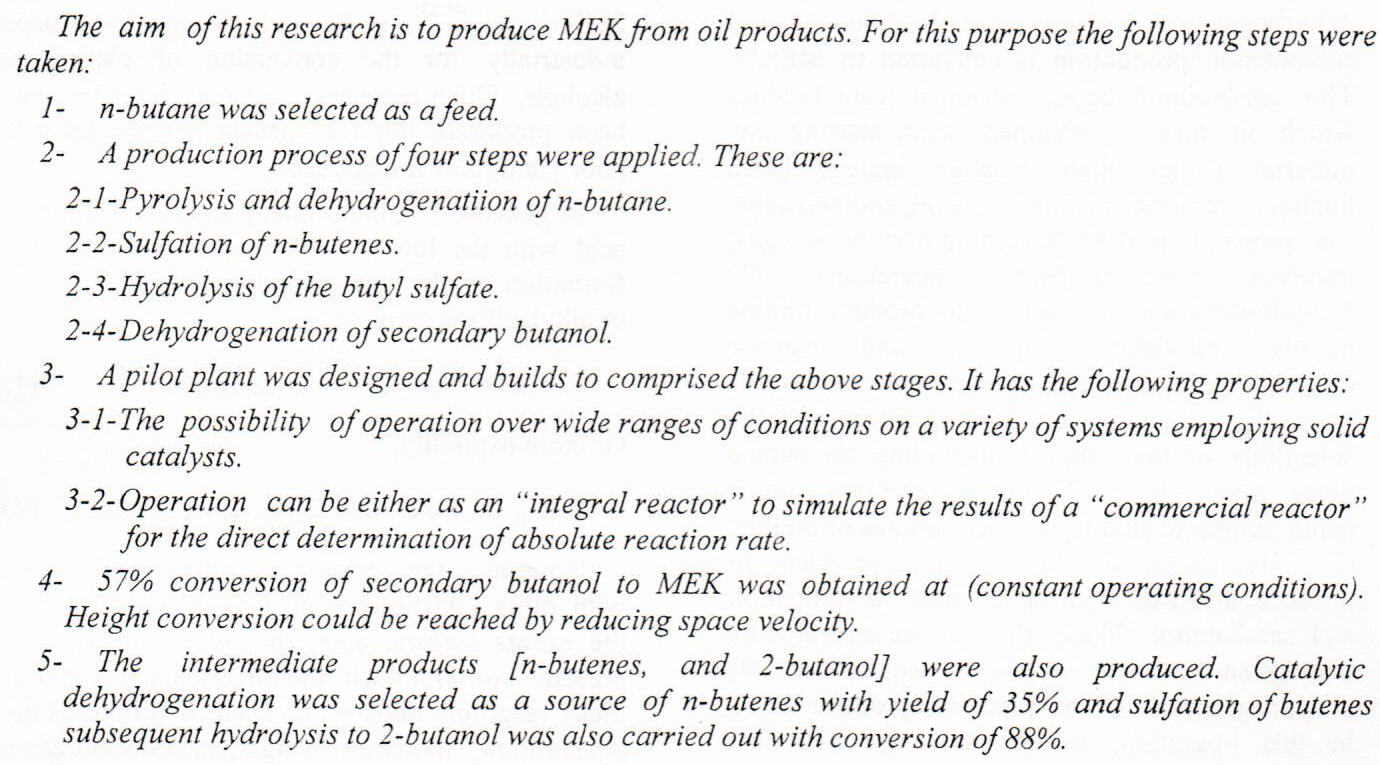
Production of Methyl Ethyl Ketone from N-Butane

A single specimen of the African catfish, Clarias gariepinus, was recorded for the first time in Baghdad, Iraq. The specimen was caught during a fish survey to document some local species in northern Baghdad (Al-Rusafa) on March 21, 2023. The total length of the specimen was 43 cm, and its weight was 590 grams. Some biometric measurements of the specimen were studied and found to be consistent with the general characteristics of the African catfish Clarias gariepinus (Burchell, 1822). It is possible that the fish entered Iraqi inland waters, specifically from the Euphrates River via Syria or from the Tigris River via Turkey.

Uropathogenic E. coli (UPEC) is problematic and still the leading cause of urinary tract infections worldwide. It is developed resistance against most antibiotics. The investigation, surveillance system, and efficient strategy will facilitate selecting an appropriate treatment that could control the bacterial distribution. The present study aims to investigate the epidemiology and associated risk factors of uropathogenic E. coli and to study their antibiotic resistance patterns. 1585 midstream urine specimens were collected from symptomatic urinary tract infections (UTI) patients (225 males and 1360 females) admitted to Zakho emergency hospital, Zakho, Kurdistan Region, Iraq from January 2016 until the end of December 2
... Show More (28)
(28)
 (11)
(11)


Inthis study new derivatives of Schiff bases and nucleoside analogues have been synthesized from the starting material D-glucose after a series of reactions. Derivative 1 was prepared from D-glucose then react with P-bromoacetophenone gave derivative 2 was reacted with dimethyl sulfoxide and acetic anhydride for dehydration a molecule of water gave 3. The spiro ring was prepared at 3-position from the reaction of 3 derivative with 1-phenyl-2–thioureagave 4. The protection group at 1 position was removed by using acetic acid fllowed by periodate oxidation to obtain 6. Reaction of 6 with hydrazide derivative at once and dtriazole derivative at another gave 8 and 9 respectively. Compound 6 was reduced to gave derivative 7. The 1-hydroxylgrou
... Show MoreFive novel nickel, iron, cobalt, copper, and mercury complexes were synthesized from tetraazamacrocyclic Schiff base ligand (L), which were derived from 3-(4-(dimethyl amino) benzylidene) pentane-2,4-dione and 1,2- diaminocyclohexane in a 2:2 molar ratio. Many physico-chemical and spectroscopic techniques, including melting point, 1HNMR, 13CNMR, elemental analysis, molar conductance, magnetic susceptibility, UV-Vis, FT-IR, and thermogravimetric analysis (TGA), were used to characterize the Schiff base ligand and all metal complexes. The octahedral geometry of all the complexes [MLCl2] is confirmed by spectroscopic analyses. All substances' biological properties, such as their in vitro antioxidant activity or level of free radical scavenging
... Show MoreTanqua anomala (von Linstow,1904) specimens were recovered, from the lining wall of the gastro-intestinal tract of the dice snake Natrix tessellate tessellate (Laurenti, 1768) collected in Baghdad city, central Iraq. Measurements of the males, females and a comparison of the nematode with other studies tabulated. Reporting of Tanqua anomala from this snake represents the first record for Iraq as well as a new host record.
Background: Background : Patients with non-rheumatic atrial fibrillation have high risk of thromboembolism especially ischemic stroke usually arising from left atrial appendage .Transoesophageal echocardiography provides useful information for risk stratification in these patients as it detects thrombus in the left atrial or left atrial appendage. Objective : This study was conducted at Al-Kadhimiya Teaching Hospital to assess the prevalence of left atrial chamber thrombi in patients with chronic non-rheumatic atrial fibrillation using transoesophageal echocardiography and its clinical significance as well as to verify the superiority of transoesophageal over transthoracic echocardiography in the detection of these abnormalities. Type of
... Show MoreDate stones were used as precursor for the preparation of activated carbons by chemical
activation with ferric chloride and zinc chloride. The effects of operating conditions represented
by the activation time, activation temperature, and impregnation ratio on the yield and adsorption
capacity towards methylene blue (MB) of prepared activated carbon by ferric chloride activation
(FAC) and zinc chloride activation (ZAC) were studied. For FAC, an optimum conditions of 1.25
h activation time, 700 °C activation temperature, and 1.5 impregnation ratio gave 185.15 mg/g
MB uptake and 47.08 % yield, while for ZAC, 240.77 mg/g MB uptake and 40.46 % yield were
obtained at the optimum conditions of 1.25 h activation time, 500
(7)
(6)
(4)
Out of 150 clinical samples, 50 isolates of Klebsiella pneumoniae were identified according to morphological and biochemical properties. These isolates were collected from different clinical samples, including 15 (30%) urine, 12 (24%) blood, 9 (18%) sputum, 9 (18%) wound, and 5 (10%) burn. The minimum inhibitory concentrations (MICs) assay revealed that 25 (50%) of isolates were resistant to gentamicin (≥16µg/ml), 22 (44%) of isolates were resistant to amikacin (≥64 µg/ml), 21 (42%) of isolates were resistant to ertapenem (≥8 µg/ml), 18 (36%) of isolates were resistant to imipenem (4- ≥16µg/ml), 43 (86%) of isolates were resistant to ceftriaxone (4- ≥64 µg/ml), 42 (84%) of isolates were resistant to ceftazidime (1
... Show More
(4)