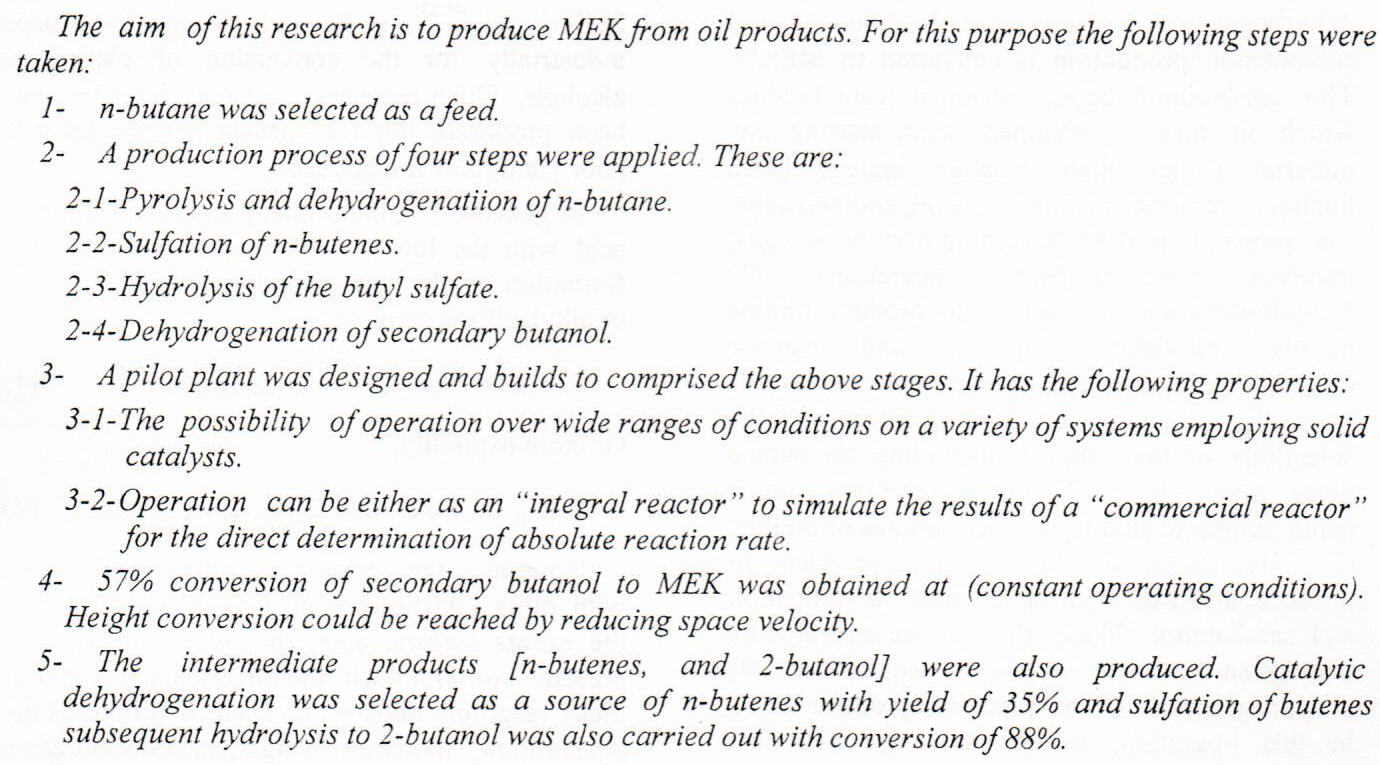
Production of Methyl Ethyl Ketone from N-Butane

New data on jumping spiders (Salticidae) and tangle-web spiders (Theridiidae) of Armenia are provided on the basis of recently collected specimens in various regions of Armenia. One species, Ballus rufipes (Simon, 1868) is recorded as new to the Caucasus Region, in addition to the following species: Neon reticulatus (Blackwall, 1853), Pellenes brevis (Simon, 1868), Salticus scenicus (Clerck, 1757) and Synageles dalmaticus (Keyserling, 1863) that belong to a family Salticidae, are recorded in Armenia for the first time.
A further 7 species of Theridiidae are recorded in Armenia for the first time Kochiura aulica (C. L. Koch, 1838), Steatoda albomaculata (De Geer, 1778), Steatoda bipunctata (Linnaeus, 1758), Steatoda castanea Clerk, 175
 (3)
(3)
 (3)
(3)


Enhancing quality image fusion was proposed using new algorithms in auto-focus image fusion. The first algorithm is based on determining the standard deviation to combine two images. The second algorithm concentrates on the contrast at edge points and correlation method as the criteria parameter for the resulted image quality. This algorithm considers three blocks with different sizes at the homogenous region and moves it 10 pixels within the same homogenous region. These blocks examine the statistical properties of the block and decide automatically the next step. The resulted combined image is better in the contras
... Show More
(9)
(3)

Dengke Naniura is a traditional food from Sumatera Utara, Indonesia, that is produced through fermenting process, and this food is believed to contain high probiotics. The objective of the current research is to determine the potential of LAB as a probiotic that has been obtained from Dengke Naniura. Dengke Naniura was traditionally prepared from Cyprinus carpio. Four LABs have been successfully isolated from Dengke Naniura, such as D7DA3, D7B3, D7DBF and D7DN3. Those four LAB isolates were identified as Lactobacillus sp. This result has been confirmed by the non-spore forming bacterium, non-motile, and Gram-positive. Also, it has been supported by biochemical test, for the example Voges Proskauer, catalase test, Methyl
... Show More
(10)
(4)
(6)
(5)
Background: The COVID-19 infection is a more recent pandemic disease all over the world and studying the pulmonary findings on survivors of this disease has lately commenced.
Objective: We aimed to estimate the cumulative percentage of whole radiological resolution after 3 months from recovery and to define the residual chest CT findings and exploring the relevant affecting factors.
Subjects and Methods: Patients who had been previously diagnosed with COVID-19 pneumonia confirmed by RT-PCR test and had radiological evidence of pulmonary involvement by Chest CT during the acute illness were included in the present study. The radiol
... Show More
(4)
The study aimed to determine the impact of energy for the north and south magnetic poles on the the growth of bacteria isolated from cases of tooth decay, 68 swabs were collected from surfaces of faulty tooth, the detected of Staphylococcus aureus
... Show MoreEducation specialists have differed about determining the best ways to detect the
talented. Since the appearance of the mental and psychological measurement movement, some
scholars adopted intelligence ratios as a criterion to identify the talented and others went to
rely on the degree of academic achievement. Each of these two methods has its own flaws and
mistakes and a large number of talented children were victims of these two methods.
Therefore the need to use other scales for the purpose of detection of talented children
appeared because they provide valuable information which may not be obtained easily
through objective tests and these scales are derived from consecutive studies of gifted andtalented children
(11)
(4)
New schiff bases series (VIII) a-e and 1,3-thiazolidin-4-one derivatives (IX) a-e containing the 1,2,4-triazole and 1,3,4-thiazazole rings were synthesized and screening their biological activities. These compounds were identified via Fourier transform infrared (FT-IR) spectra, some via Proton nuclear magnetic resonance (1H-NMR) and mass spectra. The biological results indicated that all of these compounds did not reveal antibacterial effectiveness against (Escherichia coli and Klebsiella species) (G-). Some of these compounds showed moderate antibacterial activity against (Staphylococcus aureus, and Staphylococcus epidermidis) (G+), and all compounds exhibited moderate activity against Candida albicans.
(1)