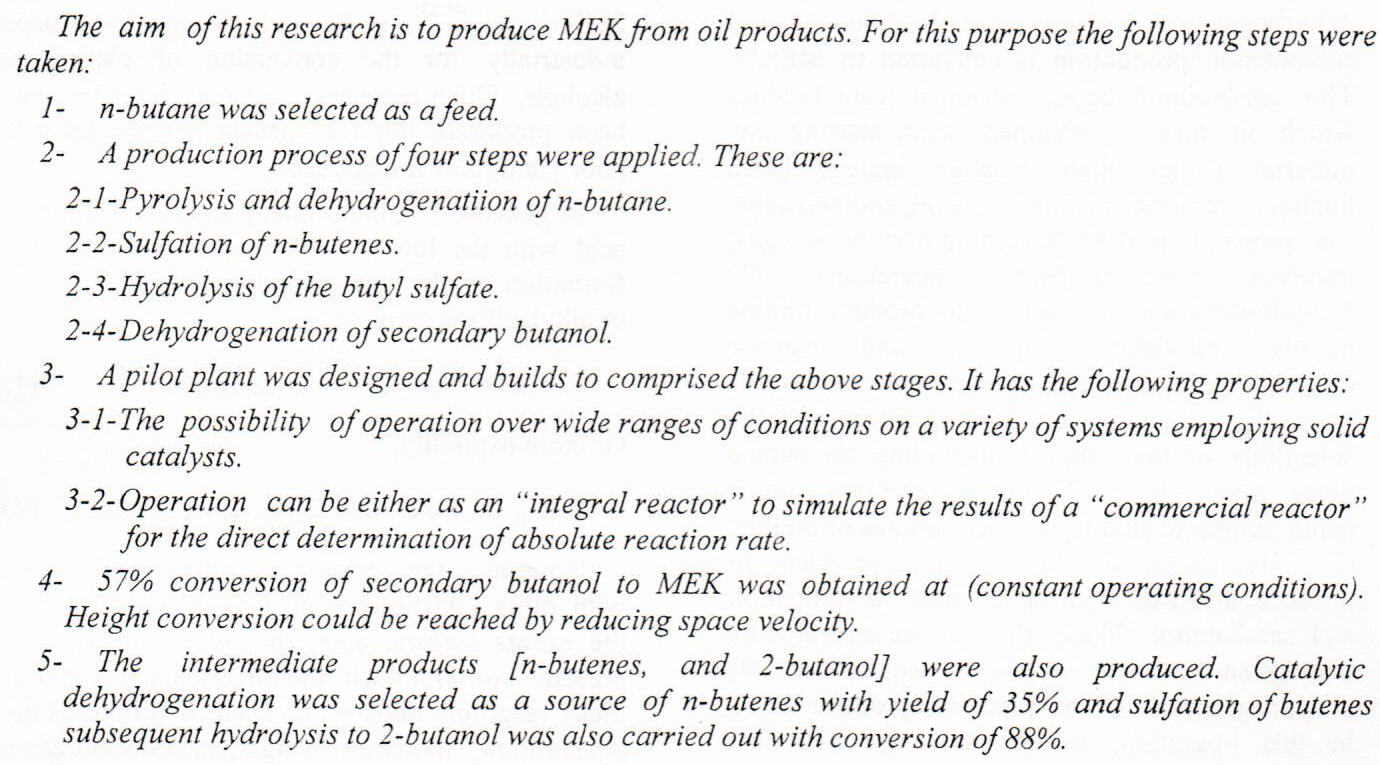
Production of Methyl Ethyl Ketone from N-Butane

The present work aimed to study the efficiency of nanofiltration (NF) and reverse osmosis (RO) process for treatment of heavy metals wastewater contains zinc. In this research, the salt of heavy metals were zinc chloride (ZnCl2) used as feed solution.Nanofiltration and reverse osmosis membranes are made from polyamide as spiral wound module. The parameters studied were: operating time (0 – 70 min), feed concentrations for zinc ions (10 – 300 mg/l), operating pressure (1 – 4 bar).The theoretical results showed, flux of water through membrane decline from 19 to 10.85 LMH with time. Flux decrease from 25.84 to 10.88 LMH with the increment of feed concentration. The raise of pressure, the flux increase for NF and RO membranes.The maximum
... Show MoreThis research was aimed to the purification and characterization of cytosine deaminase as a medically important enzyme from locally isolated Escherichia coli; then studying its cytotoxic anticancer effects against colon cancer cell line. Cytosine deaminase was subjected to three purification steps including precipitation with 90% ammonium sulfate saturation, ion exchange chromatography on DEAE-cellulose column, and gel filtration chromatography throughout Sephadex G-200 column. Specific activity of the purified enzyme was increased up to 9 U/mg with 12.85 folds of purification and 30.85% enzyme recovery. Characterization study of purified enzyme revealed that the molecular weight of cytosine deaminase produced by E. coli was about 48 KDa,
... Show More (4)
(4)
 (2)
(2)



This work deals with thermal cracking of heavy vacuum gas oil which produced from the top of vacuum distillation unit at Al- DURA refinery, by continuous process. An experimental laboratory plant scale was constructed in laboratories of chemical engineering department, Al-Nahrain University and Baghdad University. The thermal cracking process was carried out at temperature ranges between 460-560oC and atmospheric pressure with liquid hourly space velocity (LHSV) equal to 15hr-1.The liquid product from thermal cracking unit was distilled by atmospheric distillation device according to ASTM D-86 in order to achieve two fractions, below 220oC as a gasoline fraction and above 220oC as light cycle o
... Show More
solation of candida spp. From cancer patients who suffered oral candidiasis due to immunodeficiency
(2)
An experiment was conducted in a greenhouse - research station B - College of Agricultural Engineering Sciences, University of Baghdad, during the fall season of 2018 with the aim of propagating and initially studying the field performance of 18 and 20 potential potato lines derived from Rivera and Arizona cv. after in vitro exposure of nodal segments to different dosages of gamma rays (0, 10, 20, and 30 Gray) and EMS (0, 10, 20, and 30 mM). Each control cultivar and their derived lines were independently cultured in plastic bags according to the RCBD, with three replications. The results showed that the highest plant height and number of leaves were obtained from Arizona derived lines which gave 60.11 cm and 25.30 leaves.plant-1 in
... Show More
(9)
(2)
The δ-mixing ratios have been calculated for several γ-transitions in 90Mo using the 𝛔 𝐉 method. The results are compared with other references the agreement is found to be very good .this confirms the validity of the 𝛔 𝐉 method as a tool for analyzing the angular distribution of γ-ray. Key word: population parameter, γ-ray transition, 𝛔 𝐉 method, multiple mixing ratios.
(13)
(12)
Nine fish specimens of Thryssa setirostris (Broussonet, 1782) were collected from the Arabian Gulf, during the period from July 2015 to April 2016. Because of the scarcity of this fish and overlapping and ambiguous of its taxonomic characters with other Thryssa spp., a detailed taxonomic study was conducted. The present study includes the most important meristic and morphometric characteristics.
The mean of the total length of the specimens was 149.67 mm; dorsal fin consists of 12 rays, anal fin with 34-37 rays and pectoral fin with 12-13 rays; Gill rakers were 4 upper,1 medial an.10 lower. The most important character that isolates T. setiristis from
... Show More
(3)
(3)
Enterococcus faecalis is a natural inhabitant of the human gastrointestinal tract but can become dominant and cause infections when the intestinal homeostasis is disrupted. Enterococcal bacteria are considered one of the main reasons for the failure of endodontic treatment. This study aim to isolation and identification of E.faecalis depended on phenotype and molecular method, the phenotypic patterns using traditional biochemical methods, and then diagnosed it based on the genotypes and using specialized primers for 16srRNA and D-Ala: D-Ala ligase genes using polymerase chain reaction, In order to achieve successful treatment, it is necessary to study the bacterial behavior within the root canal system together with their resistance and def
... Show More