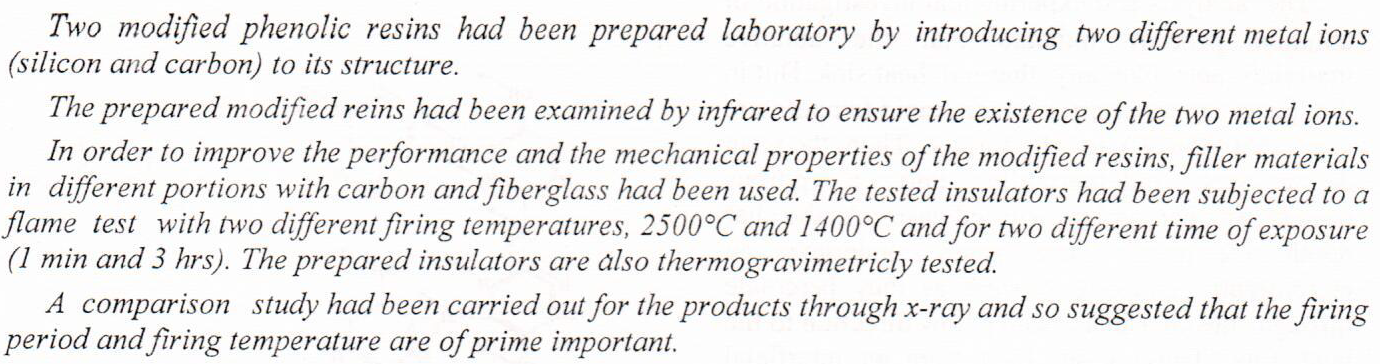
Isolation Behavior of Metal Modified Novolac Resin

Expanded use of antibiotics may increase the ability of pathogenic bacteria to develop antimicrobial resistance. Greater attention must be paid to applying more sustainable techniques for treating wastewater contaminated with antibiotics. Semiconductor photocatalytic processes have proven to be the most effective methods for the degradation of antibiotics. Thus, constructing durable and highly active photocatalytic hybrid materials for the photodegradation of antibiotic pollutants is challenging. Herein, FeTiO3/Fe-doped g-C3N4 (FTO/FCN) heterojunctions were designed with different FTO to FCN ratios by matching the energy level of semiconductors, thereby developing effective direct Z-type heterojunctions. The photodegradation behaviors of th
... Show More (32)
(32)
 (32)
(32)


 (9)
(10)
(9)
(10)
This paper presents a new design of a nonlinear multi-input multi-output PID neural controller of the active brake steering force and the active front steering angle for a 2-DOF vehicle model based on modified Elman recurrent neural. The goal of this work is to achieve the stability and to improve the vehicle dynamic’s performance through achieving the desired yaw rate and reducing the lateral velocity of the vehicle in a minimum time period for preventing the vehicle from slipping out the road curvature by using two active control actions: the front steering angle and the brake steering force. Bacterial forging optimization algorithm is used to adjust the parameters weights of the proposed controller. Simulation resul
... Show MoreShort Multi-Walled Carbon Nanotubes functionalized with OH group (MWCNTs-OH) were used to synthesize flexible MWCNTs networks. The MWCNTs suspension was synthesized using Benzoquinone (BQ) and N, N Dimethylformamide alcohol (DMF) in specific values and then deposited on filter paper by filtration from suspension (FFS) method. Polypyrrole (PPy) conductive polymer doped with metallic nanoparticles (MNPs) prepared using in-situ chemical polymerization method. To improve the properties of the MWCNTs networks, a coating layer of (PPy) conductive polymer, PPy:Ag nanoparticles, and PPy: Cu nanoparticles were applied to the network. The fabricated networks were characterized using an X-ray diffractometer (XRD), UV-Vis. spectrometer, and Ato
... Show More
(3)
Sludge from stone-cutting (SSC) factories and stone mines cannot be used as decorative stones, stone powder, etc. These substances are left in the environment and cause environmental problems. This study aim is to produce artificial stone composite (ASC) using sludge from stone cutting factories, cement, unsaturated resin, water, silicon carbide nanoparticles (SiC-NPs), and nano-graphene oxide (NGO) as fillers. Nano graphene oxide has a hydrophobic plate structure that water is not absorbed due to the lack of surface tension on these plates. NGO has a significant effect on the properties of artificial stone due to its high specific surface area and low density in the composite. Its uniform distribution in ASC is very low due to its hydropho
... Show More
(5)
(4)
The permeability estimates for the uncored wells and a porosity function adopting a modified flow zone index-permeability crossplot are given in this work. The issues with implementing that approach were mostly crossplots, due to the influence of geological heterogeneity, did not show a clear connection (scatter data). Carbonate reservoir flow units may now be identified and characterized using a new approach, which has been formally confirmed. Due to the comparable distribution and flow of clastic and carbonate rock fluids, this zoning method is most effective for reservoirs with significant primary and secondary porosity. The equations and correlations here are more generalizable since they connect these variables by combining cor
... Show More
The current study was designed to remove Lead, Copper and Zinc from industrial wastewater using Lettuce leaves (Lactuca sativa) within three forms (fresh, dried and powdered) under some environmental factors such as pH, temperature and contact time. Current data show that Lettuce leaves are capable of removing Lead, Copper and Zinc ions at significant capacity. Furthermore, the powder of Lettuce leaves had highest capability in removing all metal ions. The highest capacity was for Lead then Copper and finally Zinc. However, some examined factors were found to have significant impacts upon bioremoval capacity of studied ions, where best biosorption capacity was found at pH 4, at temperature 50º C and contact time of 1 hour.
(5)
(6)
(5)
(8)
(6)