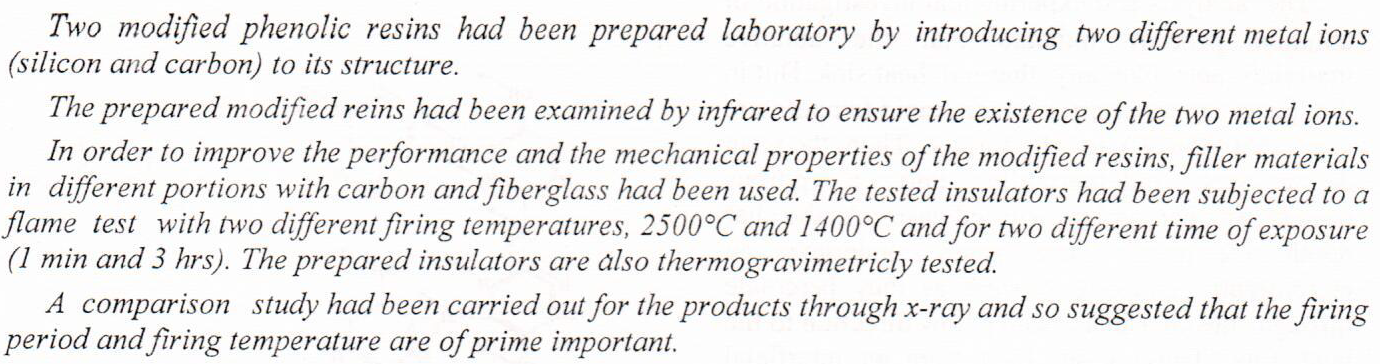
Isolation Behavior of Metal Modified Novolac Resin

In the present work, the behavior of thick-walled cylinder of elasto-plastic material (polymeric material) has been studied analytically. The study is based on modified Von-Mises yield criterion (for non metallic material). The equations of stress distribution are obtained for the cylinder under general cases of elastic expansion, plastic initiation and elastic-plastic expansion.
A computer program is developed for evaluating the stress distribution. The solution is carried out for worst boundary conditions when the cylinder is subjected to the combination of pressure load, inertia load, and temperature gradient.
The results are presente
... Show MoreThe adsorption behavior of congo red dye from its aqueous solutions was investigated onto natural and modified bauxite clays. Both bauxite and modified bauxite are primarily characterized by using, FTIR, SEM, AFM, and XRD. Several variables are studied as a function of adsorption including contact time, adsorbent weight, pH, ionic strength, particle size and temperature under batch adsorption technique. The absorbance of the solution before and after adsorption was measured spectrophotometrically. The equilibrium data fit with Langmuir model of adsorption and the linear regression coefficient R2 is found to be 0.9832 and 0.9630 for natural and modified bauxite respectively at 37.5°C which elucidate the best fitting isotherm model. The gene
... Show More (7)
(7)
 (2)
(2)


This thesis aims to study the effect of addition polymer materials on mechanical properties of self-compacting concrete, and also to assess the influence of petroleum products (kerosene and gas oil) on mechanical properties of polymer modified self-compacting concrete (PMSCC) after different exposure periods of (30 ,60 ,90 ,and 180 days).
Two type of curing are used; 28 days in water for SCC and 2 days in water followed 26 days in air for PMSCC.
The test results show that the PMSCC (15% P/C ratio) which is exposed to oil products recorded a lower deterioration in compressive strength's values than reference concrete. The percentages of reduction in compressive strength values of PMSCC (15% P/C ratio) was
... Show MoreBuckling analysis of a laminated composite thin plate with different boundary conditions subjected to in-plane uniform load are studied depending on classical laminated plate theory; analytically using (Rayleigh-Ritz method). Equation of motion of the plates was derived using the principle of virtual work and solved using modified Fourier displacement function that satisfies general edge conditions. The eigenvalue problem generated by using Ritz method, the set of linear algebraic equations can be solved using MATLAB for symmetric and anti-symmetric, cross and angle-ply laminated plate considering some design parameters such as aspect ratios, number of layers, lamination type and orthotropic ratio. The results obtained g
... Show More
(3)
The optimization calculations are made to find the optimum properties of combined quadrupole lens consist of electrostatic and magnetic lenses to produce achromatic lens. The modified bell-shaped model is used and the calculation is made by solving the equation of motion and finding the transfer matrices in convergence and divergence planes, these matrices are used to find the properties of lens as the magnification and aberrations coefficients. To find the optimum values of chromatic and spherical aberrations coefficients, the effect of both the excitation parameter of the lens (n) and the effective length of the lens into account as effective parameters in the optimization processing
A modified Leslie-Gower predator-prey model with a Beddington-DeAngelis functional response is proposed and studied. The purpose is to examine the effects of fear and quadratic fixed effort harvesting on the system's dynamic behavior. The model's qualitative properties, such as local equilibria stability, permanence, and global stability, are examined. The analysis of local bifurcation has been studied. It is discovered that the system experiences a saddle-node bifurcation at the survival equilibrium point whereas a transcritical bifurcation occurs at the boundary equilibrium point. Additionally established are the prerequisites for Hopf bifurcation existence. Finally, using MATLAB, a numerical investigation is conducted to verify t
... Show More
(17)
(3)
 (8)
(5)
(8)
(5)
A modified Leslie-Gower predator-prey model with a Beddington-DeAngelis functional response is proposed and studied. The purpose is to examine the effects of fear and quadratic fixed effort harvesting on the system's dynamic behavior. The model's qualitative properties, such as local equilibria stability, permanence, and global stability, are examined. The analysis of local bifurcation has been studied. It is discovered that the system experiences a saddle-node bifurcation at the survival equilibrium point whereas a transcritical bifurcation occurs at the boundary equilibrium point. Additionally established are the prerequisites for Hopf bifurcation existence. Finally, using MATLAB, a numerical investigation is conducted to verify the va
... Show More
(17)
(3)
Water samples from a variety of sources in Kelantan, Malaysia (lakes, ponds, rivers, ditches, fish farms, and sewage) were screened for the presence of bacteriophages infecting
(11)
(8)
(4)
(2)