Removal of Chromium from Wastewater by Adsorption
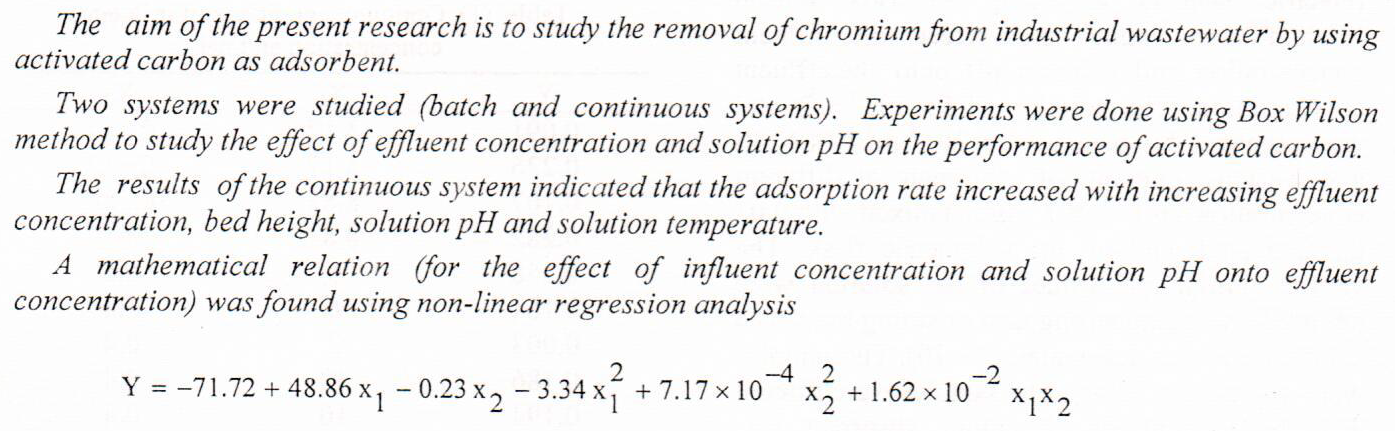

The present work is concerned with the finding of the optimum conditions for biochemical wastewater treatment for a local tannery. The water samples were taken from outline areas (the wastewater of the chrome and vegetable tannery) in equal volumes and subjected to sedimentation, biological treatment, and chemical and natural sedimentation treatment.
The Box-Wilson method of experimental design was adopted to find useful relationships between three operating variables that affect the treatment processes (temperature, aeration period and phosphate concentration) on the Biochemical Oxygen Demand (BOD5).
The experimental data collected by this method were successfully fitted to a second order polynomial mathematical model. The most fa
Adsorption studies were carried out to test the ability of the Iraqi rice bran (Amber type) to adsorb some metals divalent cations (Cd2+, Co2+, Cu2+, Fe2+, Ni2+, Pb2+, and Zn2+) as an alternative tool to remove these pollutants from water. The Concentrations of these ions in water were measured using flame and flamless atomic absorption spectrophotometry techniques. The applicability of the adsorption isotherm on Langmuir or Freundlisch equation were tested and found to be dependent on the type of ions. The results showed different adsorptive behavior and different capacities of the adsorption of the ions on the surface of the bran. The correlation between the amounts adsorbed and different cation parameters including (electronegativity, io
... Show More
 (193)
(193)
 (129)
(129)

 (2)
(2)
(18)
(20)
(2)
(2)
(18)
(20)
Release of industrial effluents comprising dyes in water bodies is one of the foremost causes of water pollution. Therefore, the proper and proficient treatment of these dyes contaminated left-over material before their release is crucial. Herein, an eco-friendly biological macromolecule Gum-Acacia (GA) integrated Fe3O4 nanoparticles composite hydrogel was manufactured via co-precipitation technique for effective adsorption of Congo red (CR) dye existing in water bodies. The as-prepared magnetic GA/Fe3O4 composite hydrogel was characterized by FTIR, XRD, EDX, VSM, SEM, and BET techniques. These studies discovered the fruitful fabrication of biodegradable magnetic GA/Fe3O4 composite hydrogel possessing porous structure with large surface are
... Show More
(23)
(20)
In this study, manganese dioxide (MnO₂) nanoparticles (NPs) were synthesized via the hydrothermal method and utilized for the adsorption of Janus green dye (JG) from aqueous solutions. The effects of MnO₂ NPs on kinetics and diffusion were also analyzed. The synthesized NPs were characterized by scanning electron microscopy (SEM), X-ray diffraction (XRD), energy-dispersive X-ray analysis (EDX), and Fourier-transform infrared spectroscopy (FT-IR), with XRD confirming the nanoparticle size of 6.23 nm. The adsorption kinetics were investigated using three models: pseudo-first-order (PFO), pseudo-second-order (PSO), and the intraparticle diffusion model. The PSO model provided the best fit (R² = 0.999), indicating that the adsorpti
... Show More
(8)
(1)
The wastewater arising from pulp and paper mills is highly polluted and has to be treated before discharged into rivers. Coagulation-flocculation process using natural polymers has grown rapidly in wastewater treatment. In this work, the performance of alum and Polyaluminum Chloride (PACl) when used alone and when coupled with Fenugreek mucilage on the treatment of pulp and paper mill wastewater were studied. The experiments were carried out in jar tests with alum, PACl and Fenugreek mucilage dosages range of 50-2000 mg/L, rapid mixing at 200 rpm for 2 min, followed by slow mixing at 40 rpm for 15 min and settling time of 30 min. The effectiveness of Fenugreek mucilage was measured by the reduction of turbidity and Chemical Oxygen Demand
... Show MoreTo study the comparative use of some soil minerals (zeolite, bentonite, phosphate rock, and limestone) in the adsorption and release of lead and its removal rates from its aqueous solutions using adsorption equations. Two laboratory experiments were carried out for the adsorption and release of lead. The adsorption experiment took 0.5 g of some of the above soil minerals. Lead was added as Pb (NO3)2 at levels of 3.0, 2.0, 1.5, 1.0, 0.5, and 0.0 mmol L-1 containing a concentration of 0.01M of calcium chloride. The experimental unit’s number was 72, the concentration of dissolved lead in the equilibrium solution was estimated and the amount of lead adsorbed was calculated. As for the lead release experiment, samples fo
... Show More