Removal of Chromium from Wastewater by Adsorption
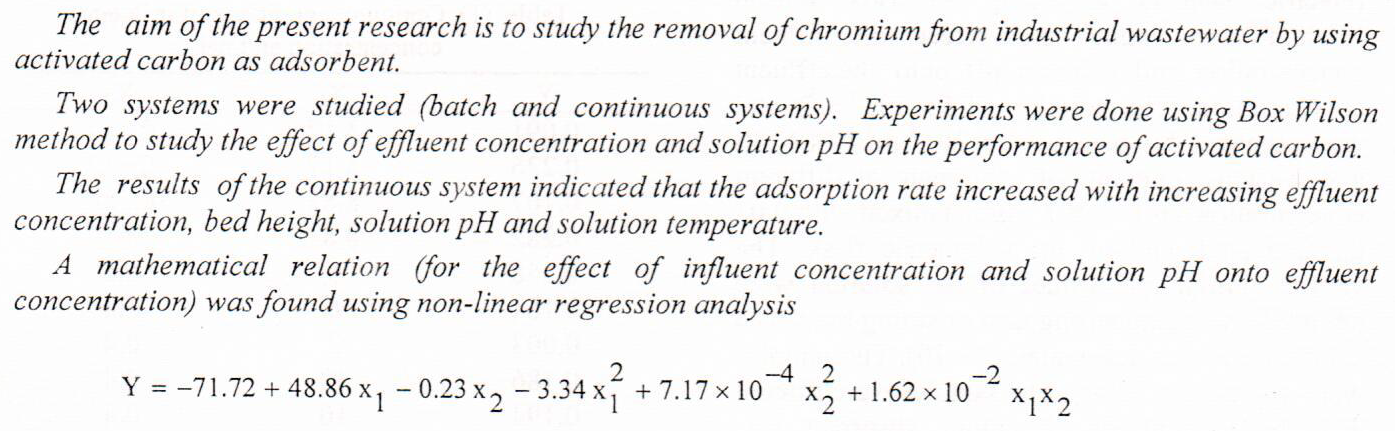

 (9)
(9)
 (10)
(10)


The experiment was conducted at the faculty of agriculture University of Ain Shams-Egypt, from January to March 2008, to study the effect of different levels of chromium yeast (cr-yeast) on broiler chickens on some physiological traits. A total of 450, one-day old unsexed chickens (Cobb) strain were used. The birds were randomly allocated to five treatments with 3 replicates each. The treatments were control (T1), without supplementation, T2, T3, T4 and T5 which were supplemented with 0.5, 1, 1.5 and 2 mg cr-yeast/kg diet respectively. Chromium yeast supplementation treatments caused a significant (p < 0.05) increase in plasma glucose levels, while supplemented Cr-yeast at levels of 1 (T3), 1.5 (T4), 2 (T5) mg/kg diet resulted in a signific
... Show More
(13)
(7)
The present study investigated the use of pretreated fish bone (PTFB) as a new surface, natural waste and low-cost adsorbent for the adsorption of Methyl green (MG, as model toxic basic dye) from aqueous solutions. The functional groups and surface morphology of the untreated fish bone (FB) and pretreated fish bone were characterized using Fourier transform infrared (FTIR), scanning electron microscopy (SEM) and Energy dispersive X-ray spectroscopy (EDS),respectively. The effect of operating parameters including contact time, pH, adsorbent dose, temperature, and inorganic salt was evaluated. Langmuir, Freundlich and Temkin adsorption isotherm models were studied and the results showed that the adsorption of basic dye followed Freundlich iso
... Show More
(8)
(5)
The electrocardiogram (ECG) is the recording of the electrical potential of the heart versus time. The analysis of ECG signals has been widely used in cardiac pathology to detect heart disease. The ECGs are non-stationary signals which are often contaminated by different types of noises from different sources. In this study, simulated noise models were proposed for the power-line interference (PLI), electromyogram (EMG) noise, base line wander (BW), white Gaussian noise (WGN) and composite noise. For suppressing noises and extracting the efficient morphology of an ECG signal, various processing techniques have been recently proposed. In this paper, wavelet transform (WT) is performed for noisy ECG signals. The graphical user interface (GUI)
... Show More
(1)
 (1)
(1)
Many water supplies are now contaminated by anthropogenic sources such as domestic and agricultural waste, as well as manufacturing activities, the public's concern about the environmental effects of wastewater contamination has grown. Several traditional wastewater treatment methods, such as chemical coagulation, adsorption, and activated sludge, have been used to eliminate pollution; however, there are several drawbacks, most notably high operating costs, because of its low operating and repair costs, the usage of aerobic waste water treatment as a reductive medium is gaining popularity. Furthermore, it is simple to produce and has a high efficacy and potential to degrade pollu
... Show MoreThis study investigates the possibility of removing ciprofloxacin (CIP) using three types of adsorbent based on green-prepared iron nanoparticles (Fe.NPs), copper nanoparticles (Cu. NPS), and silver nanoparticles (Ag. NPS) from synthesized aqueous solution. They were characterized using different analysis methods. According to the characterization findings, each prepared NPs has the shape of a sphere and with ranges in sizes from of 85, 47, and 32 nanometers and a surface area of 2.1913, 1.6562, and 1.2387 m2/g for Fe.NPs, Cu.NPs and Ag.NPs, respectively. The effects of various parameters such as pH, initial CIP concentration, temperature, NPs dosage, and time on CIP removal were investigated through batch experiments. The res
... Show More
(3)
(3)
Reverse Osmosis (RO) has already proved its worth as an efficient treatment method in chemical and environmental engineering applications. Various successful RO attempts for the rejection of organic and highly toxic pollutants from wastewater can be found in the literature over the last decade. Dimethylphenol is classified as a high-toxic organic compound found ubiquitously in wastewater. It poses a real threat to humans and the environment even at low concentration. In this paper, a model based framework was developed for the simulation and optimisation of RO process for the removal of dimethylphenol from wastewater. We incorporated our earlier developed and validated process model into the Species Conserving Genetic Algorithm (SCG
... Show More
(16)
(13)