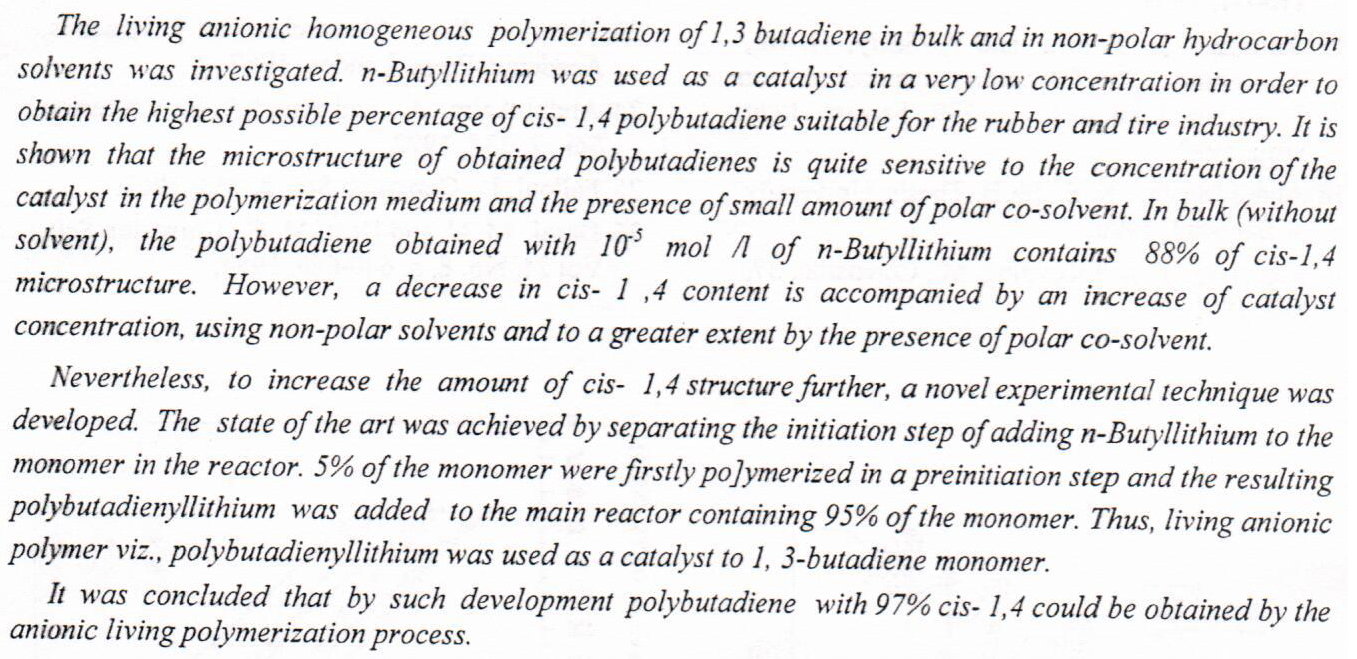
New Development in the Process for the Production of Polybutadiene Rubber

 (24)
(24)
 (22)
(22)



ZnO nanostructures were synthesized by hydrothermal method at different temperatures and growth times. The effect of increasing the temperature on structural and optical properties of ZnO were analyzed and discussed. The prepared ZnO nanostructures were characterized by X-ray diffraction (XRD), UV–Vis. absorption spectroscopy (UV–Vis.), Photoluminescence (PL), and scanning electron microscopy (SEM). In this work, hexagonal crystal structure prepared ZnO nanostructures was observed using X-ray diffraction (XRD) and the average crystallite size equal 14.7 and 23.8 nm for samples synthesized at growth time 7 and 8 hours respectively. A nanotubes-shaped surface morphology was found using scanning electron microscopy (SEM). The optic
... Show More
(4)
|
In this work, an experimental investigation has been done for heat transfer by natural-convection through a horizontal concentric annulus with porous media effects. The porous structure in gap spacing consists of a glass balls and replaced by plastic (PVC) balls with different sizes. The outer surface of outer tube is isothermally cooled while the outer surface of inner tube is heated with constant heat flux condition. The inner tube is heated with different supplied electrical power levels. Four different radius ratios of annulus are used. The effects of porous media material, particles size and annulus radius ratio on heat dissipation in terms of average Nusselt number have been analyzed. |
The presence of heavy metals in the environment is major concern due to their toxicity. In the present study a strong acid cation exchange resin, Amberlite IR 120 was used for the removal of lead, zinc and copper from simulated wastewater. The optimum conditions were determined in a batch system of concentration 100 mg/L, pH range between 1 and 8, contact time between 5 and 120 minutes, and amount of adsorbent was from 0.05 to 0.45 g/100 ml. A constant stirring speed, 180 rpm, was chosen during all of the experiments. The optimum conditions were found to be pH of 4 for copper and lead and pH 6 for zinc, contact time of 60 min and 0.35 g of adsorbent. Three different temperatures (25, 40 and 60°C) were selected to investigate the effect
... Show More
(7)
Bubbled slabs can be exposed to damage or deterioration during its life. Therefore, the solution for strengthening must be provided. For the simulation of this case, the analysis of finite elements was carried out using ABAQUS 2017 software on six simply supported specimens, during which five are voided with 88 bubbles, and the other is solid. The slab specimens with symmetric boundary conditions were of dimensions 3200/570/150 mm. The solid slab and one bubbled slab are deemed references. Each of the other slabs was exposed to; (1) service charge, then unloaded (2) external prestressing and (3) loading to collapse under two line load. The external strengthening was applied using prestressed wire with four approaches, wh
... Show More
(1)
In this research the behavior of reinforced concrete columns with large side openings under impact loads was studied. The overall cross sectional dimensions of the column specimens used in this research were (500*1400) mm with total height of (14000) mm. The dimensions of side openings were (600*2000) mm. The column was reinforced with (20) mm diameter in longitudinal direction, while (12) mm ties were used in the transverse direction. The effect of eccentric impact loads on the horizontal and vertical displacement for this column was studied. &
... Show More
(59)
(53)
AA3003-H14 aluminum alloy plates were welded by friction stir welding and TIG welding.
Fatigue properties of the welded joints were evaluated based on the superior tensile properties for
FSW at 1500 rpm rotational speed and 80 mm/min welding speed. However, there is not much
information available on effect of welding parameters with evolution of fatigue life of friction stir
welds. The present study experimentally analyzed fatigue properties for base, FSW, and TIG welds
of AA 3003-H14 aluminum alloy. Fatigue properties of FSW joints were slightly lower than the
base metal and higher than TIG welding.
(3)
Manganese sulfate and Punica granatum plant extract were used to create MnO2 nanoparticles, which were then characterized using techniques like Fourier transform infrared spectroscopy, ultraviolet-visible spectroscopy, atomic force microscopy, X-ray diffraction, transmission electron microscopy, scanning electron microscopy, and energy-dispersive X-ray spectroscopy. The crystal's size was calculated to be 30.94nm by employing the Debye Scherrer equation in X-ray diffraction. MnO2 NPs were shown to be effective in adsorbing M(II) = Co, Ni, and Cu ions, proving that all three metal ions may be removed from water in one go. Ni(II) has a higher adsorption rate throughout the board. Co, Ni, and Cu ion removal efficiencie
... Show More
(5)
(8)
(13)