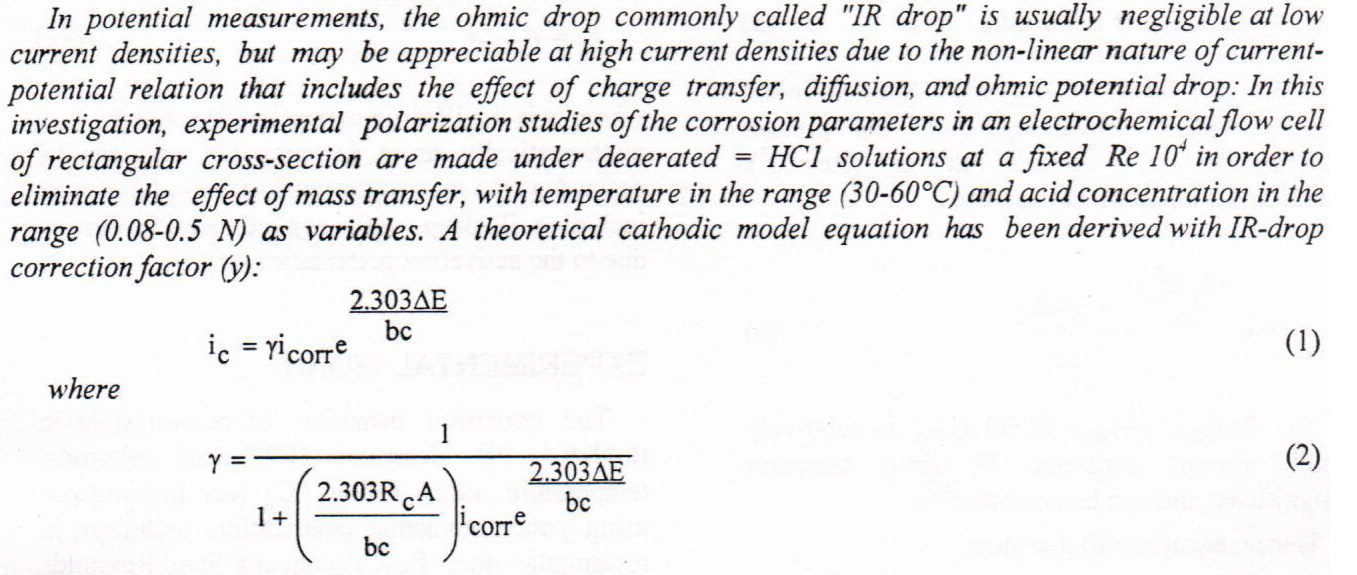
Determination of Corrosion Parameters for a Cathodic Reaction Complicated by IR Drop Effect in a Flow System

A new laboratory study conducted on stepped spillways in order to investigate their efficiency of dissipating flow energy. All previous study on stepped spillway indicated that the flow energy dissipation decreased as increasing in discharge. Increasing in the step numbers and the spillway slope led to energy dissipation decrease. In this study, an experimental attempt to increase energy dissipation at variable discharges was performed on stepped spillway and that leads to decreasing the cost of initiating the stilling basin or may be ignoring it. Five spillways were constructed from concrete and tested to investigate and compare among them. Three were roughed by gravel with different size for each one, one of them was s
... Show MoreA fluorescence microscopy considered as a powerful imaging tool in biology and medicine. In addition to useful signal obtained from fluorescence microscopy, there are some defects in its images such as random variation in brightness, noise that caused by photon detection and some background pixels in the acquired fluorescence microscopic images appear wrongly auto-fluorescence property. All these practical limitations have a negative impact on the correct vision and analysis of the fluorescent microscope users. Our research enters the field of automation of image processing and image analysis using image processing techniques and applying this processing and analysis on one of the very important experiments in biology science. This research
... Show More (1)
(1)

A simple, environmentally benign, cost-effective, and sensitive colorimetric determination for the pharmaceutical drug dexamethasone sodium phosphate (DXP) has been developed by the formation of a colored complex with fluoranil. The process was sensitive and linear over the range 1 to 40 μg/mL, excellent correlation coefficient 0.9989, recovery% 99.80 ± 1.3, limit of detection (LOD) and limit of quantification (LOQ) were 0.23 and 0.9 μg/mL, respectively, and good RSD ~1.63%. The experimental conditions were optimized after an intensive study. The approach was validated statistically for the quantification of the analyte in its pure and/or pharmaceutical form. Despite the proposed approach is selective, it still can be applied for
... Show More
(8)
 (6)
(6)

The preparation of composite metal oxide to attain high efficiency in removing phenol from wastewater has a great concern. In the present study, the focus would be on adopting antimony-tin oxide coating onto graphite substrates instead of titanium; besides the effect of SbCl3 concentration on the SnO2-Sb2O3 composite would be examined. The performance of this composite electrode as the working electrode in the removal of phenol by sonoelectrochemical oxidation will be studied. The antimony-tin dioxide composite electrode was prepared by cathodic deposition with SnCl2 . 2H2O solution in a mixture of HNO3 and NaNO3, with different concentrations of SbCl3. The SnO2-Sb2O3 deposit layer’s structure and morphology were examined and the 4 g/l Sb
... Show More
(8)
(5)

In recent days, the escalating need to seamlessly transfer data traffic without discontinuities across the Internet network has exerted immense pressure on the capacity of these networks. Consequently, this surge in demand has resulted in the disruption of traffic flow continuity. Despite the emergence of intelligent networking technologies such as software-defined networking, network cloudification, and network function virtualization, they still need to improve their performance. Our proposal provides a novel solution to tackle traffic flow continuity by controlling the selected packet header bits (Differentiated Services Code Point (DSCP)) that govern the traffic flow priority. By setting the DSCP bits, we can determine the appropriate p
... Show More
(1)
Groundwater modelling is particularly challenging in arid regions where limited water recharge is available. A fault zone will add a significant challenge to the modelling process. The Western Desert in Iraq has been chosen to implement the modelling concept and calculate the model sensitivity to the changes in aquifer hydraulic properties and calibration by researching 102 observations and irrigation wells. MODFLOW-NWT, which is a Newtonian formulation for MODFLOW-2005 approaches, have been used in this study. Further, the simulation run has been implemented using the Upstream-Weighting package (UPW) to treat the dry cells. The results show sensitivity to the change of the Kx value for the major groundwater discharge flow. Only abo
... Show More
(12)
(7)
(73)
(58)
(10)
(10)
A batch and flow injection (FI) spectrophotometric methods are described for the determination of barbituric acid in aqueous and urine samples. The method is based on the oxidative coupling reaction of barbituric acid with 4-aminoantipyrine and potassium iodate to form purple water soluble stable product at λ 510 nm. Good linearity for both methods was obtained ranging from 2 to 60 μg mL−1, 5–100 μg mL−1 for batch and FI techniques, respectively. The limit of detection (signal/noise = 3) of 0.45 μg mL−1 for batch method and 0.48 μg mL−1 for FI analysis was obtained. The proposed methods were applied successfully for the determination of barbituric acid in tap water, river water, and urine samples with good recoveries of 99.92
... Show More
(14)
(6)