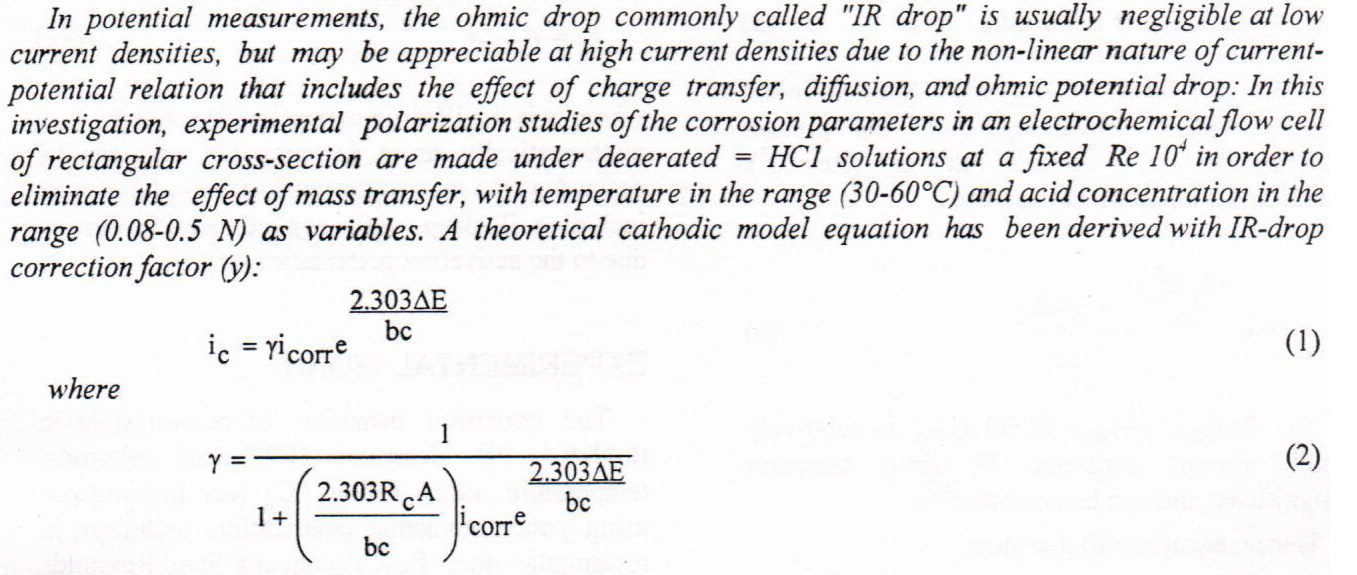
Determination of Corrosion Parameters for a Cathodic Reaction Complicated by IR Drop Effect in a Flow System

The current study presents an experimental investigation of heat transfer and flow characteristic for subcooled flow boiling of deionized water in the microchannel heat sink. The test section consisted of a single microchannel having 300μm wide nominal dimensions and 300μm height (hydraulic diameter of 300μm). The test section formed of oxygen-free copper with 72mm length and 12mm width. Experimental operation conditions spanned the heat flux (78-800) kW/m2, mass flux (1700 and 2100) kg/m2.s at 31˚C subcooled inlet temperature. The boiling heat transfer coefficient is measured and compared with existing correlations. Also, the experimental pressure drop is measured and compared with microscale p
... Show More (2)
(2)

There are still areas around the world suffer from severe shortage of freshwater supplies. Desalination technologies are not widely used due to their high energy usage, cost, and environmental damaging effects. In this study, a mathematical model of single-bed adsorption desalination system using silica gel-water as working pair is developed and validated via earlier experiments. A very good match between the model predictions and the experimental results is recorded. The objective is to reveal the factors affecting the productivity of fresh water and cooling effect in the solar adsorption system. The proposed model is setup for solving within the commercially-available software (Engineering Equation Solver). It is implemented to so
... Show More (8)
(6)
(8)
(6)


The research work represent a fast and simple method for the determination of methionine using chemiluminescence for the methionine-sodium hydroxide-luminol for the generation of a chemiluminesecent derivative of luminal. The emission was measured by continuous flow analysis made sample size of 83µL was used.Response versus concentration extended from 0.2-20 mM.L-1 with a percentage linearity of 96.17% or with 99.17% percentage of linearity for the range 0.6-20 mM.L-1. Reaching to a L.O.D. at (S/N=3) for 5 µM.L-1 from the gradual dilution for the minimum concentration in the calibration graph with a repeatability of less than 0.5% (n=10). A comparison was made between the new developed method with the classical method for the spectrophoto
... Show MoreThis research was carried out to study the effect of plants on the wetted area for two soil types in Iraq and predict an equation to determine the wetted radius and depth for two different soil types cultivated with different types of plants, the wetting patterns for the soils were predicted at every thirty minute for a total irrigation time equal to 3 hr. Five defferent discharges of emitter and five initial volumetric soil moisture contents were used ranged between field capacity and wilting point were utilized to simulate the wetting patterns. The simulation of the water flow from a single point emitter was completed by utilized HYDRUS-2D/3D software, version 2.05. Two methods were used in developing equations to predict the domains o
... Show More
This study presents a rapid, sensitive, and straightforward approach to measure chlorpheniramine maleate (CPM) by using turbidity CFIA. The method involves CPM reacting with sodium nitroprusside (Nitropress) to produce a pale white precipitate. The NAG-SSP-5S1D analyzer was used to measure turbidity at 0°–180° angle to detect the attenuation of incident light as a result of collision on the surfaces of the precipitate particles. The linear range of CPM measurements was between 0.008 and 11 m.mol/L, with correlation coefficient of 0.9983 and R2% = 99.65. The limit of detection was determined to be 0.0328 µg/sample from the lowest concentration in the calibration curve, and the repeatability of the method (RSD%) was less than 0.4% (n = 6
... Show More
(2)
(1)
(42)
(39)
The first flow injection spectrophotometric method is characterized by its speed and sensitivity which have been developed for the determination of promethazine-HCl in pure and pharmaceutical preparation. It is based on the in situ detection of colored cationic radicals formed via oxidation of the drug with sodium persulphate to pinkish-red species and the same species was determined by using homemade Ayah 3SX3-3D solar flow injection photometer. Optimum conditions were obtained by using the high intensive green light emitted diode as a source. Linear dynamic range for the absorbance versus promethazine-HCl concentration was 0-7 mmol.L-1, with the correlation coefficient (r) was 0.9904 while the percentage linearity (r2%) was 98.09%. the L.
... Show More
Been using a pv system program to determine the solar window for Baghdad city . the solar window for any location can be determine by deviating left and right from the geographical south as well as deviation according to the amount of tilt angle with the horizon for fixed panel so that will not change the average of solar radiation incident over the whole year and this lead to help in the process of installation of fixed solar panel without any effect on annual output .the range of solar window for Baghdad city between two angles ( -8 - +8 ) degrees left to right of the geographical south and tilt angle that allowed for the horizon range between angles (21- 30) degrees so that the amount of solar radiation that falling on the solar pan
... Show More
Background: The surgical treatment of pilonidal sinus varies from wide excision and laying the wound open or excision with primary closure or excision with the use of skin graft in some special cases.
Objectives: The objectives of this study is to determine the efficacy of treating non complicated pilonidal sinus disease with minimal excision and primary closure technique, complications and recurrence rate.
Patients and methods: This is a prospective study conducted in shahid ahmed ismaiel hospital in rania – As sulaimania IRAQ during the period from December 2013 to January 2016 and was carried on one hundred (100) consecutive patients with non complicated non recurrent pilonidal sinus patients who were treated with minimal exci
The presence of heavy metals in the environment is major concern due to their toxicity. In the present study a strong acid cation exchange resin, Amberlite IR 120 was used for the removal of lead, zinc and copper from simulated wastewater. The optimum conditions were determined in a batch system of concentration 100 mg/L, pH range between 1 and 8, contact time between 5 and 120 minutes, and amount of adsorbent was from 0.05 to 0.45 g/100 ml. A constant stirring speed, 180 rpm, was chosen during all of the experiments. The optimum conditions were found to be pH of 4 for copper and lead and pH 6 for zinc, contact time of 60 min and 0.35 g of adsorbent. Three different temperatures (25, 40 and 60°C) were selected to investigate the effect
... Show More
(7)