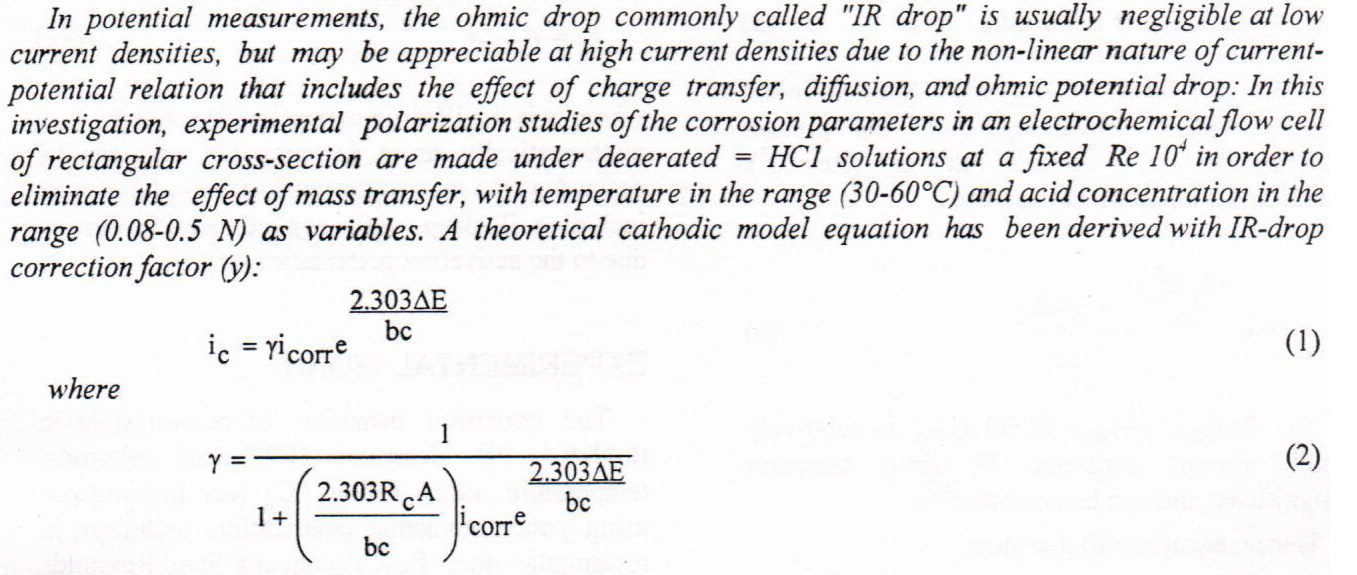
Determination of Corrosion Parameters for a Cathodic Reaction Complicated by IR Drop Effect in a Flow System

This study aimed to determine the effect of varicocelectomy on sperm parameters, oxidant- antioxidant status and chromatin maturity percent. The current study has been conducted on 154 infertile patients complaining from varicocele and varicocelomized men in addition to 25 fertile men as control. The results revealed significant decrease (P<0.05) in sperm concentration, progressive motile sperm percent, normal sperm morphology percent, GSH, SOD1, CAT levels and chromatin maturity percent and significant increase (P<0.05) in MDA and ROS concentrations in infertile patients with varicocele when compared to fertile men. The results revealed improvement (P<0.05) of sperm parameters quality, GSH, SOD1, CAT, MDA, ROS concentration and chromatin m
... Show More
Construction is a complicated process that takes place in an almost uncontrollable environment. Although projects can be carefully planned in advance in principle, there is a chance that unforeseen events and crises can disrupt these plans, affecting project development. Because the initial investment expenditures in construction projects are so large, they may be quickly influenced by crises, resulting in significant financial losses. The 2014 financial crisis was one of the most prominent crises that Iraq faced, which significantly impacted various activities in general and the construction industry in particular. Despite the importance of crisis management systems, the researchers found a great lack of local studies looking at cr
... Show More (7)
(7)
Construction is a complicated process that takes place in an almost uncontrollable environment. Although projects can be carefully planned in advance in principle, there is a chance that unforeseen events and crises can disrupt these plans, affecting project development. Because the initial investment expenditures in construction projects are so large, they may be quickly influenced by crises, resulting in significant financial losses. The 2014 financial crisis was one of the most prominent crises that Iraq faced, which significantly impacted various activities in general and the construction industry in particular. Despite the importance of crisis management systems, the researchers found a great lack of local studies l
... Show More
(7)
Today, the success or failure of organizations depends to possess the wisdom of their managers promised that the key to organizational success of the business environment, making the right decisions, and create the ability to work and think towards discrimination of products and services the organization . Seek this research to investigation the relationship between the wisdom management and differentiation strategy for service operations . It was a test of that relationship in light of the results of the analysis of the data collected through the questionnaire distributed on a sample from (98) Director Mangers, head of department and head of division in the General Establishment of Civil Aviation . The research used descriptive st
... Show More
In this work, varying compositions of SiO2 micro filler were added
with the Polyvinyl Chloride (PVC) and samples have been prepared
using film casting technique. The results have been analyzed and
compared for PVC samples with (1 wt%, 3 wt%, 5 wt% and 10 wt%)
SiO2 micro filler. Mechanical characteristics such as tensile strength,
elongation at break and Young`s modulus were measured for all the
samples, where the tensile strength was increased from 8.39 Mpa for
purified PVC to 16 Mpa for 3% SiO2/PVC composite. Also, thermal
conductivity measurement values illustrated that composite materials
have a good thermal insulation at 10 wt. %, thermal conductivity was
decreased from 0.1684 W/m.
The topic of strategic intelligence is considered as important topics that acquires the attention of organizations, Because of its role in supplying the decision-making centers by strategic ideas according to the opportunities and threats facing the organization, in an effort to improve the performance of their organizations to reach the high performance organization.
A lot of organizations lack to strategy guides the strategic intelligence towards achieving high performance organization.
This research aims to determine the level of strategic intelligence that characterized the leaders of diseases and kidney transplant center in Medicine city. What is the application level of the
... Show More
 (2)
(1)
(2)
(1)

The removal of congo red (CR) is a critical issue in contemporary textile industry wastewater treatment. The current study introduces a combined electrochemical process of electrocoagulation (EC) and electro-oxidation (EO) to address the elimination of this dye. Moreover, it discusses the formation of a triple composite of Co, Mn, and Ni oxides by depositing fixed salt ratios (1:1:1) of these oxides in an electrolysis cell at a constant current density of 25 mA/cm2. The deposition ended within 3 hours at room temperature. X-ray diffractometer (XRD), field emission scanning electron microscopy (FESEM), atomic force microscopy (AFM), and energy dispersive X-ray (EDX) characterized the structural and surface morphology of the multi-oxide sedim
... Show More
(3)
ABSTRICT:
This study is concerned with the estimation of constant and time-varying parameters in non-linear ordinary differential equations, which do not have analytical solutions. The estimation is done in a multi-stage method where constant and time-varying parameters are estimated in a straight sequential way from several stages. In the first stage, the model of the differential equations is converted to a regression model that includes the state variables with their derivatives and then the estimation of the state variables and their derivatives in a penalized splines method and compensating the estimations in the regression model. In the second stage, the pseudo- least squares method was used to es
... Show More
This work studies with produce of light fuel fractions of gasoline, kerosene and gas oil from treatment of residual matter that will be obtained from the solvent extraction process as by product from refined lubricate to improve oil viscosity index in any petroleum refinery. The percentage of this byproduct is approximately 10% according to all feed (crude oil) in the petroleum refinery process. The objective of this research is to study the effect of the residence time parameter on the thermal cracking process of the byproduct feed at a constant temperature, (400 °C). The first step of this treatment is the thermal cracking of this byproduct material by a constructed batch reactor occupied with control device at a selective range of re
... Show More