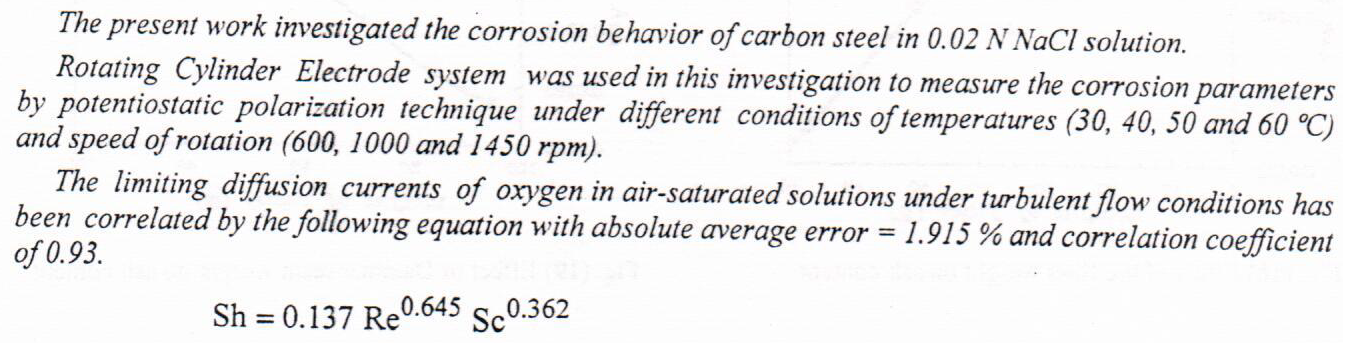
Effect of Velocity and Temperature on Mass Transfer of Oxygen in Corrosion Processes

Numerical simulations have been investigated to study the external free convective heat transfer from a vertically rectangular interrupted fin arrays. The continuity, Naver-Stockes and energy equations have been solved for steady-state, incompressible, two dimensional, laminar with Boussiuesq approximation by Fluent 15 software. The performance of interrupted fins was evaluated to gain the optimum ratio of interrupted length to fin length (
Agricultural lands have great importance in people's lives, and their exploitation has a great impact on strengthening the national economy. Therefore, countries have given great importance to this sector, and because of the importance of this sector, the state has given large areas of these lands to the farmers to invest in agriculture, and among these farmers are those who died and left behind children who took up crafts. Agriculture, for fear that these agricultural lands would be abandoned and turned into waste lands, a land system was introduced called (regular distribu- tion), which corresponds to (legitimate inheritance). Under this system, these lands were trans- ferred to the children of farmers who died so that the process of inve
... Show MoreThe heat transfer and flow resistance characteristics for air flow cross over circular finned tube heat exchanger has been studied numerically and experimentally. The purpose of the study was to improve the heat transfer characteristics of an annular finned-tube heat exchanger for better performance. The study has concentrated on the effect of the number of perforations and perforations shapes on the heat transfer and pressure drop across a staggered finned tube heat exchanger. The Numerical part of present study has been performed using ANSYS Fluent 14.5 using SST Turbulent model, while the experimental study consist from a test rig with different models of heat exchangers and all required measurement devices were build
... Show MoreSteady natural convection in a square enclosure with wall length (L= 20 cm) partially filled by saturated porous medium with same fluid (lower layer) and air (upper layer) is investigated. The conceptual study of the achievements of the heat transfer is performed under effects of bottom heating by constant heat flux (q=150,300,450,600W/m2 ) for three heaters size (0.2,0.14,0.07)m with symmetrically cooling with constant temperature on two vertical walls and adiabatic top wall. The relevant filled studied parameters are four different porous medium heights (Hp=0.25L,0.5L, 0.75L, L), Darcey number (Da1) 3.025×10⁻⁸ and (Da2) 8.852×10⁻⁴ ) and Rayleigh number range (60.354 - 241.41), (1.304×10⁶ – 5.2166×10⁶ ) for Da1 and Da2 cases respecti
... Show MoreThe size and the concentration of the gold nanoparticles (GNPs)
synthesized in double distilled deionized water (DDDW) have been
found to be affected by the laser energy and the number of pulses.
The absorption spectra of the nanoparticles DDDW, and the
surface plasmon resonance (SPR) peaks were measured, and found to
be located between (509 and 524)nm using the UV- Vis
spectrophotometer. SPR calculations, images of transmission
electron microscope, and dynamic light scattering (DLS) method
were used to determine the size of GNPs, which found to be ranged
between (3.5 and 27) nm. The concentrations of GNPs in colloidal
solutions found to be ranged between (37 and 142) ppm, and
measured by atomic absorptio
 (2)
(2)

A theoretical and protection study was conducted of the corrosion behavior of carbon steel surface with different concentrations of the derivative (Quinolin-2-one), namely 7-Ethyl-4-methyl-1-[(4-nitro-benzylidene)-amino]-1H-quinolin-2-one (EMNQ2O). Theoretically, Density Functional Theory (DFT) of B3LYP/ 6-311++G/ 2d, 2p level was carried out to calculate the geometrical structure, physical properties and chemical inhibition chemical parameters, with the local reactivity in order to predict both the reactive centers and to know the possible sites of nucleophilic and electrophilic attacks, in vacuum and two solvents (DMSO and H2O), all at the equilibrium geometry. Experimentally, the inhibition efficiencies (%IE) in (3.5% NaCl)
... Show More (17)
(6)
(17)
(6)


Most cultivars of sorghum have low field emergence as common problem. Three experiments were carried out at Agriculture College, Baghdad University. First experiment was conducted in laboratory according to Complete Randomized Design (CRD) with four replicates. Second and third experiments were conducted at field according to Randomized Complete Block Design (RCBD) during the spring and the fall seasons of 2015, respectively, with four replicates for each one. Same two factors were studied at each experiment. First factor was seed priming by seed soaking for 10 hours in distilled water, solvents of GA3, KCl and thiamine (300, 40 and 30 mg*L-1, respectively) and non-primed seed. Second factor was three cultivars of sorghum (Inqath, Kafier an
... Show More
(24)
(17)
This study aimed to determine the possibility of culturing genus Artemia in under laboratory conditions for locally culturing and producing. Different salinity concentrations were used, ranging from 5-40g/l . the results showed that the concentration 30g/l is the best for hatching. This concentration recorded hatching efficiency of 68800 nauplii/g cysts and hatching percentage of 45.86%, while the concentration 5g/l recorded less hatching efficiency and hatching percentage of 20266 nauplii/g and 13.5% respectively . Investigating the effect of salinity on individuals survival and growth using saline concentrations ranging from 30to 100g/l, revealed that the best percentage was 75.00% in the first week with 70g/l, whilst the best rates of
... Show More
Field experiment was conducted during 2007 in the experimental field of crop science Department/ Collage of Agriculture/ University of Baghdad, in order to identify the mechanism of compensation of cotton plant of Lashata Variety, with different levels of fruiting form removal in various time intervals and the effect of this factor on yield component. We use complete randomized block design with three replications. To compare the treatments: (control), 50% bud removal for one, two and three successive weeks, and 100% bud removal for one, two and three successive weeks, 50% flower removal for one, two and three successive weeks and 100% flower removal for one, two and three successive weeks, 50% boll removal for one, two and three successive
... Show MoreIn the present study, a pressure drop technique was used to identify the phase inversion point of oil-in-water to water-in-oil flows through a horizontal pipe and to study the effect of additives (nanoparticles, cationic surfactant and blend nanoparticles-surfactant) on the critical dispersed volume fraction (phase inversion point). The measurements were carried for mixture velocity ranges from 0.8 m/sec to 2.3 m/sec. The results showed that at low mixture velocity 0.8 and 1 m/sec there is no effect of additives and velocity on phase inversion point, while at high mixture velocities the phase inversion point for nanoparticles and blend (nanoparticles/surfactant) systems was delayed (postponed) to a higher value of the dispers
... Show More