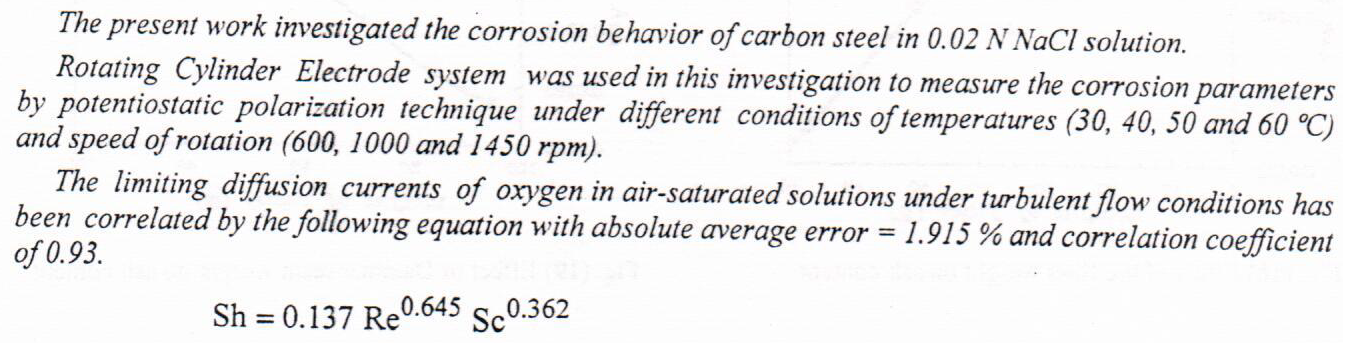
Effect of Velocity and Temperature on Mass Transfer of Oxygen in Corrosion Processes

 (3)
(3)


A great deal of attention has recently been given to the use of polyvinyl alcohol and its suitably modified derivatives as aqueous and coating phase corrosion inhibitors because of their polymeric nature, relatively high aqueous phase solubility, and biodegradable properties. The purpose of this study was to investigate the thermal stability and inhibition efficiency of modified polyvinyl alcohol/carboxymethyl cellulose. Gold or silver nanoparticles were used to accomplish this goal. In the current study, polyvinyl alcohol reacted with newly synthesized compounds [I-VI] in DMF to produce modifications of polyvinyl alcohol [VII-XII]. To create [XIII-XVIII], modified polyvinyl alcohol is blended with carboxymethyl cellulose. Then, ble
... Show More
(1)
(1)
Dynamic machine foundations can be considered as a necessary component of the industrial infrastructure. Design of the dynamic equipment foundations has, however, traditionally been grounded on a rule of thumb that is inaccurate and rigid to use at the discretion of the engineers. The conventional rule of thumb, which includes minimum weight ratios and resonance avoidance criteria, has been used singularly with two poles, which can be either conservatively designed systems that are too heavy, or systems that are going to experience too much vibration and fatigue. This paper presents a novel, analytical framework for the reinterpretation of traditional design practices, using a physics-based approach, and results in a single, unified overall
... Show More
An experimental study was performed to estimate the forced convection heat transfer performance and the pressure drop of a single layer graphene (GNPs) based DI-water nanofluid in a circular tube under a laminar flow and a uniform heat flux boundary conditions. The viscosity and thermal conductivity of nanofluid at weight concentrations of (0.1 to 1 wt%) were measured. The effects of the velocity of flow, heat flux and nanoparticle weight concentrations on the enhancement of the heat transfer are examined. The Nusselt number of the GNPs nanofluid was enhanced as the heat flux and the velocity of flow rate increased, and the maximum Nusselt number ratio (Nu nanofluid/ Nu base fluid) and thermal performance factor
... Show MoreThe dye–semiconductor interface between N749 sensitized and zinc semiconductor (ZnSe) has been investigated and studied according to quantum transition theory with focusing on the electron transfer processes from the N749 sensitized (donor) to the ZnSe semiconductor (acceptor). The electron transfer rate constant and the orientation energy were studied and evaluated depended on the polarity of solvents according to refractive index and dielectric constant coefficient of solvents and ZnSe semiconductor. Attention focusing on the influence of orientation energies on the behavior of electron transfer rate constant. Differentdata of rate constant was discussion with orientation energy and effective driving energy for N749-ZnSe system.
... Show More (4)
(4)
An improved Metal Solar Wall (MSW) with integrated thermal energy storage is presented in this research. The proposed MSW makes use of two, combined, enhanced heat transfer methods. One of the methods is characterized by filling the tested ducts with a commercially available copper Wired Inserts (WI), while the other one uses dimpled or sinusoidal shaped duct walls instead of plane walls. Ducts having square or semi-circular cross sectional areas are tested in this work.
A developed numerical model for simulating the transported thermal energy in MSW is solved by finite difference method. The model is described by system of three governing energy equations. An experimental test rig has been built and six new duct configurations have b
The behavior corrosion inhibition of aluminum alloy (Al6061) in acidic (0.1 M HCl) and saline (3.5% NaCl) solutions was investigated in the absence and the presence of expired diclofenac sodium drug (DSD) as a corrosion inhibitor. The influence of temperature and was studied using electrochemical techniques. In addition, scanning electron microscopy (SEM) was used to study the surface morphology. The results showed that DSD acted as a powerful inhibitor in acidic solutions, while a moderate influence was observed with saline one. Maximum inhibition efficiency was 99.99 and 83.32% in acidic and saline solutions at 150 ppm of DSD, respectively. Corrosion current density that obtained using electrochemical technique was increased with temperat
... Show More
(48)
(43)

Reaxys Chemistry database information SciVal Topics Metrics Abstract A novel CoO–ZnO nanocomposite was synthesized by the photo irradiation method using a solution of cobalt and zinc complexes and used as a coating applied by electrophoretic deposition (EPD) for corrosion protection of stainless steel (SS) in saline solution. The samples were characterized using powder XRD, scanning electron microscopy (SEM) and electrochemical polarization. It was also found that the coating was still stable after conducting the corrosion test: it contained no cracks and CoO–ZnO nanocomposites clearly appeared on the surface. SEM showed that the significant surface cracking disappeared. XRD confirmed that CoO–ZnO nanocomposites comprised CoO and Zn
... Show More
(21)
(6)