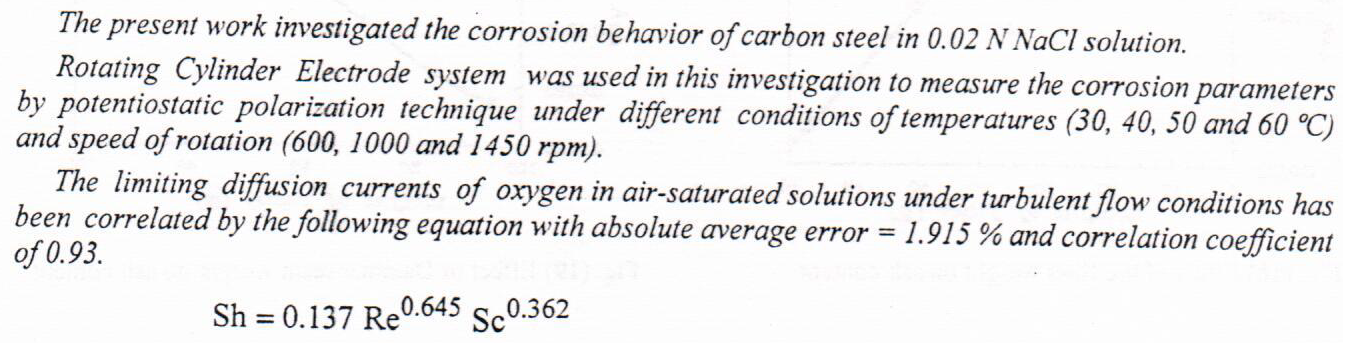
Effect of Velocity and Temperature on Mass Transfer of Oxygen in Corrosion Processes

Spectrophotometric method was developed for the determination of copper(II) ion. Synthesized (2,2[O-Tolidine-4,4-bis azo]bis[4,5-diphenyl imidazole]) (MBBAI) was used as chromogenic reagent at pH=5. Various factors affecting complex formation, such as, pH effect, reagent concentration, time effect and temperature effect, have been considered and studied. Under optimum conditions concentration ranged from (5.00-80.00) µg/mL of copper(II) obeyed Beer`s Low. Maximum absorption of the complex was 409nm with molar absorpitivity 0.127x10⁴ L mol-1 cm-1. Limit of detection(LOD) and Limit of quantification were 1.924 and 6.42 μg/mL, respectively.
... Show More (11)
(11)
 (5)
(5)


 (1)
(1)
(1)
(1)
Background: Due to the variations in tooth anatomy and size among different populations, this study aimed to compare the mesiodistal width of primary second molars in Iraqi children with the mesiodistal width of stainless-steel crowns from different companies. Materials and Methods: This cross-sectional study was conducted on 220 intact maxillary and mandibular primary second molars selected from boys and girls’ Iraqi children aged 8-9 years collected from different primary schools in Baghdad city. The mesiodistal dimensions of the selected teeth and the available maxillary and mandibular stainless-steel crowns from three different companies were measured by using a 3-D scanner, and then the whole measurements were calculated usin
... Show More
(2)
(2)
(3)
(4)
(2)
(1)
Several stress-strain models were used to predict the strengths of steel fiber reinforced concrete, which are distinctive of the material. However, insufficient research has been done on the influence of hybrid fiber combinations (comprising two or more distinct fibers) on the characteristics of concrete. For this reason, the researchers conducted an experimental program to determine the stress-strain relationship of 30 concrete samples reinforced with two distinct fibers (a hybrid of polyvinyl alcohol and steel fibers), with compressive strengths ranging from 40 to 120 MPa. A total of 80% of the experimental results were used to develop a new empirical stress-strain model, which was accomplished through the application of the parti
... Show More
(39)
(35)
Gundelia, a genus of flowering plants native to the Mediterranean region, particularly in Iraq, holds promise as a sustainable adsorbent for the treatment of dye-polluted water. This study explores the potential of Gundelia seeds (GS) waste as a biobased adsorbent for removing methylene blue dye from synthesized wastewater. Utilizing various analytical techniques, including scanning electron microscopy (SEM), Fourier transform infrared (FTIR) spectroscopy, and X-ray diffraction analysis (XRD), we assessed GS as an active adsorbent with performance comparable to fabricated and expensive composites. Key parameters such as pH (3-11), pH at the point of zero charge, temperature (298-328 K), dose (0.02-0.1 g), dye concentration (10-50 ppm), and
... Show More
(1)
(1)
A newly developed analytical method was conducted for the determination of Ketotifen fumarate (KTF) in pharmaceuticals drugs via quenching of continuous fluorescence of 9(10H)-Acridone (ACD). The method was applied using flow injection system of a new homemade ISNAG fluorimeter with fluorescence measurements at ± 90◦ via 2×4 solar cell. The calibration graph was linear in the range of 1-45 mmol/L, with correlation coefficient r = 0.9762 and the limit of detection 29.785 µg/sample from the stepwise dilution for the minimum concentration in the linear dynamic ranged of the calibration graph. The method was successfully applied to the determination of Ketotifen fumarate in two different pharma
... Show More
(5)
(3)