Effect of Velocity and Temperature on Mass Transfer of Oxygen in Corrosion Processes
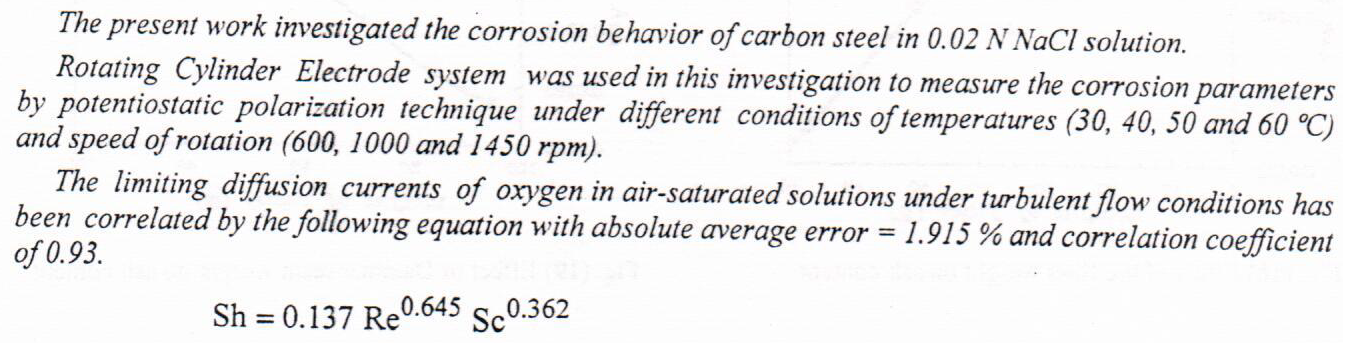

 (8)
(8)

The problem of steady, laminar, natural convective flow in an square enclosure with and without partitions is considered for Rayleigh number (103-106) and Prandtl number (0.7). Vertical walls were maintained isothermal at different temperatures while horizontal walls and the partitions were insulated. The length of partition was taken constant. The number of partitions were placed on horizontal surface in staggered arrangement from (1– 3) and ratio of partition thickness (H/L= 0.033, 0.083, 0.124). The problem is formulated in terms of the vorticity-stream function procedure. A numerical solution based on a program in Fortran 90 with the finite difference method is obtained. Representative results illustrating the effects of the thickn
... Show MoreIn the recent decade, injection of nanoparticles (NPs) into underground formation as liquid nanodispersions has been suggested as a smart alternative for conventional methods in tertiary oil recovery projects from mature oil reservoirs. Such reservoirs, however, are strong candidates for carbon geo-sequestration (CGS) projects, and the presence of nanoparticles (NPs) after nanofluid-flooding can add more complexity to carbon geo-storage projects. Despite studies investigating CO2 injection and nanofluid-flooding for EOR projects, no information was reported about the potential synergistic effects of CO2 and NPs on enhanced oil recovery (EOR) and CGS concerning the interfacial tension (γ) of CO2-oil system. This study thus extensively inves
... Show MoreObliquely deposited (70o) Bi, Sb, and Bi-Sb alloy thin films have been prepared by thermal
resistive technique. Structural properties of these films were studied using XRD. Their resistance and
voltage responsivity for Nd:YAG and CO2 laser pulses have been recorded as function of operating
temperature between 10 oC and 120 oC. It was found that the maximum responsivity for these detectors
can be obtained at 75 oC. On the other hand, the dependence of responsivity on the width of detectors was
investigated.
A thin CdS Films have been evaporated by thermal evaporation technique with different thicknesses (500, 1000, 1500 and 2000Å) and different duration times of annealing (60, 120 180 minutes) under 573 K annealing temperature, the vacuum was about 8 × 10⁻⁵ mbar and substrate temperature was 423 K. The structural properties of the films have been studied by X- ray diffraction technique (XRD). The crystal growth became stronger and more oriented as the film thickness (T) and duration time of annealing ( Ta) increases.
Studied competence spam to malicious moth figs at temperatures and Kagafat host different results showed that female intruder, despite their ability to shell larvae host and when densities of different, but it is able to lay eggs at a temperature of 14 + or -1 and finally urged the efficiency spam to malicious affected heavily host and that the greater the intensity of the host spam increased efficiency and its performance life
 (2)
(2)

Experimental work was carried out to investigate the effect of fire flame (high temperature) on specimens of one way slabs using Self Compacted Concrete (SCC). By using furnace manufactured for this purpose, twenty one reinforced concrete slab specimens were exposed to direct fire flame. All of specimens have the same dimensions. The slab specimens were cooled in two types, gradually by left them in the air and suddenly by using water. After that the specimens were tested under two point loads, to study, the effect of
different: temperature levels (300ºC, 500ºC and 700ºC), and cooling rate (gradually and sudden cooling conditions) on the concrete compressive strength, modulus of rupture, flexural strength and the behavior of reinf
(6)
Experimental research was carried out to investigate the effect of fire flame (high temperature) on specimens of short columns manufactured using SCC (Self compacted concrete). To simulate the real practical fire disasters, the specimens were exposed to high
temperature flame, using furnace manufactured for this purpose. The column specimens were cooled in two ways. In the first the specimens were left in the air and suddenly cooled using water, after that the specimens were loaded to study the effect of degree of
temperature, steel reinforcement ratio and cooling rate, on the load carrying capacity of the reinforced concrete column specimens. The results will be compared with behaviour of columns without burning (control specime
(5)