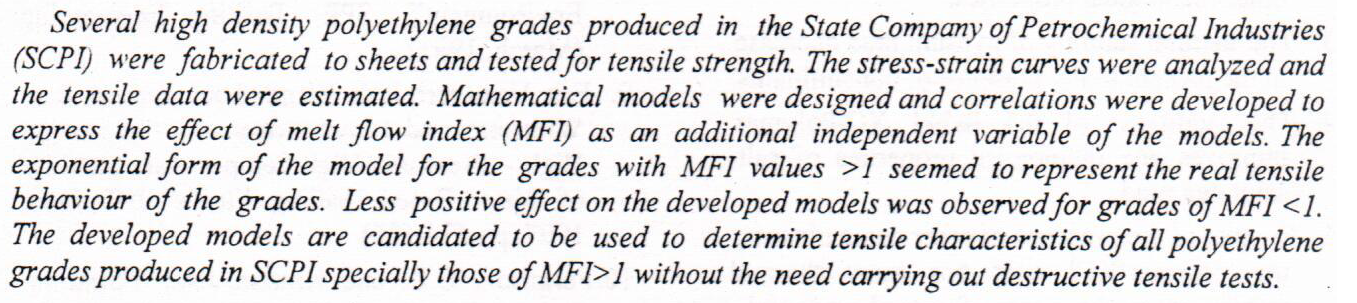
The Effect of MFI of High-Density Polyethylene on the Mathematical Modeling of Tensile Characteristic

The research aimed at studying the inhibitive effect of the hot watery dry and ethanolic ginger(85%) and fragrant oil which are added in concentrates of o.o25, o.o5o and 0.1g / 100g respectively in the growth of bacteria and molds. The results of the initial chemical diagnosis showed containment of ginger roots extract on. Alkaloids, Glycosides, Flavonoids and Suponins. The highest inhibitive effect of the bacteria reached the concentrate . 0.1% of the oil extract then the concentrate 0.050% of the ethanolic hot extract follows it. While 0.1% was the least inhibitive concentrate for the hot watery extract. But the inhibitive effect of the hot oily and alcoholic extracts in the numbers of molds colonies was 0.025%, when the concentrate 0.1%
... Show More
Soil defilement with "raw petroleum" is a standout amongst the most across the board and genuine ecological issues going up against both the industrialized and oil country like Iraq. Along these lines, the impact of "raw petroleum" on soil contamination is one of most critical subjects that review these days. The present examination expects to research "unrefined oil"effectson the mechanical and physical properties of clayey soils. The dirt examples were acquired from Al-Doura area in Baghdad city and arranged by the "Brought together Soil Grouping Framework (USCS)" as silty mud of low pliancy (CL). Research center tests were done on contaminated and unpolluted soil tests with same thickness. The dirtied tests are set up by blending
... Show More (10)
(10)
Despite the broad approbation of additive manufacturing technologies over diverse industries, printed parts’ performance, quality, and related build time are still greatly influenced by printing parameters. These parameters majorly affect mechanical strength, surface finish, dimensional accuracy, and overall production time of the printed part. Customized 3D printing layer thickness, speed, and acceleration are crucial parameters that affect the speedy printing process and final product quality. The current work considers layer thickness in addition to speed and high acceleration values effect on the surface quality, surface roughness and productivity time of 3D printed Polylactic Acid (PLA). The experimental methodology implemented withi
... Show More (4)
(3)
(4)
(3)

Knowing the distribution of the mechanical rock properties and in-situ stresses for the field of interest is essential for many applications concerning reservoir geomechanics, including wellbore instability analysis, hydraulic fracturing, sand production, reservoir compaction, subsidence and water/gas injection throughout the filed life cycle. Determining the rock's mechanical properties is challenging because they cannot be directly measured at the borehole. The recovered carbonate core samples are limited and only provide discrete data for specific depths. This study focuses on creating a detailed 1D geomechanical model of the Mishrif reservoir in the Nasriyah oil field to identify the fault regime type for each unit in the format
... Show More
(1)
Horizontal wells have revolutionized hydrocarbon production by enhancing recovery efficiency and reducing environmental impact. This paper presents an enhanced Black Oil Model simulator, written in Visual Basic, for three-dimensional two-phase (oil and water) flow through porous media. Unlike most existing tools, this simulator is customized for horizontal well modeling and calibrated using extensive historical data from the South Rumaila Oilfield, Iraq. The simulator first achieves a strong match with historical pressure data (1954–2004) using vertical wells, with an average deviation of less than 5% from observed pressures, and is then applied to forecast the performance of hypothetical horizontal wells (2008–2011). The result
... Show More
(8)
(7)
 (11)
(5)
(2)
(2)
(11)
(5)
(2)
(2)
In this study, an analytical model depending on experimental results for InPInGaAs
avalanche photodiode at low bias was presented and the characteristics of
gain for this photodiode were determined directly by the impulse response. The
model have considered the most important mechanisms contributing the
photocurrent, they are trapping, photogeneration in the undepleted region and
charge-carriers velocity due to the built-in electrical field. Also, the bandwidth
was determined as a function to the total gain of photodiode and it was mainly
determined by diffusion and trapping processes at low gain regarding to the multilayer
structure considered in this study
This paper includes an experimental study of hydrogen mass flow rate and inlet hydrogen pressure effect on the fuel cell performance. Depending on the experimental results, a model of fuel cell based on artificial neural networks is proposed. A back propagation learning rule with the log-sigmoid activation function is adopted to construct neural networks model. Experimental data resulting from 36 fuel cell tests are used as a learning data. The hydrogen mass flow rate, applied load and inlet hydrogen pressure are inputs to fuel cell model, while the current and voltage are outputs. Proposed model could successfully predict the fuel cell performance in good agreement with actual data. This work is extended to developed fuel cell feedback
... Show More