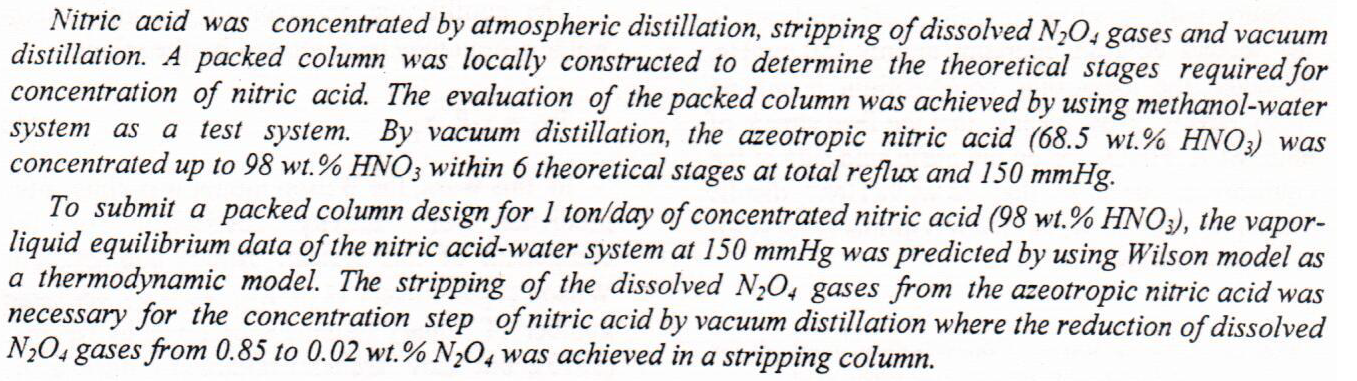
Concentration of Nitric Acid by Vacuum Distillation

 (3)
(3)
 (1)
(1)

 (4)
(4)
Background: Bone augmentation techniques are commonly employed in medical fields. This biomaterial system must be readily available, easily applicable by minimally-invasive technique and able to release an osteoinductive growth factor. Such a system will be able to engineer new bone formation locally at the site of injection. Hyaluronic acid has osteogenic potential that can be exploited not only for repairing bone defects but also for providing transplantable bone for the reconstruction of a variety of bone defects. The aims of this study were to evaluate the effects of Hyaluronic acid gel on bone healing by immunohistochemical estimation of transforming growth factor -beta 3 in experimental and control groups. Materials and methods: Thirt
... Show MoreIn the present work, the phthalic acid (phthH2) and 1.10 phenonthroline (phen), and their complexes were synthesized and isolated as [M(phth)(phen)2], Mn(II), Fe(II), Co(II), Ni(II) Cu(II), Zn(II), and Cd(II) ions. These complexes were characterized by elemental analysis, melting point, conductivity, percentage metal, UV–Vis, FT-IR, and magnetic moment measurements. The molar conductance indicates that all the metal complexes in DMSO are nonelectrolytic. phthalic acid (phtha), and 1,10-Phenanthroline (phen), behaved as bidentate, coordinating to the metal ion through their two oxygen and two pyridinyl nitrogen atoms respectively, as corroborated by. Electronic spectra, FTIR, spectroscopy amusement indicated that all the metal complexes ad
... Show More
(47)
(41)
 (7)
(14)
(7)
(14)
n this study new derivatives of Schiff bases (5-10) were synthesized from the new starting material 1 . Which has been synthesized by the reaction of (1 mol.) of dichloroacetic acid with two moles of morpholine, in the presence of potassium hydroxide, Ester derivatives 2 and 3 were synthesized by the reaction of 1 with methanol or ethanol respectively in the presence of sulphuric acid as catalyst . Compound 2 was also prepared from dimethylsulphate with high yield , 2 and 3 was used to synthesized 2,2-dimorpholinylacetohydrazide 4 via reaction with NH2NH2.H2O 80% .Imines (5-10) were synthesized via the reaction of 4 with appropriate aromatic aldehydes in the presence of G.A.A as a catalyst . Derivatives compounds (1-10) were identifie
... Show More
(3)
(1)
Designing high-performance solid polymer electrolytes (SPEs) remains a key challenge, primarily due to their inherently low ionic conductivity, which hampers the advancement of all-solid-state lithium-ion batteries (ASSLiBs). In this work, we address this limitation by developing a green, crosslinked polymer blend comprising carboxymethyl cellulose (CMC) - extracted and functionalized from palm frond fibers - and poly (vinyl alcohol) (PVA). Citric acid (CA) was utilized as a crosslinking agent, while lithium perchlorate (LiClO4) was incorporated as a dopant to enhance ionic conductivity. The SPE membranes were fabricated via solution casting, with the optimized formulation - designated CP-15X-Li25 - containing 15 wt.-% CA and 25 wt.-% LiClO
... Show More
(3)
(4)
This study was carried out at Poultry Research Station, State Board of Agricultural Research, Ministry of Agriculture for the period from 27 September 2014 to 9 November 2014 to evaluate the Supplementation of different levels of Conjugated Linoleic Acid (CLA) on productive performance of broiler. Four hundred eighty chicks (Ross-308),one day old were randomly distributed to four dietary treatments for 42 days of age with 3 replicates/vtreatment (40 bird/replicate). Experimental treatments were as follow; T1 (Control diet) without supplement, while the treatment T2,T3 and T4 were Supplemented with 1, 1.5, 2 g CLA /kg diet respectively. The results showed significant (P ≤ 0.05) increased in mean of body weight, weight gain, ave
... Show More
(1)
Exposing the dorsal superficial skin of rats to partial-depth burn leads to bacterial and microbes Invasion. Topical treatment is required in most superficial burn cases Moist exposed burn ointment (MEBO) protects wounds from infection and enhances healing without any harmful effects of purified chemicals is caused. The topical using of HA gel in rat models with full and partial thickness surgical wounds shows enhancement in wound repair. In this study, we compared the healing efficacy of topical use of hyaluronic acid gel products with MEBO as standard management in rats that were exposed to a partial-thickness burn. The experiment included twenty-four (24) adult albino rats of male sex with weight (150-220 gm) of 3 months’ age divided i
... Show More
(8)
(1)