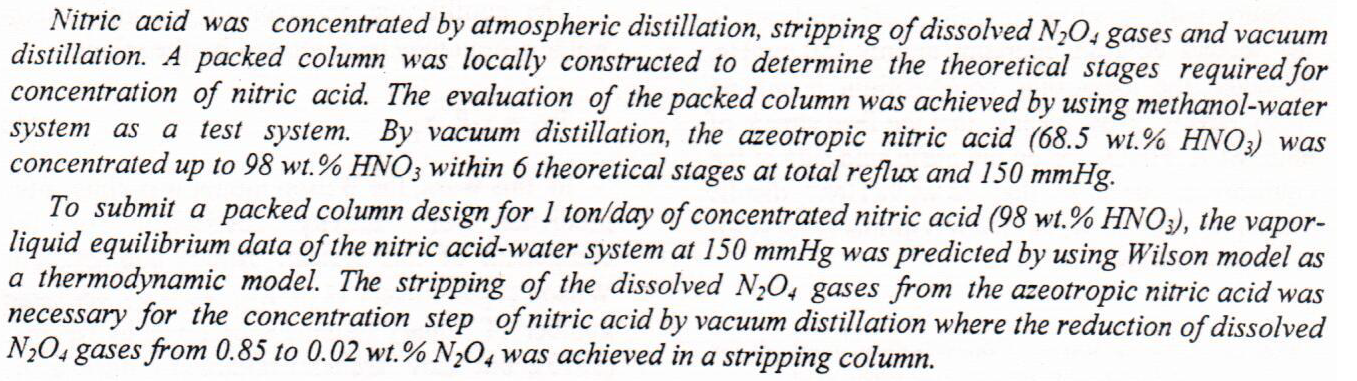
Concentration of Nitric Acid by Vacuum Distillation

KE Sharquie, SM Al-Tammimy, S Al-Mashhadani, RK Hayani, AA Al-Nuaimy, Dermatology online journal, 2006 - Cited by 34
 (6)
(6)

Conducted the study of the experimental conditions of the interaction of glass the visual Alpmuth containing 15% Mall of zinc with phosphoric acid ????? various degrees of thermal and clip areas prone to interact different way turntable
(5)
 (4)
(4)

Abstract This study investigated the treatment of textile wastewater contaminated with Acid Black 210 dye (AB210) using zinc oxide nanoparticles (ZnO NPs) through adsorption and photocatalytic techniques. ZnO NPs were synthesized using a green synthesis process involving eucalyptus leaves as reducing and capping agents. The synthesized ZnO NPs were characterized using UV-Vis spectroscopy, SEM, EDAX, XRD, BET, Zeta potential, and FTIR techniques. The BET analysis revealed a specific surface area and total pore volume of 26.318 m2/g. SEM images confirmed the crystalline and spherical nature of the particles, with a particle size of 73.4 nm. A photoreactor was designed to facilitate the photo-degradation process. The study investigated the inf
... Show More
(11)
(3)
Rheumatoid arthritis (RA) is a chronic inflammatory disease associated with decreased antioxidant state .This study aim to investigate the status of oxidant/antioxidant in a sample of Iraqi patients with RA and the role of peroxynitrite and its natural scavenger uric acid in them .This case-controlled study was conducted at Baghdad teaching hospital /Baghdad from December 2010-May 2011 . Twenty-five patients with mean age 39 years and 25 apparently healthy subject as controls with mean age 29 years were included in the study .Investigations include estimation of serum levels of nitric oxide (NO) ,peroxynitrite (PN) , malondialdehyde (MDA) , and uric acid (UA) .Serum PN levels were significantly elevated in RA patients a
... Show More
In this paper, we used two monomers, 3,3',4,4'-benzophenone tetracarboxylic dianhydride (BTDA) and m,m'-diaminobenzophenone (m, m’-DABP), to produce polyamide acid and then converted it to polyimide (PI). The effects of phosphoric acid (H3PO4) molarity (1, 2, and 3 M) on the structural, thermal, mechanical, and electrical characteristics of the polyimides/polyaniline (PI/PANI) nanocomposites were studied. Two sharp reflection peaks were developed by the addition of PANI to PI. When 3 M H3PO4 is added, the crystalline sharp peak loses some of its intensity. The complex formation of PI/PANI-H3PO4 was confi
... Show More
(19)
(16)

A group of amino derivatives [4-aminobenzenesulfonamide,4-amino-N¹ methylbenzenesulfonamide, or N¹-(4-aminophenylsulfonyl)acetamide] bound to carboxyl group of mefenamic acid a well known nonsteroidal anti-inflammatory drugs (NSAIDs) were designed and synthesized for evaluation as a potential anti-inflammatory agent. In vivo acute anti-inflammatory activity of the final compounds (9, 10 and 11) was evaluated in rat using egg-white induced edema model of inflammation in a dose equivalent to (7.5mg/Kg) of mefenamic acid. All tested compounds produced a significant reduction in paw edema with respect to the effect of propylene glycol 50% v/v (control group). Moreover, the 4-amino-N-methylbenzenesulfonamide derivative (c
... Show More
(2)
Acidizing is one of the most used stimulation techniques in the petroleum industry. Several reports have been issued on the difficulties encountered during the stimulation operation of the Ahdeb oil field, particularly in the development of the Mishrif reservoir, including the following: (1) high injection pressures make it difficult to inject acid into the reservoir formation, and (2) only a few acid jobs have been effective in Ahdeb oil wells, while the bulk of the others has been unsuccessful. The significant failure rate of oil well stimulation in this deposit necessitates more investigations. Thus, we carried out this experimental study to systematically investigate the influence of acid treatment on the geomechanical properties of Mi4
... Show More
(23)
2,2'-(1-(3,4-bis(carboxydichloromethoxy)-5-oxo-2,5-dihydrofuran-2-yl)ethane-1,2-diyl)bis(oxy)bis(2,2-dichloroacetic acid) a derivative of L-ascorbic acid was prepared by reaction of L-ascorbic acid with trichloroacetic acid (1:4) ratio, in the presence of potassium hydroxide. A series of new metal complexes of this ligand were prepared by a reaction with the chlorides of Cd(II), Co(II), Ni(II), Cu(II) and Zn(II). The new ligand and its complexes were identified by C.H.N., IR, UV-visible spectra, Thermogravimetric analysis (TGA), as well as 1H, 13C-NMR and Mass spectra for ligand L. The complexes were also identified by molar conductance, atomic absorption, magnetic susceptibility and X-ray diffraction for Cu (II) complex. FT-IR spectra
... Show More