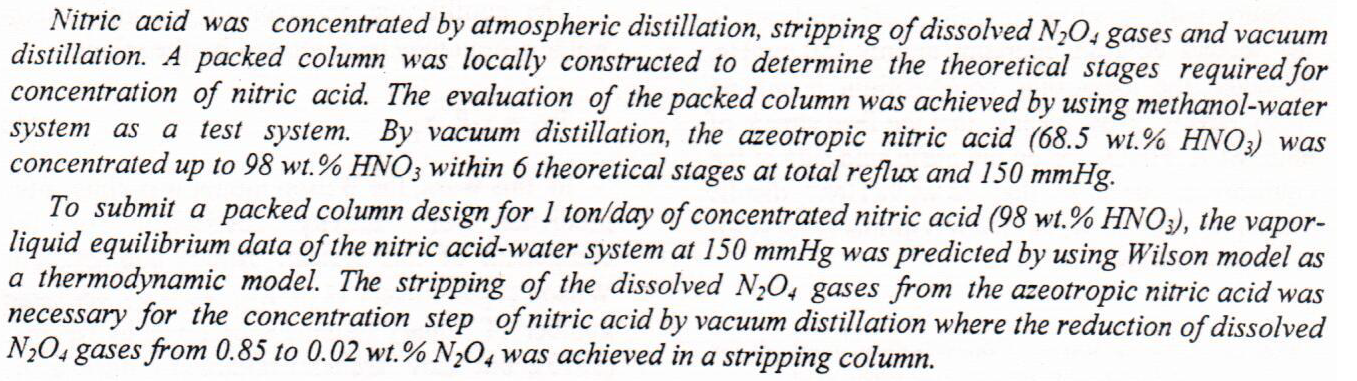
Concentration of Nitric Acid by Vacuum Distillation

Alloys were performed from In2O3 doped SnO2 with different doping ratio by quenching from the melt technique. Pulsed Laser Deposition PLD was used to deposit thin films of different doping ratio In2O3 : SnO2 ( 0, 1, 3, 5, 7 and 9 % wt.) on glass substrate at ambient temperature under vacuum of 10 -3 bar thickness of ~100nm. The structural type ,grain size and morphology of the prepared alloys compounds and thin films were examined using X-ray diffraction and atomic force microscopy . The results showed that all alloys have polycrystalline structures and the peaks belonged to the preferred plane for crystal growth were identical with the ITO (Indium – Tin –Oxide) standard cards also another peaks were ob
... Show More (12)
(12)
 (5)
(5)


In this study, concentrations of radon and uranium were measured for twenty six samples of soil. The radon concentrations in soil samples measured by registrant alpha-emitting radon (222Rn) by using CR-39 track detector. The uranium concentrations in soil samples measured by using registrar fission fragments tracks in CR-39 track detector that caused by the bombardment of U with thermal neutrons from 241 Am-Be neutron source that has flux of 5 ×10³n cm-2 s-1.
The concentrations values were calculated by a comparison with standard samples The results show that the radon concentrations are between (91.931-30.645Bq/m3).
The results show that also the uranium concentrat
(1)
Release of industrial effluents comprising dyes in water bodies is one of the foremost causes of water pollution. Therefore, the proper and proficient treatment of these dyes contaminated left-over material before their release is crucial. Herein, an eco-friendly biological macromolecule Gum-Acacia (GA) integrated Fe3O4 nanoparticles composite hydrogel was manufactured via co-precipitation technique for effective adsorption of Congo red (CR) dye existing in water bodies. The as-prepared magnetic GA/Fe3O4 composite hydrogel was characterized by FTIR, XRD, EDX, VSM, SEM, and BET techniques. These studies discovered the fruitful fabrication of biodegradable magnetic GA/Fe3O4 composite hydrogel possessing porous structure with large surface are
... Show More
(23)
(20)

In this work, studying the effect of ethylenediamine as a corrosion inhibitor was investigated for carbon steel in aerated HCl solution in range of 0.1-1N under dynamic conditions, i.e., rotational velocity of 400–1200 rpm in the temperature range 35 – 65 ºC. Weight loss method was employed in absence and presence of the inhibitor as an adsorption type in concentration range 1000 – 5000 ppm using rotating cylinder specimens. The experimental results showed that corrosion rate in absence and presence of inhibitor is increased with increasing temperature, rotational velocity and concentration of acid. It is decreased with increasing inhibitor concentration for the whole range of temperature, rotational velocity and concentrati
... Show MoreFive species of Lactic acid bacteriawere isolated from raw milk, yoghurt, vegetables and pickles, Lactobacillus plantarum, Lactobacillus acidophilus, Lactobacillus brevis, Lactobacillus casei and Lactobacillus bulgaricus isolates were identified by 16S rRNA gene. Evaluate of antimicrobial activity against all the bacterial strains Staphylococcus aureus, Salmonella spp., Pseudomonas fluorescens, Escherichia coli, Bacillus cereus and Bacillus subtilis. It showed that bacteriocin of Lactic acid bacteriamore effective than supernatant of lactic acid bacteria, the results showed that isolatemost efficient isolate belonging to Lactobacillus brevis, the diameter of the inhibition of the bacteriocin of Lactobacillus brevis were 27.7, 26.3 and 25.1
... Show More
(4)
Low conversion copolymerization of N-vinyl-2-pyrrolidon M.W = (111.14) VP (monomer-1) has been conducted with acrylic acid AA and methymethacrylate MMA in ethanol at 70ºC , using Benzoyl peroxide BPO as initiator . The copolymer composition has been determined by elemental analysis. The monomer reactivity ratios have been calculated by the Kelen-Tudos and Finman-Ross graphical procedures . The derived reactivity ratios (r1 , r2 ) are : (0.51 , 4.85) for (VP / AA ) systems and (0.34 , 7.58) for (VP , MMA) systems , and found the reactivity ratios of the monomer AA , MMA is mor than the monomer VP in the copolymerization of (VP / AA) and (VP /MMA) systems respectly . The reactivity ratios values were used for microstructures calculation.
The corrosion behavior of bare and chemical conversion coated (through anodizing) aluminum ASA 606 I in stagnant chromic acid solutions . Solutions of 2, 6 & J O wt. % Cr03 at 45°C, have been investigated using polarization technique. The anodizing experiments were conducted under fixed conditions of 35 minute exposure time and 30 volt supplied voltage. The most important feature achieved was the great difference in behavior between the anodic polarization curves for bare and anodized aluminum in different concentrations of chromic acid solutions.
AASAH Enass J Waheed, Shatha MH Obaid, Research Journal of Pharmaceutical, Biological and Chemical Sciences, 2019 - Cited by 5

