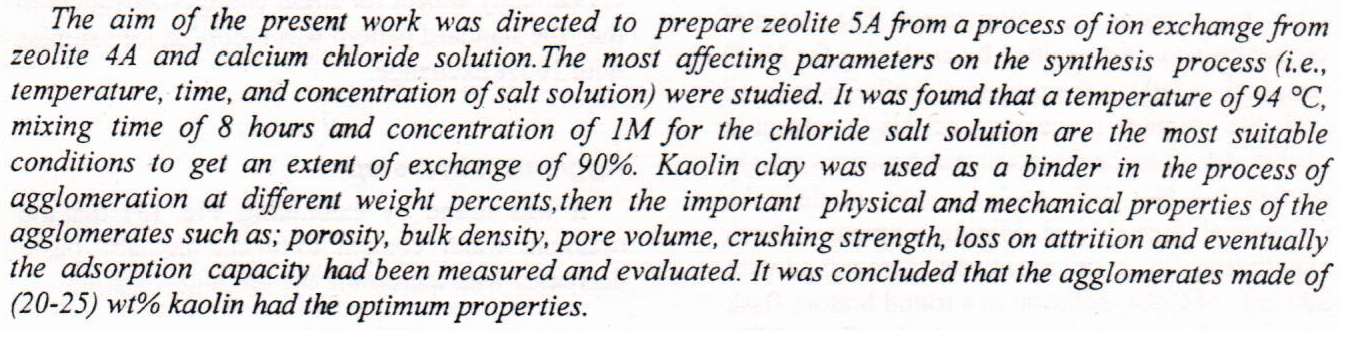
Preparation and Agglomeration of Zeolite 5A from Locally Available Raw Materials

Objectives: This study aimed to evaluate and compare the effect of plasma treatment versus conventional treatment on the micro shear bond strength (μSBS), surface roughness, and wettability of three different CAD/CAM materials. Materials and methods: Sixty cylindrical specimens (5 mm diameter ×3 mm height) were prepared from three different CAD/CAM materials: Group A: Zirconia, Group B: Lithium disilicate, and Group C: Resin nano-ceramic. Each group was subdivided into two subgroups according to surface treatment used: Subgroup I: Conventional treatment, zirconia was sandblasted with Al2O3, while lithium disilicate and resin nano-ceramic were etched with hydrofluoric acid. Subgroup II: Plasma treatment, the surface of each material was tr
... Show More (19)
(19)
 (11)
(11)



Aim: To evaluate the effect of ultrasonic agitation for retrograde biodceramic root repair, MTA and biodentine filling materials on push-out bond strength to dentine walls. Materials and Methods: Ninety extracted human teeth with single straight roots were selected randomly. After disinfection and cleaning, the coronal portions were sectioned to standardize the root canal length at 15mm. following root canal shaping, obturation and apical roots resection, retrograde cavities were prepared. Teeth were categorized depending on the filling material used into three groups, 30 teeth each. Group A filled with bioceramic root repair material, B with MTA and C with Biodentine material. These groups were divided in to three subgroup (n= 10). Subgrou
... Show More
(1)
The present work elucidates the utilization of activated carbon (AC) and activated carbon loaded with silver nanoparticles (AgNPs-AC) to remove tetracycline (TC) from synthetically polluted water. The activated carbon was prepared from tea residue and loaded with silver nanoparticles. Scanning electron microscopy (SEM), X-ray diffraction (XRD), Fourier transform infrared spectroscopy (FTIR), and Brunauer-Emmett-Teller (BET) were used to characterize the activated carbon (AC) and silver nanoparticles-loaded activated carbon (AgNPs-AC). The impact of various parameters on the adsorption effectiveness of TC was examined. These variables were the initial adsorbate concentration (Co), solution acidity (pH), adsorption time (t), and dosag
... Show More
Introduction and Aim: Klebsiella pneumoniae is a Gram-negative bacterium responsible for a wide range of infections, including respiratory tract infections (RTIs). This research was aimed to study the antibacterial and anti-biofilm effect of AgNPs produced by Gram positive and negative bacteria on RTIs associated with K. pneumoniae. Materials and Methods: The biofilm formation of K. pneumoniae was determined by tube method qualitatively from select bacterial species characterized by UV-Visible spectroscopy. The antibacterial susceptibility of the bacteria AgNPs was tested for their antibacterial and antibiofilm activity on a clinical isolate of K. pneumoniae. Results: K. pneumoniae isolated from RTIs were strong biofilm prod
... Show More
(5)
(2)
Introduction and Aim: Klebsiella pneumoniae is a Gram-negative bacterium responsible for a wide range of infections, including respiratory tract infections (RTIs). This research was aimed to study the antibacterial and antibiofilm effect of AgNPs produced by Gram positive and negative bacteria on RTIs associated with K. pneumoniae. Materials and Methods: The biofilm formation of K. pneumoniae was determined by tube method qualitatively from select bacterial species characterized by UV-Visible spectroscopy. The antibacterial susceptibility of the bacteria AgNPs was tested for their antibacterial and antibiofilm activity on a clinical isolate of K. pneumoniae. Results: K. pneumoniae isolated from RTIs were strong biofilm producers. The ant
... Show MoreThe twelve samples of agricultural soils from four regions in Al-Najaf governorate with sampling plant with soil. Physical properties of the soil where studied, such as electrical conductivity ranged from (136.33-1070.00)μS/cm-3, and moisture which ranged between the values (0.39-36.48)%. The chemical analysis of the soil have included the proportion of calcium carbonate the ratio between (44.00-48.00%) has been observed increasing amounts of calcium carbonate in surface models. The pH where results indicate that pH values were close to study models ranged between (6.88-7.42) these values generally within the normal range for the measured pH values of the Iraqi soil. The amount of gypsum ranged betwe
... Show More