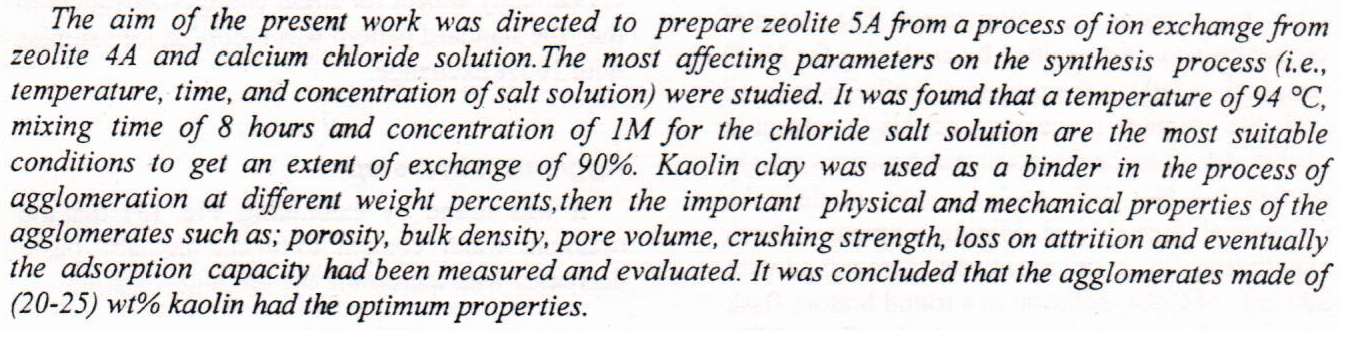
Preparation and Agglomeration of Zeolite 5A from Locally Available Raw Materials

This study includes adescription of Human serum Albumin by amodified using ion- exchange chromatography with manipulated comparison with cold ethanol precipitation method , It has been nticed that this procedure is superior orer the classical method . The Final yield by the new method 69.32% with purity of 83.42% compared with cohn which yield 60.30 % with purity of 80.7 % . The new method prored that it suitable for the pusi Fication of such material because it yield no precipitation material and it increases the Final yield of albumin solutions . • Human serum Albumin . • Albumin purification . • Ion – exchange chromatography . • Human plasma . • Albumin extraction .


Abstract
In this research will be treated with a healthy phenomenon has a significant impact on different age groups in the community, but a phenomenon tonsillitis where they will be first Tawfiq model slope self moving averages seasonal ARMA Seasonal through systematic Xbox Cengnzla counter with rheumatoid tonsils in the city of Mosul, and for the period 2004-2009 with prediction of these numbers coming twelve months, has found that the specimen is the best representation of the data model is the phenomenon SARMA (1,1) * (2,1) 12 from the other side and explanatory variables using a maximum temperature and minimum temperature, sol
Green nanotechnology is a thrilling and rising place of technology and generation that bracesthe ideas of inexperienced chemistry with ability advantages for sustainability, protection, andthe general protection from the race human. The inexperienced chemistry method introduces aproper technique for the production, processing, and alertness of much less dangerous chemicalsubstances to lessen threats to human fitness and the environment. The technique calls for inintensity expertise of the uncooked materials, particularly in phrases in their creation intonanomaterials and the resultant bioactivities that pose very few dangerous outcomes for peopleand the environment. In the twenty-first century, nanotechnology has become a systematic
... Show More (10)
(10)
Petroleum is one of the most important substances consumed by man at present times, a major energy source in this century, petroleum oils can cause environmental pollution during various stages of production, transportation, refining and use, petroleum hydrocarbons pollutions ranging from soil, ground water to marine environment, become an inevitable problem in the modern life, current study focused on bioremediation process of hydrocarbons contaminants that remaining in the bottom of gas cylinders and discharged to the soil. Twenty-four bacterial isolates were isolated from contaminated soils all of them gram negative bacteria, bacterial isolates screening to investigate the ability of biodegradation of hydrocarbons, these isolates inocula
... Show MoreAnew Schiff base (NaHL) has been prepared from the reaction between the salt of amino acid glycine with 2-hydroxy naphthaldehyde. By tridentate Schiff base of (ONO), donors were characterized by using U.V and spectrophotometer techniques. Complexes of Co(II) Ni(II) Cu(II) and Zn(II) ion with the ligand have been prepared, these complexes were identified by infrared, electronic spectral data, elemental analysis, magnetic moments, and molar conductivity measurements. It is concluded from the elemental analysis that all the complexes have (1:2) [metal:ligand] molar ratios, octahedral, with the exception to Zn(II) complex which have (1:1)[metal:ligand] molar ratio.
... Show More
Some of metal compounds have been synthesized of record ligand from aldehid interaction of a substance which is salicyladehyde with another material which is urea. During the analysis of the metal component, The prepared complexes were characterized by elemental analysis, IR ,UV-visible , conductivity and magnetic susceptibility measurements. this confirms the ratio[1:1] between the metal and ligand. It is found that theortical values agree with practical values All the studied complexes are suggested as an octahedral stereochemistry.
New Schiff base and their Mn(II),Co(II),Ni(II), Cu(II) and Hg(II) complexes formed by the condensation of O-phathaldehyde and ethylene diamine (2:1) to give ligand (L1) in the first step ,then the ligand (L1) with 2- aminophenol (1:2) to give ligand (L2) were prepared by classic addition through microwave method . These compounds (Ligands and complexes) have been diagnosed electronic spectra, FT-IR,1H-&13C-NMR (only ligand), magnetic susceptibility, elemental microanalysis and molar conductance measurements. Analytical values displayed that all the complexes appeared (metal: ligand) (1:1) ratio with the six chelation. All the compounds appear a high activity versus four types of bacteria such as; (Escherichia coli), (Sta
... Show More
(5)
The ligand 2-[1-(1H-indol-3-yl)ethylimino) methyl]naphthalene-1-ol, derived from 1-hydroxy-2-naphthaldehyde and 2-(1H-indol-3-yl)ethylamine, was used to produce a new sequence of metal ions complexes. Thus ligand reactions with NiCl2.6H2O, PdCl2, FeCl3.6H2O and H2PtCl6.6H2O were sequentially made to collect mono-nuclear Ni(II), Pd(II), Fe (III), and Pt(IV). (IR or FTIR), Ultraviolet Reflective (UV–visible), Mass Spectra analysis, Bohr-magnetic (B.M.), metal content, chloride content and molar conductivity have been the defining features of the composites. The Fe(III) and Pt(IV) complexes have octahedral geometries, while the Ni(II) complex has tetra
... Show More (12)
(3)
(12)
(3)

In this work, the effect of preparing a composite of copper oxide nanoparticles with carbon on some of its optical properties was studied. The composite preparing process was carried out by exploding graphite electrodes in an aqueous suspension of copper oxide. The properties of the plasma which is formed during the explosion were studied using emission spectroscopy in order to determine the most important elements that are present in the media. The electron’s density and their energy, which is the main factor in the composite process, were determined. The particle properties were studied before and after the exploding process. The XRD showed an additional peak in the copper oxides pattern corresponding to the hexagonal graphite struct
... Show More