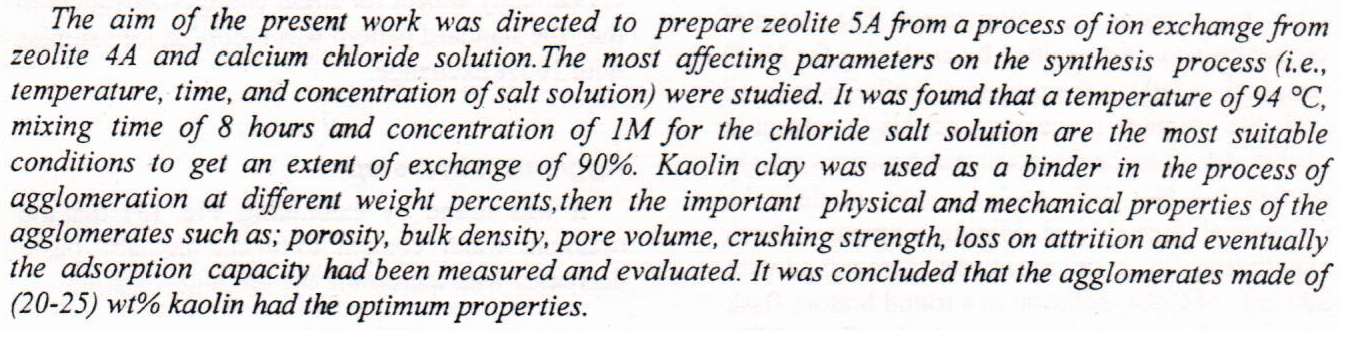
Preparation and Agglomeration of Zeolite 5A from Locally Available Raw Materials

This paper investigated the fatigue life behavior of two composite materials subjected to different times of shot peening (2, 4 and 6 min).The first material prepared from unsaturated polyester with E-glass reinforcement by 33% volume fraction. While, the second one was prepared from unsaturated polyester with aluminum powder by2.5% volume fraction. The experimental results showed that the improvement in endurance limit was obtained (for the first material) at 2, 4 and 6 min shot peening times where the percentage of maximum improvement was 25% at shot peening time of 6 min. While, the endurance limit of the second material decreased at shot peening times of 2, 4 and 6 min where the percentage of maximum reduction was 29 % at shot peenin
... Show MoreThis research is studying technique sculptures super - realism, search through, how the method of work, and the search for the materials used in their manufacture, and this is the first study in the field of art and the field of academic study in the country.Research consists of an introduction, And four sections, The introduction containing information on: research problem, Importance of research, Goals of the research, Limits of research, research approach, and research tools.The first section contains a technical study sculptures super -realism in contemporary sculpture, while the second section includes a search for alternative materials available in the local markets, for making sculptures super - realism, the third section dedicate
... Show More
Background: The aim of this study was to comparatively evaluate the push out bond strength (PBS) of root canal fillings using four different obturation techniques (single cone (SC), cold lateral compaction (CLC), continuous wave (CW), and carrier based gutta percha (CBG)). Materials and Methods: Forty mandibular premolar decoronated and instrumented with rotary ProTaper to F3 then teeth were divided randomly into 4 groups of 10 teeth for each as follow: group (I) single- cone obturation with matched-taper gutta-percha, group (II) cold lateral compaction technique, group (III) continuous wave of obturation technique, and group( IV) carrier based gutta-percha technique. Zinc oxide eugenol (ZOE) sealer was used as a root canal sealer for the
... Show More This research aims to identify the economic design techniques and materials that can be used in the implementation of cosmetic supplements to the spaces of the dwelling. The research relied on the descriptive and analytical approach by describing and analyzing models of design techniques and materials that can be used in the production of cosmetic supplements in the interior spaces of the dwelling.
The results of the research concluded that the beautification of the spaces of the dwelling is one of the necessary and important pieces to add aesthetic touches to the internal spaces, and that the use of economic design techniques and materials contributes to the implementation of many pieces of complementary beautification of the
Broadcasting across satellites has become an important media phenomenon and largely available for watchers. As the receiver can see the events at the very moment and at any spot in the world. This study aims to discover the degree of the extent of exposure of Iraqi people to the news broadcasting satellites in Arabic language, (Al Jazeera, Al Arabiya, Al Ekhbariya Satellite Channels) as one of the media that serves the public; and to discover the range of these Satellite Channels in covering the local Iraqi situation in different sides and aspects; and to know the significance of the Iraqi people in watching those news programmers; and state the motives behind the Iraqi public's dependence on these channels.
The
... Show More
In this study, a novel application of lab-scale dual chambered air-cathode microbial fuel cell (MFC) has been developed for simultaneous bio-treatment of real pharmaceutical wastewater and renewable electricity generation. The microbial fuel cell (MFC) was provided with zeolite-packed anodic compartment and a cation exchange membrane (CEM) to separate the anode and cathode. The performance of the proposed MFC was evaluated in terms of COD removal and power generation based on the activity of the bacterial consortium in the biofilm mobilized on zeolite bearer. The MFC was fueled with real pharmaceutical wastewater having an initial COD concentration equal to 800 mg/L and inoculated with anaerobic aged sludge. Results demo
... Show MoreIn this work, chemical spray pyrolysis deposition (CSP) technique was used to prepare a mixed In2O3-CdO thin films with different CdO content (10, 30 and 50)%volume ratio on glass substrates at 150 ᵒC substrate temperature. The surface morphology and structural properties were measured to find the optimum conditions to improve thin films properties for using as photo detector. Current –Time, the sensitivity and response speed vary for each mixture. Samples with 10% vol. CdO content has square pulse response with average rise time nearly 1s and fall time 1s.
Background: Since the invention of laser in 1960, lasers have been developed and approved in many fields. Lasers can now be regarded as practical tools with unique properties that have been utilized effectively in several applications in fields of medical and biological sciences.Objectives: The aim of the current study was to preparation of vaccines (live attenuated and killed) by irradiation of the bacteria by the low level diode laser.Methods: six bacterial isolates were isolated from human samples of diabetic foot infections, which used for preparation of vaccines. The experiment was conducted on fifteen adult male rabbits; they were divided into three groups with 5 rabbits each. Blood samples were collected from the marginal ear vein
... Show MoreAg nanoparticles were prepared using Nd:YAG laser from Ag matel in distilled water using different energies laser (100 and 600) mJ using 200 pulses, and study the effect of the preparation conditions on the structural characteristics of and then study the effect of nanoparticles on the rate of killing the two types of bacteria particles (Staph and E.coli). The goal is to prepare the nanoparticle effectively used to kill bacteria.
 (3)
(3)
Many complexes of 3,5-dimethyl-1H-pyrazol-1-yl phenyl methanone with Cr(III), Co(II), Ni(II), Cu(II) and Cd(II) were synthesized and characterized by FT-IR, UV/visible spectra, elemental analysis, room temperature magnetic susceptibility and molar conductivity. Cd(II) complex was expected to have tetrahedral structure while all the other complexes were expected to have an octahedral structure.