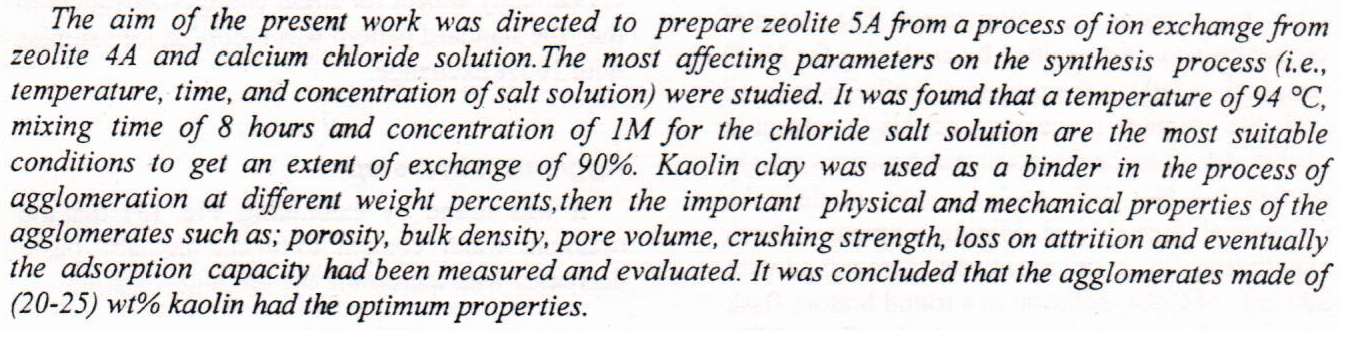
Preparation and Agglomeration of Zeolite 5A from Locally Available Raw Materials

While conservative access preparations could increase fracture resistance of endodontically treated teeth, it may influence the shape of the prepared root canal. The aim of this study was to compare the prepared canal transportation and centering ability after continuous rotation or reciprocation instrumentation in teeth accessed through traditional or conservative endodontic cavities by using cone-beam computed tomography (CBCT).
Forty extracted intact, matured, and 2-rooted human maxillary first premolars were selected for this
 (8)
(8)
 (7)
(7)

 (1)
(1)
(73)
(53)
(1)
(1)
(73)
(53)
 (2)
(2)
Anemia of chronic disease (ACD) and iron deficiency anemia (IDA) are the two most important types of anemia in rheumatoid arthritis (RA). Functional iron deficiency in ACD can be attributed to overexpression of the main iron regulatory hormone hepcidin leading to diversion of iron from the circulation into storage sites resulting in iron-restricted erythropoiesis. The aim is to investigate the role of circulating hepcidin and to uncover the frequency of IDA in RA. The study included 51 patients with RA. Complete blood counts, serum iron, total iron binding capacity, ferritin, and hepcidin- 25 were assessed. ACD was found in 37.3% of patients, IDA in 11.8%, and combined (ACD/IDA) in 17.6%. Serum hepcidin was higher in ACD than in con
... Show More
(21)
(26)
(9)
Bipedal robotic mechanisms are unstable due to the unilateral contact passive joint between the sole and the ground. Hierarchical control layers are crucial for creating walking patterns, stabilizing locomotion, and ensuring correct angular trajectories for bipedal joints due to the system’s various degrees of freedom. This work provides a hierarchical control scheme for a bipedal robot that focuses on balance (stabilization) and low-level tracking control while considering flexible joints. The stabilization control method uses the Newton–Euler formulation to establish a mathematical relationship between the zero-moment point (ZMP) and the center of mass (COM), resulting in highly nonlinear and coupled dynamic equations. Adaptiv
... Show More
(3)
(2)
(73)
(53)
Copper (Cu) is an essential trace element for the efficient functioning of living organisms. Cu can enter the body in different ways, and when it surpasses the range of biological tolerance, it can have negative consequences. The use of different nanoparticles, especially metal oxide nanoparticles, is increasingly being expanded in the fields of industry and biomedical materials. However, the impact of these nanoparticles on human health is still not completely elucidated. This comparative study was conducted to evaluate the impacts of copper oxide nanoparticles (CuO NPs) and copper sulphate (CuSO4 0.5 (H2O)) on infertility and reproductive function in male albino mice BALB/c. Body weight, the weight of male reproductive organs, mal
... Show More
(29)
(23)
(15)