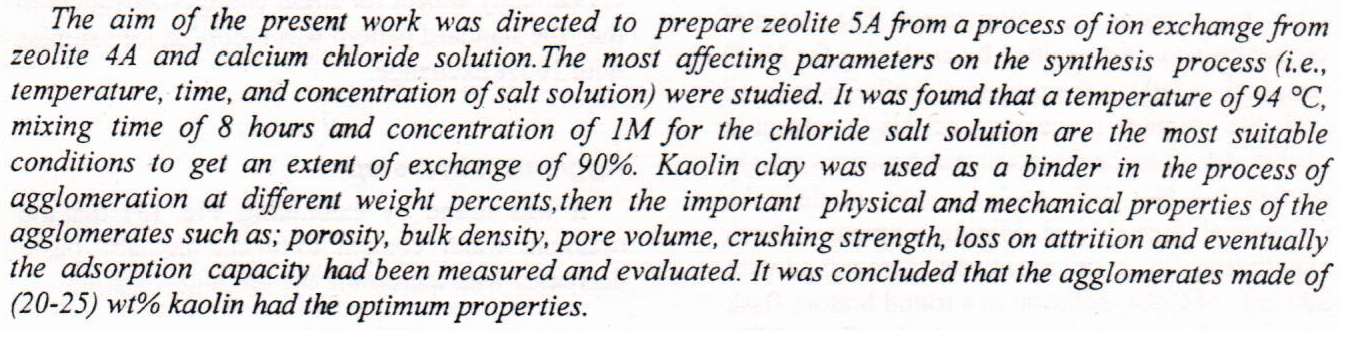
Preparation and Agglomeration of Zeolite 5A from Locally Available Raw Materials

In this investigation, the mechanical properties and microstructure of Metal Matrix Composites (MMCs) of Al.6061 alloy reinforced by ceramic materials SiC and Al2O3 with different additive percentages 2.5, 5, 7.5, and 10 wt.% for the particle size of 53 µm are studied. Metal matrix composites were prepared by stir casting using vortex technique and then treated thermally by solution heat treatment at 530 0C for 1 hr. and followed by aging at 175 0C with different periods. Mechanical tests were done for the samples before and after heat treatment, such as impact test, hardness test, and tensile test. Also, the microstructure of the metal matrix composites was examine
... Show More
This study focuses on producing wood-plastic composites using unsaturated polyester resin reinforced with Pistacia vera shell particles and wood industry waste powder. Composites with reinforcement ratios of 0%, 20%, 30%, and 40% were prepared and tested for thermal conductivity, impact strength, hardness, and compressive strength. The results revealed that thermal conductivity increases with reinforcement, while maintaining good thermal insulation, reaching a peak value of 0.633453 W/m·K. Hardness decreased with increased reinforcement, reaching a minimum nominal hardness value of 0.9479. Meanwhile, impact strength and compressive strength improved, with peak values of 14.103 k/m² and 57.3864568 MPa, respectively. The main aim is to manu
... Show More (23)
(23)
 (10)
(10)

Background: The base of the denture is largely responsible for providing the prosthesis with retention, stability, and support by being closely adapted to the oral mucosa. However; the process of bone resorption is irreversible and may lead to an inadequate fit of the prosthesis; this can be overcome by relining. Materials and methods: Acrylic based soft denture liner is prepared by preparing polymer from purified methylmethacrylate monomer with (10-2) initiator and (30%) dibutylphthalate plasticizer concentrations. Biological properties were evaluated in comparison with the control material through subcutaneous specimens' implantation in the New Zealand rabbits. Excisional biopsies were taken after (1, 3, days 1, 2, 3, 4 weeks) period. Mic
... Show MoreTherapeutically and prophylactically using Microspheres containing doxycycline isolated from shell of shrimp. Low molecule weight poly lactic acid was prepared. In this study, Poly lactic acid (PLA)/ poly vinyl alcohol (PVA)/poly ethyleneglycol(PEG) loading doxycycline blend solutions was prepared. Also Poly lactic acid (PLA)-Tannin blend via solvent evaporation method was prepared. Microspheres of chitosan/gelatin microsphere loading doxycycline was prepared by emulsion crosslinking technique. Both microsphere and blends were characterized by Fourier transform infrared (FTIR) spectrophotometer. The FTIR spectra were shown distinguish bands. The in vitro release of doxcycline from its matrix at pH 7 was studied. The prophylactic
... Show More
This study was undertaken to prepare Nano zinc oxide (ZnO) by precipitation and microemulsion methods. Scanning electron microscopy (SEM), X-ray diffraction (XRD), FTIR spectrometry, atomic force microscopy (AFM), and Brunauer Emmett Teller (BET) surface area were the techniques employed for the preparation. The particle size of prepared nano ZnO was 69.15nm and 88.49nm for precipitation and microemulsion methods, respectively, which corresponded to the BET surface area 20.028 and 16.369m2/g respectively. The activity of prepared nano ZnO as a photocatalyst was estimated by the removal of ampicillin (Amp) under visible light. This study, therefore, examined the effect of pH in the range of 5-11, initial concen
... Show More
(2)
... Show More
(2)
(2)
(2)
(1)
 (3)
(3)