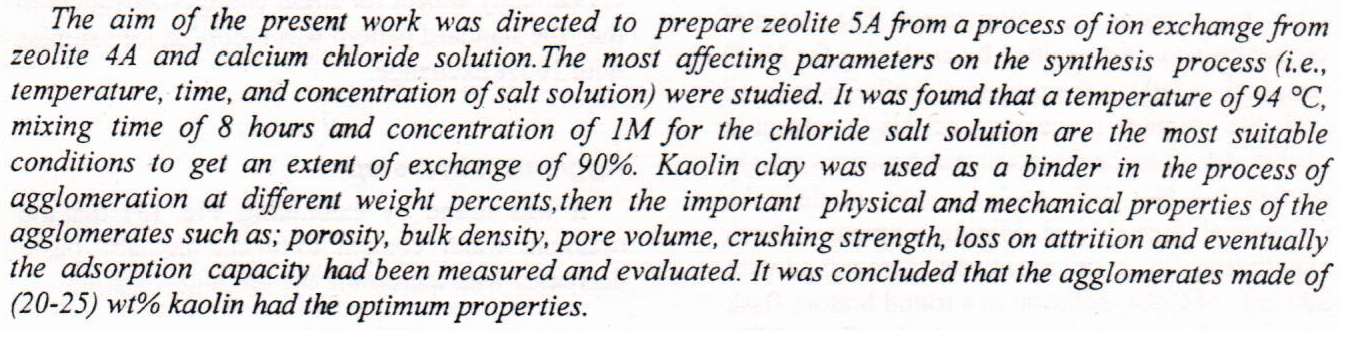
Preparation and Agglomeration of Zeolite 5A from Locally Available Raw Materials

In the present work, zeolite Y has been synthesized successfully by sol-gel method.Zeolite was synthesized by crystallization of the final gel which consist from seeding and feed stock gels at 85 oC. HY zeolite was prepared by an ion exchange process with ammonium chloride solution and then loaded with different percentages of platinum and titanium by the wet - impregnation method.
X-ray Diffraction (XRD), X-ray Florescence (XRF), Scanning Electron Microscopy (SEM), BET surface area and, Crushing strength were used to characterize the synthesized and prepared catalysts . Results showed high crystallinity 90% with silica to alumina ratio 5 for HY, high surface area of 600 m2/g and pore
... Show More (33)
(33)
 (19)
(19)


Modifying of HY/Zeolite is by loading nickel for applying catalyst in thermal catalytic cracking of furfural extract-40 from the lubricating base oil unit. The study involved the characterizing of HY-zeolite and promoted catalyst with nickel by X-ray diffraction analysis, Scanning electron microscopy (SEM), BET (Brunauer, Emmett, and Teller), and infrared ray analyses FTIR. The catalytic thermal cracking tubular reactor with a fixed bed with two type catalysts; HY/zeolite and Ni HY/zeolite, individually at a temperature of 580oC with LHSV 5h-1 was investigated. The results indicated that increase the conversion of catalytic cracking of furfural extract-40 also increases the yield of useful petroleum
... Show More
(1)
The nanostructured Manganese dioxide/Carbon fiber (CF) composite electrode was prepared galvanostatically using a facile method of anodic electrodeposition by varying the reaction time and MnSO4 concentration of the electrochemical solution. The effects of these parameters on the structures and properties of the prepared electrode were evaluated. For determining the crystal characteristics, morphologies, and topographies of the deposited MnO2 films onto the surfaces of carbon fibers, the X-ray diffraction (XRD), field emission scanning electron microscopy (FESEM), and atomic force microscopy (AFM) techniques were used, respectively. It found that the carbon fibers were coated with γ-MnO2 with a density that increased with increasing the de
... Show More
(3)
(2)
Preparation and Characterization of Maleate, Tartarate,and Phthalate Modified Pectin
In this study we examine variations in the structure of perovskite compounds of LaBa2Cu2O9, LaBa2CaCu3O12 and LaBa2Ca2Cu5O15 synthesized using the solid state reaction method. The samples’ compositions were assessed using X-ray fluorescence (XRF) analysis. The La: Ba: Ca: Cu ratios for samples LaBa2Cu2O9, LaBa2CaCu3O12 and LaBa2Ca2Cu5O15 were found by XRF analysis to be around 1:2:0:2, 1:2:1:3, and 1:2:2:5, respectively. The samples’ well-known structures were then analyzed using X-ray diffraction. The three samples largely consist of phases 1202, 1213, and 1225, with a trace quantity of an unknown secondary phase, based on the intensities and locations of the diffraction peaks. According to the measured parameters a, b, and c, every sa
... Show More
(3)
(1)

In this research, radon concentrations in some types of healthy drinking water samples available in Iraq's market were measured using a technique called Durridge RAD-7-H2O with closed loop. Then the rate of annual effective dose in human taken this water is determined.
It was found that, radon concentrations in studied samples ranged between 1.2 Bq.m-3 to 142 Bq.m-3. The results of the radon concentrations and the rate of annual effective dose for drinking water samples were significantly lower than the USEPA and WHO recommended limits that equal 500 Bq/m3 and 1 mSv/y resp
... Show More
(2)
Here, we synthesized three new blended ligand complexes of chromium (III), iron (III), and lanthanum (III) ions with a Schiff base made from the condensation of [o-aminophenol and 2-hydroxyacetophenone in the presence of concentrated sulphoric acid (HL1)] as a primary ligand and o-nitroaniline (L2) as a secondary. The Schiff base and its dual ligand chelate were characterized using several spectroscopic studies, IR, 1HNMR, electronic and mass spectra, in addition to elemental analyses, molar conductivity measurements, and magnetic moments. The spectroscopic and analytical outcomes confirmed the formation of the chelates in a 1:1:1(L1: M: L2) ratio. Similarly, an octahedral structure became counseled for all chelates.