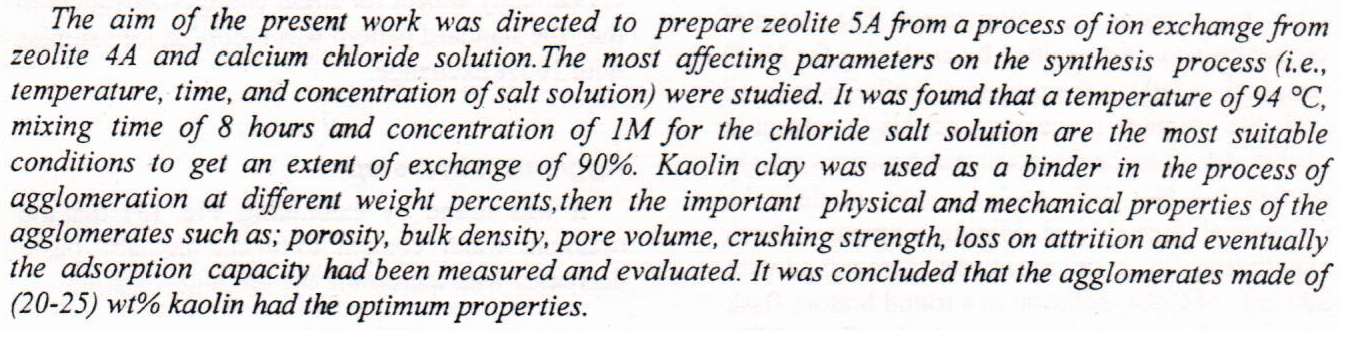
Preparation and Agglomeration of Zeolite 5A from Locally Available Raw Materials

This study found that one of the constructive, necessary, beneficial, most effective, and cost-effective ways to meet the great challenge of rising energy prices is to develop and improve energy quality and efficiency. The process of improving the quality of energy and its means has been carried out in many buildings and around the world. It was found that the thermal insulation process in buildings and educational facilities has become the primary tool for improving energy efficiency, enabling us to improve and develop the internal thermal environment quality processes recommended for users (student - teacher). An excellent and essential empirical study has been conducted to calculate the fundamental values of the
... Show More (2)
(2)

For desulfurization of naphtha, NaY zeolite was prepared from Dewekhala kaolin clay (Al-Anbar region). For the prepared zeolite adsorbent, x-ray diffraction, sodium content, silica to alumina ratio, surface area, bulk density and crushing strength were determined. From the x-ray diffraction of the prepared NaY zeolite and by a comparison with the standard NaY zeolite, it was found that the prepared adsorbent in this work has approximately the same crystal structure as the standard. Adsorption process was done in a laboratory unit at 25
... Show MoreThis search includes the preparation of Schiff base ligand (SB) from condensation primary amine with vanillin. The new ligand was diagnosed by spectroscopic methods as Mass, NMR, CHN and FTIR. Ligand complexes were mixed from new (SB) and Anthranillic acid (A) with five metal (II) chlorides. The preparation and diagnosis were conducted by FTIR, CHN, UV-visible, molar conductivity, atomic absorption and magnetic moment. The octahedral geometrical shape of the complexes was proposed. The ligands and their new complexes were screened with two different types of bacteria.
 (22)
(3)
(22)
(3)


In this work , the effect of chlorinated rubber (additive I), zeolite 3A with chlorinated rubber (additive II), zeolite 4A with chlorinated rubber (additiveIII), and zeolite 5A with chlorinated rubber (additive IV), on flammability for epoxy resin studied, in the weight ratios of (2, 4, 7,10 & 12%) by preparing films of (130x130x3) mm in diameters, three standard test methods used to measure the flame retardation which are ; ASTM : D-2863 , ASTM : D-635 & ASTM : D-3014. Results obtained from these tests indicated that all of them are effective and the additive IV has the highest efficiency as a flame retardant.
A mathematical model was proposed to study the microkinetics of esterification reaction of oleic acid with ethanol over prepared HY zeolite catalyst. The catalyst was prepared from Iraqi kaolin source and its properties were characterized by different techniques. The esterification was done under different temperature (40 to 70˚C) with 6:1 for molar ratio of ethanol to oleic acid and 5 % catalyst loading. The microkinetics study was done over two period of time each period was examined individually to calculate the reaction rate constant and activation energy. The impact of the mass transfer resistance to the reactant was also investigated; two different studies have been accomplished to do this purpose. The e
... Show More
(10)
The present research was conducted to synthesis Y-Zeolite by sol-gel technique using MWCNT (multiwalled carbon nanotubes) as crystallization medium to get a narrow range of particle size distribution with small average size compared with ordinary methods. The phase pattern, chemical structure, particle size, and surface area were detected by XRD, FTIR, BET and AFM, respectively. Results shown that the average size of Zeolite with and without using MWCNT were (92.39) nm and (55.17) nm respectively .Particle size range reduced from (150-55) nm to (130-30) nm. The surface area enhanced to be (558) m2/g with slightly large pore volume (0.231) km3/g was obtained. Meanwhile, degree of crystallization decrease
... Show More
(1)
A mathematical model was proposed to study the microkinetics of esterification reaction of oleic acid with ethanol over prepared HY zeolite catalyst. The catalyst was prepared from Iraqi kaolin source and its properties were characterized by different techniques. The esterification was done under different temperature (40 to 70˚C) with 6:1 for molar ratio of ethanol to oleic acid and 5 % catalyst loading.
The microkinetics study was done over two period of time each period was examined individually to calculate the reaction rate constant and activation energy. The impact of the mass transfer resistance to the reactant was also investigated; two different studies have been accomplished to do this purpose.
&nb
... Show MoreThe present research was conducted to synthesis Y-Zeolite by sol-gel technique using MWCNT (multiwalled carbon nanotubes) as crystallization medium to get a narrow range of particle size distribution with small average size compared with ordinary methods. The phase pattern, chemical structure, particle size, and surface area were detected by XRD, FTIR, BET and AFM, respectively. Results shown that the average size of Zeolite with and without using MWCNT were (92.39) nm and (55.17) nm respectively .Particle size range reduced from (150-55) nm to (130-30) nm. The surface area enhanced to be (558) m2/g with slightly large pore volume (0.231) km3/g was obtained. Meanwhile, degree of crystallization decreased to 120%.
(1)
In this paper activated carbon adsorbents produced from waste tires by chemical activation methods and application of microwave assisted KOH activation. The influence of radiation time, radiation power, and impregnation ratio on the yield and oil removal which is one of the major environmental issues nowadays and considered persistent environmental contaminants and many of them are suspected of being carcinogenic. Based on Box-Wilson central composite design, polynomial models were developed to correlate the process variables to the two responses. From the analysis of variance the significant variables on each response were identified. Optimum conditions of 4 min radiation time, 700 W radiation power and 0.5 g/g impregnation ratio
... Show More
(61)
(48)