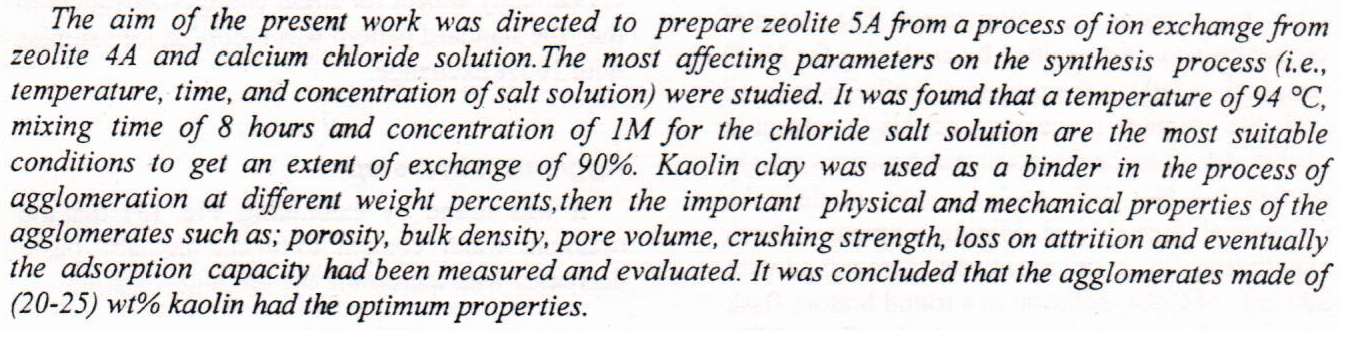
Preparation and Agglomeration of Zeolite 5A from Locally Available Raw Materials

Abstract
Nano-crystalline ZSM-5 zeolite was synthesized by hydrothermal method using chelating agent and two gel compositions:Compositionɪ:Al2O3:86SiO2:5.5TPA:12.7Na2O:3.4Trien:3320H2O.Compositionɪɪ:Al2O3:68SiO2:5.4TPA:10Na2O:2.6Trien:2626H2O.Study of hydrothermal reaction factors on characteristics of nano- sized zsm-5 has been carried on ,among them are crystallization temperature, crystallization time and concentration of template ( TPAOH ) solution. Synthesis was accomplished in PTFE lined autoclave ( reactor ) . The product were characterized by X-ray diffraction ( XRD ),Atomic force microsc
... Show MoreWater-based drilling fluids (WBDFs) are the industry-preferred medium for drilling reactive shale formations, yet they remain susceptible to shale swelling, fluid invasion, and cuttings dispersion—all of which compromise wellbore stability. Although oil-based fluids (OBFs) provide effective shale inhibition, their high cost and adverse environmental profile limit their use. Nanoparticles (NPs) derived from waste feedstocks offer a low-cost, environmentally responsible alternative for enhancing WBDF performance, but no prior study has simultaneously evaluated both waste-derived SiO2 and Al2O2 NPs within a single WBDF system. This study synthesised SiO2 NPs from Halfaya bentonite clay waste and Al2O2 NPs from recycled aluminium scrap, char
... Show More (2)
(2)
 (2)
(2)


The steady 3-D raw water turbulent flow is numerically investigated. This flow is formed of solid silica sand (quartz) carried by water in stainless steel pipe. The flow in a straight pipe and flow in a pipe with a sudden contraction are analyzed using a two-way coupled Eulerian-Lagrangian approach. Erosion rate is estimated by Oka erosion model combined with the constant coefficient of restitution. The effect of solid particles mass flow rate, inlet velocity, particle diameter, internal pipe diameter, orientation, contraction coefficient, and wall pipe contraction angle on erosion rate are examined. The predicted erosion is distributed homogenously for straight pipe, while the step wall area of the contraction is the most eroded part. The
... Show More
(3)
(1)
تضمن هذا العمل تحضير ليكند قاعدة شيف جديدة مشتقة من مادة البولي أكريلاميد والكلوترالديهايد [(2S, 2'S) – N, N' - (pentane-1, 5-diylidene) bis (2- methylbutan amide)] مع بعض المعادن الثقيلة (Cr + 3 Mn + 3 , Fe + 3 , ,Co + 2, Ni + 2 ,Cu + 2 Zn + 2 , Cd + 2,) لتنتج المعقدات المقابلة. تم تشخيص قواعد شيف ومعقداتها المعدنية بأستخدام طيف الأشعة تحت الحمراء والأشعة المرئية وفوق البنفسجية، والتوصيلية ,وقيم المغناطيسية والتحليل الحراري الوزني وحيود الأشعة السينية ومجه
... Show More
(7)
(1)
In this study, a new class of polymeric nanocomposites was synthesized and characterized. One mole of dimethyl adipate and two moles of thiosemicarbazide in ethanol first reacted to form the compound [C1]. Compound [C1] then reacted with sodium hydroxide to produce compounds [C2]. Hydrazine hydrate reacted with compound [C2] to generate compound [C3]. Compound [C4] was synthesized from compound [C3] and maleic anhydride. A polymer [C5] is formed by the reaction of the compound [C4] with ammonium persulfate as an initiator. This polymer was then combined with nano: ZnNPs, AgNPs, SiNPs, or IONPs using a hotplate stirrer for 3 hours to produce nanocomposites [C6-C9]. FTIR, 1H-NMR, and Field Emission Scanning Electron Microscope (FESEM) were
... Show MoreThe present study revealed a low-cost process for utilizing desert sand for preparing nanosilica by sol-gel technique. This work required sodium hydroxide, concentrated hydrochloric acid, distillate water as raw materials, and Iraqi sand. Nanosilica sample was characterized by X-Ray Diffraction (XRD), scanning electron microscopy analysis (SEM), atomic force microscope(AFM), surface area (BET) method, and fourier transform infrared (FTIR). The XRD result of produced sample is referred to as amorphous silica, and it has a broad peak at 2Θ= 22° – 22.5 º. SEM showed spherical, agglomerated silica particles with a diameter range of 26.57–28.93 nm. In addition, the average particle size was 76.35nm, with a dimension range of 40-11
... Show More
(8)
In humans, Pseudomonas aeruginosa is the second most frequent gram negative nosocomial pathogen in hospitals and has the highest case-fatality rate of all hospital-acquired bacteremia because of the hardy resistance of these bacteria to mechanical cleansing as well as to disinfectant, and many antibiotics. The susceptibility of bacteria against the antibiotics is modulated by several local factors such as temperature which modified drug efficacy, so this study was carried out to evaluate the effect of different temperature (20,42,45)Ċon the susceptibility of Pseudomonas aeruginosa to the minimum inhibitory concentrations (MIC) of the antimicrobial agents before and after irradiation. The samples collected from 150 persons suffering from
... Show MorePhenotypic And genotypic characteristics of Salmonella enterica serotype Typhi have been determined for 29 isolates, from Baghdad in 2007. Conventional typing methods were performed by biochemical tests, and antimicrobial susceptibility test. Molecular typing performed by analysis plasmid DNA beside using the Random Amplified Polymorphic DNA (RAPD-PCR). For the latter, two universal primers that have selected for the high discriminatory power were used for RAPD analysis. All isolates were belong one biotype according to the differention by their ability to decarboxylat lysine, 29(100%) were lysine (+). All the isolates were susceptible to the Antibiotics used. However, all the strains free of plasmids. RAPD was capable of grouping the strai
... Show More
In this study, synthesised new ligand: potassium 2,2'-(quinoxaline-2,3- diyl)bis(1-phenylhydrazinecarbodithioate) (L). The ligand synthesised by reacting N1,N2-dip-tolyloxalamide as the starting material with CS2 and KOH to add the CS2 group and then with phenylendiammine to achieve (L). The ligand used in the synthesis of complexes with (CoII, NiII and CdII). The new ligand and its complexes characterised by FT-IR, UV-Vis, 1H, 13C-NMR, Mass spectroscopy, and elemental analysis, in addition to the above techniques were using magnetic moment, atomic absorption, chloride content, and melting point to describe the metal complexes.