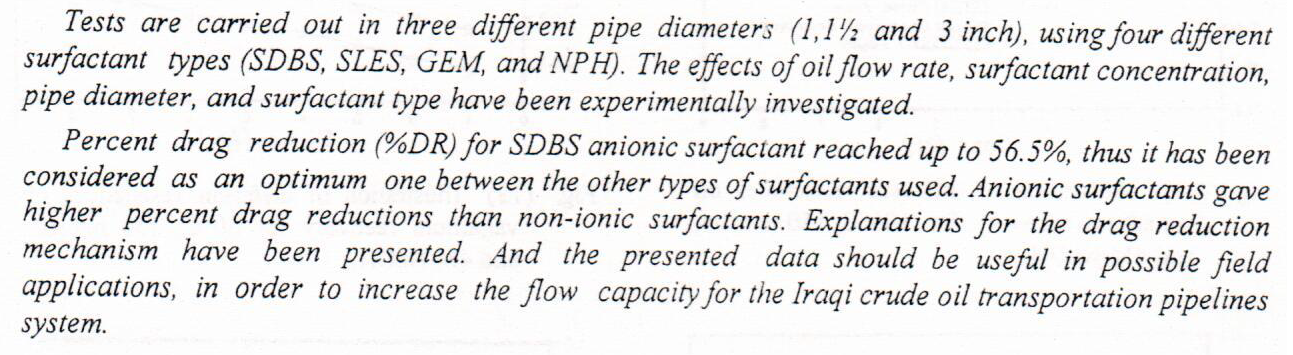
Optimizing Viscous Flow in Pipes Through Improved Flow Conditions and Chemical Injections

 (12)
 (13)



Biological activity of the carotenoids which are produced fromchemically-mutaed local isolate of Rhodotorula mucilaginosawas studied. The results showed variation of inhibition activity of caritenoids against different types of pathogenic bacteria include, Staph aureus, E. coli, B. subtilis and Salmo. typh., the number declined from 2×10⁷cell/ml to 2×10⁴, 5×10⁴, 2×10⁵, 9×10⁵ cell/ml respectively after 24hour. The produced carotenoids from alocal mutant Rhodotorula mucilaginosa revealed an antioxidant activity as free radical removal of 85.6%. Carotinoides revealed a highest stability in petroleum ether solvent for 30 days at room temperature. It found that the pigment was more stability in sesame oil compared with sun flower and coc
... Show MoreAmoxicillin have been conjugated with metronidazole as possible mutual prodrug to get a wider spectrum of activity by acting on aerobic and anaerobic bacteria, have antifungal activity, to provide protection for beta lactam ring of amoxicillin and also to improve patient compliance as it given as a single dose therapy. The structures of the synthesized compound were confirmed and characterized using elemental microanalysis (CHN), IR and some physiochemical properties. Biological study was done by using disc diffusion method against different bacterial strains which are , Staphylococcus aureus , Salmonella typhie , Pseudomonas aeruginosa , E. coli , Klebsiella pneumonia and fungi ( Candida albicans) . using nutrien
... Show More
Election study included four sites for the waters in area of Youssifiyah south of Baghdad (river water, tank water, liquefactions water, and water filtrate and seethed and purifier by alum and chloride), the samples were collected during the month of June in 2007. Temperature, electrical conductivity and acidity are measured. Also , the concentration of chloride , sulphate , carbonate , nitrate , sodium , calcium , magnesium , hard total and total dissolved substances are determined , as well as heavy metals assess environmental risk (such as Cu, Pb, Zn, Fe). It was also a study of bacterial totals included both total Bacteria (TB) and Total Coliform Bacteria (TC) and Fecal Coliform (FC) and Fecal Streptococci (FS). The stu
... Show More
(12)
(15)
Background The application of nanotechnology to biomedical surfaces is explained by the ability of cells to interact with nanometric features. The aim of this study was to consider the role of nanoscale topographic modification of CPTi dental implant using chemical etching method for the purpose of improving osseointegration. Materials and methods: Commercial pure titanium rod was machined into 20 dental implants. Each implant was machined in diameter about 3mm, length of 8mm (5mm was threaded part and 3mm was flat part). Implants were prepared and divided into 2 groups according to the types of surface modification method used: 1st group (10 implant) remained without nano surface modification (control), 2nd group include (10 implant) etche
... Show More
(7)
(5)
Thin films of pure tin mono-sulfide SnS and tin mono-sulfide for (1,2,3,4)% fluorine SnS:F with Thicknesses of (0.85 ±0.05) ?m and (0.45±0.05) ?m respectively were prepared by chemical spray pyrolysis technique. the effect of doping of F on structural and optical properties has been studied. X-Ray diffraction analysis showed that the prepared films were polycrystalline with orthorhombic structure. It was found that doping increased the intensity of diffraction peaks. Optical properties of all samples were studied by recording the absorption and transmission spectrum in range of wave lengths (300-900) nm. The optical energy gap for direct forbidden transi
... Show More