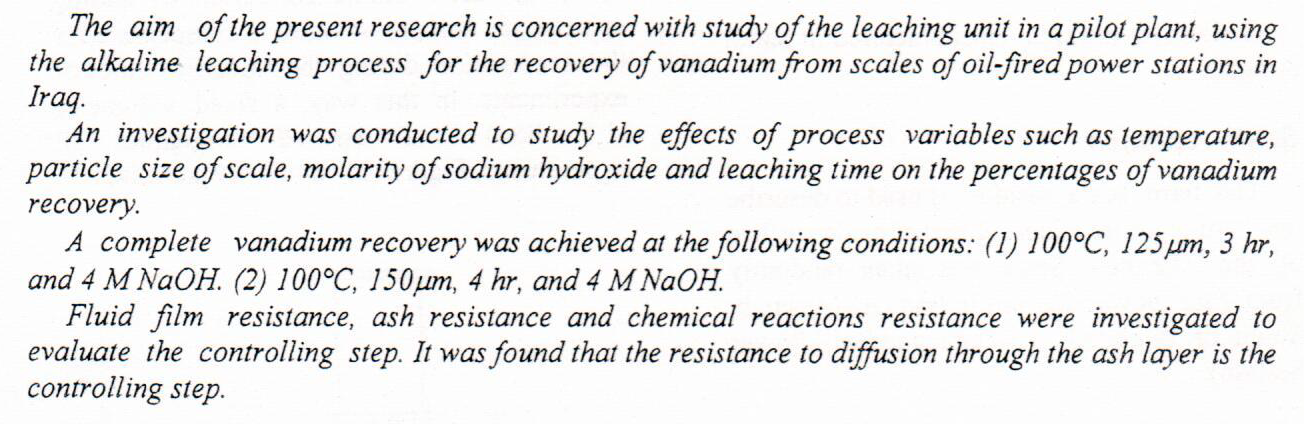
Recovery of Vanadium from Scale Residues of Oil-Fired Power Stations

The oil exports play a vital role in supporting economic development and raise the economic growth. The oil exports can increase the economic growth via three main channels which are supporting the productive, distributive and service sectors; increasing the investment and capital formation; and increasing the employment rate.
However, the oil exports did not have an important role in increasing the economic growth in Iraq. Therefore, it also did not provide the required support to other economic sectors, neither participated in increase the employees’ skills nor increase the investment rate. It may slightly contribute in enhancement the infrastructure that can attract the public and private investments
... Show More
In this work, measurements of activity concentration of naturally occurring radioactive materials (NORM) isotopes and their related hazard indices for several materials such as crude oil, sludge and water in Ahdeb oil fields in Waste governorate using high pure germanium coaxial detection technique. The average values for crude oil samples were174.72Bq/l, 43.46Bq/l, 355.07Bq/l, 264.21Bq/l, 122.52nGy/h, 0.7138, 1.1861, 0.601 mSv/y, 0.1503mSv/y and 1.8361 for Ra-226, Ac-228, K-40, Ra eq, D, H-external and H-internal respectively. According to the results; the ratio between 238U to 232Th was 4, which represents the natural ratio in the crust earth; therefore, one can be strongly suggested that the geo-stricture of the
... Show More
The work reported in this study focusing on the abrasive wear behavior for three types of pipes used in oil industries (Carbone steel, Alloy steel and Stainless steel) using a wear apparatus for dry and wet tests, manufactured according to ASTM G65. Silica sand with
hardness (1000-1100) HV was used as abrasive material. The abrasive wear of these pipes has been measured experimentally by measuring the wear rate for each case under different sliding speeds, applied loads, and sand conditions (dry or wet). All tests have been conducted using sand of particle size (200-425) µm, ambient temperature of 34.5 °C and humidity 22% (Lab conditions).
The results show that the material loss due to abrasive wear increased monotonically with
 (1)
(1)
The herbal remedy individually or in combination with standard medicines has been used in diverse medical treatises for the cure of different diseases. Pumpkin seed oil is one of the recognized edible oil and has substantial medicinal properties due to the presence of unique natural edible substances. Inflammation is an adaptive response that is triggered by noxious stimuli and conditions, which involves interactions amongst many cell types and mediators, and underlies many pathological processes. Unsaturated fatty acids (UFAs) can influence inflammation through a variety of mechanisms, and have been indicated as alternative anti-inflammatory agents to treat several inflammatory skin disorders. Pumpkin seed oil is rich in (UFAs), that its t
... Show More (6)
(5)
(6)
(5)


This research was aimed to evaluate activity of Rosemary volatile oil and Nisin A in vivo and on B. cereus isolated from some canned meat products in vitro. The results showed that the activity of Rosemary volatile oil (2000 µg/ml) and Nisin A (350 µg\ml) attained to 27 and 19 mm inhibitory zone diameter respectively in well diffusion method. The viable plate count from samples of canned meat treated with effective concentration of Rosemary volatile oil and Nisin A were examined. The samples with Rosemary volatile oil was not showed any CFU/g after 9 days of preservation while sample with Nisin A and control observed 49 and 45 CFU/g respectively. In vivo experiment on mice, two weeks after oral dose of Rosemary volatile oil (2000
... Show More
(25)
(14)
The mucilage was isolated from mustard seeds and identification by some different methods like, thermo gravimetric, FTlR., X-ray powdered, proton NMR, FTIR spectra of the three gums contain different functional group in the gums, major peaks bands noticed were belong to OH (3410.15 – 3010.88) group from hydroxyl group, CH aliphatic (2925-2343.51), C-O (1072.42-1060.85) group and C=O 1743.65, Thermo chemical parameters of mucilage was evaluated and compared with the standard gums, Results indicated the mucilage was decomposed in 392°C and mass loss 55%, The X ray process found the mucilage had single not sharp peak
... Show MoreMany reasons combined behind the Standing of U.S. against Britain in its aggression against Egypt in 1956; the consensus of world opinion on the need to stop the aggression and the fear of the Soviet military intervention which mean a new world war.
United States desired to weaken British influences in the region in general to get new oil gains in the Arabian Gulf and Egypt at the expense of Britain. The exiting of Britain from the area served U.S. strategic interests in the Middle East in general and Egypt in particular to keep the flow of oil for U.S advantage.
The United States wanted to keep its image in the region to apply its future political projects including Eisenhower Project, which intended to take the position of Britis
Interested current Research measuring damage currency Swap by converting The ministry of higher Education and scientific Research money The Iraqi dinar To U.S dollar by Trade Bank Of Iraq , And that The damage Generated resulting from Deferent Between the Exchange Rate adopted From Central Bank of Iraq and Market Exchange Rate adopted by The Trade Bank Of Iraq , and Which led to the greet damage ( losses ) in Bearing by the ministry, which led to the reduction of the financial allocations for licensed curriculum outside of Iraq , and this in turn leads to reduction in the number of students Sender ( scholarships ) outside Iraq.
Where the estimated loss (damage) that suffer by the Ministry of H
... Show More